|
Europe
Comprises market leading foodservice product distributors in the United Kingdom, Belgium, Netherlands, Czech Republic, Slovakia, Poland, Saudi Arabia and the United Arab Emirates. Sources and processes highly regarded own brands and provides products, quality ingredients, finished products, equipment and logistics to the catering and hospitality industry. |
| |
Bidvest Foodservice
Brent Varcoe
Managing director
|
Bidfood Ingredients
Charles Singer
Chief executive
|
Speciality
Masly Notrica
Managing director |
|
Revenue
R5,4 billion
0,7% decrease
Trading profit
R356,1 million
15,0% decrease |
|
 |
Financial indicators
(for the year ended June 30) |
2011
R’m |
2010
R’m |
| Revenue |
5 417,6 |
5 381,4 |
| Trading profit |
356,1 |
418,9 |
| Operating assets |
1 669,3 |
1 767,7 |
| Operating liabilities |
840,1 |
969,9 |
| Depreciation |
62,0 |
57,1 |
| Amortisation and impairments of intangible assets |
2,6 |
2,7 |
 |
|
|
| Goodwill and intangible assets |
25,0 |
29,5 |
| Sustainable development indicator overview |
|
|
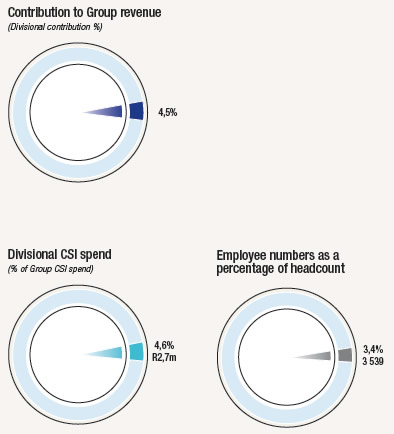
| Employees |
3 539 |
3 540 |
| Total training spend (R’000) |
9 947 |
8 113 |
| Training spend per employee (R) |
2 811 |
2 292 |
| Employees attending HIV/Aids training (%) |
15,4 |
10,9 |
| Lost-time injury frequency rate |
3,9 |
1,8 |
| Work-related fatalities (number) |
– |
– |
| BEE procurement (R’000) |
1 785 800 |
739 629 |
| CSI spend (R’000) |
2 712 |
1 473 |
| Enterprise development spend (R’000) |
4 777 |
7 022 |
| Total water usage (litres ’000) |
317 009 |
267 974 |
| Total electricity usage (including electricity from renewable sources) (kWh ’000) |
37 274 |
34 727 |
| Petrol (litres) |
1 847 378 |
2 064 717 |
| Diesel and biofuel (litres) |
5 913 011 |
5 934 580 |
| Total carbon emissions (tonnes) |
60 718 |
57 488 |
| Carbon emissions per employee (tonnes) |
17,2 |
16,2 |
| |
|
|
| |
|
|
QUICK LINK: Operational report and historic
sustainable development data
Material issues
- Food safety, product integrity (managing the cold chain) and compliant product labelling
- Sustainability of seafood species through responsible seafood procurement
- Management of credit risk as tough economic conditions increase business failures in our industry
- Reducing energy consumption, waste and the impact of business activities on the environment
- Employee engagement
Staff skills development, retention of management and succession planning
- Impact of crime on stock shrinkage
- Broad-based black economic empowerment through employment equity and procurement
- Occupational health and safety compliance
- Customer service
|