


CFO's report
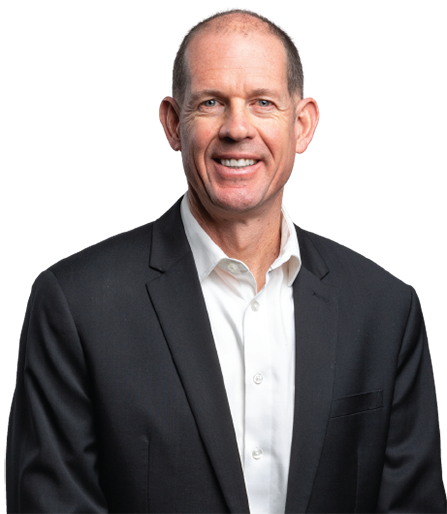
"Market momentum, solid operational performances, exceptional cash management, coupled with an unfolding and powerful growth strategy, have all contributed to a year of record profit performances."
Mark Steyn
Chief financial officer
revenue
growth to
increase
in HEPS to
1 442 cents
by operations
up to
for
There are some pertinent points to highlight prior to reviewing the overall performance:
- Following our announcement earlier in the year, there are now seven divisions reflected in the Group’s results, as the Services division was split into Services International, which houses facilities management and hygiene services worldwide, and Services South Africa, which focuses on domestic security, travel and hospitality and related allied services.
- One of the Group’s key strategic advantages, which is an important enabler for future growth, is its financial strength and flexibility. Pleasingly, despite the various challenges, we strengthened the Group’s balance sheet over the past year and improved our debt capacity and maturity profile, while at the same time limiting our downside risk on interest rates hikes.
- From an accounting perspective, the only material change is the hedge accounting adopted for currency swaps, which were used to hedge our international bond. These are now reflected on our balance sheet.
- We concluded several acquisitions this year including the purchase of hygiene consumables business Mayflower in Services International (in PHS), and hygiene service business Service Royale (in Steiner). Just after yearend, we concluded the acquisition of BIC in Australia for A$163 million, which is a facilities management business servicing A-grade properties across the country.
There was good top line growth with revenue up 13.2% to R99.9 billion. Double-digit revenue growth was achieved in Services International, Services South Africa, as well as Freight and Automotive. Branded Products benefited from strong pharmaceutical volumes and good growth across the division, while Commercial Products produced excellent results off last year’s very high base, despite supply chain constraints. Financial Services was impacted by a net roll-off in its lending and fleet books.
The gross profit margin was down slightly to 30.0% versus 30.8% in the prior year. This was largely due to the combined impact of significantly increased revenue levels from lowermargin disbursement business, largely in the Freight division, increased travel revenue in Services South Africa, higher facilities management demand within Noonan in the UK, and normalising of hygiene revenues in PHS.
Bidvest again delivered excellent expense management, with expenses only rising 4.7%, well below inflation and revenue growth. As a consequence, the expense ratio improved to 20.5% from 22.1%. This includes the impact of higher net impairment losses and restructuring costs, which were taken at Bidvest Bank. Management teams across the Group are continuing this strong focus on costs, which is expected to maintain the Bidvest tradition of superior cost management.
This year’s trading margin at 9.7% is up from 8.9% in the prior year, and Group trading profit 23.3% higher at R9.7 billion, which represents strong double-digit growth across most divisions, and good underlying organic growth.
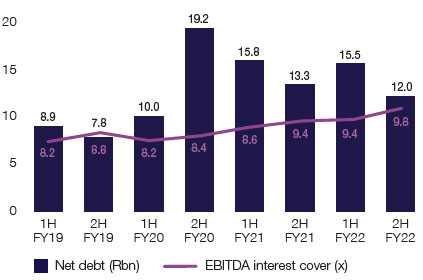
From a finance charge perspective, interest costs are up 8.3% including the IFRS 16 impact, fair value adjustments and hedge costs. Borrowing costs, excluding IFRS 16, were up 11.3%, which reflects the slightly higher gross debt levels due to the international bond and then a small step up in funding costs. But overall, the EBITDA interest cover remains very conservative and has improved to 9.8x.
Net debt and interest cover
Normalised HEPS (cents)
Acquisition costs are up on the back of the international bond that was successfully concluded last year, and the higher levels of corporate activity. Customer amortisation is also higher, largely due to the bolt-on acquisitions in Noonan, that have now been annualised over the full year.
The taxation rate increased from 28.9% to 30.0%, mainly due to a deferred tax impact stemming from higher rates announced in the UK, which will move from 19.0% to 25.0%. This offsets the benefit we enjoy from the lower tax jurisdictions. We adjusted for the UK deferred tax impact in the normalised HEPS calculation.
In terms of net capital items, there was a capital profit of R176.6 million, largely due to a R165.8 million profit on the sale of properties in Namibia. This compares to a loss last year of R179.7 million.
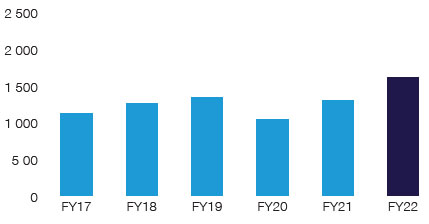
HEPS rose 21.9% to 1 442 cents and normalised HEPS – which excludes acquisition costs, the amortisation of acquired customer contracts, and the deferred tax impact referenced earlier – was 24.0% higher. Normalised HEPS is the true measure of our performance.
There were no material COVID-19 costs in the current year.
Dividends are up 24.0% with a total dividend of 744 cents for the year, on a cover ratio of 2.2x, which is within Bidvest’s policy range of 2.0x to 2.5x normalised HEPS.
DPS (cents)
Four out of seven divisions delivered R1bn trading profit Six divisions generated > 30% ROFE
Another annual cash flow highlight
Free cash flow (Rbns)
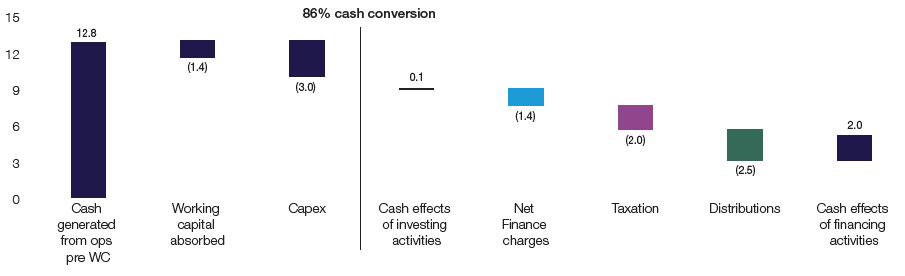
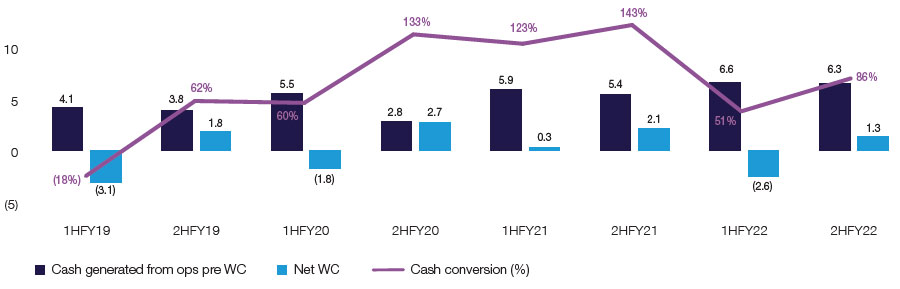
Excellent trading resulted in cash generated by operations, before working capital, increasing to R12.8 billion, well up on the R11.3 billion last year. There was a working capital absorption of R1.4 billion for the year, after a release of R2.4 billion in the previous year. This year’s absorption relates largely to an investment in inventory, which reflects the strong trading volumes and higher levels of stock being held because of supply chain delays. There was a R1.3 billion working capital release in the second half, as the normal working capital cycle resumed.
Cash conversion at 86.0% is good, lower than the 143.0% last year following the COVID-19 release, but well above the pre- COVID-19 position of 65.0%.
Cash generated vs working capital (Rbns)
The increase in debtors and creditors balances, which offset one another, largely mirror the year’s improved trading.
Balance sheet, debt and funding
Our focus on maximising returns is steadfast. We delivered a solid increase in the Group’s overall ROFE, which improved from 31.6% in the prior year to 37.6%, and ROIC at 17.1% is up from 14.1%. This is well in excess of the weighted cost of capital.
We maintain a conservative and consistent approach to debt. Gross debt at R23.5 billion is R2.8 billion higher, largely off the back of the international bond.
Long-term debt constitutes 85.0% of gross debt, and 52.0% of this is subject to fixed rates, which is pleasing considering the recent dramatic hardening of rates. Net debt, after cash and cash equivalents, is down R3.5 billion to R12.0 billion from R15.5 billion last year. This is a good reflection of the positive cash generation across the Group. Net debt to EBITDA at 1.5x, compared to 1.8x last year, is a pleasing improvement and compares favourably to the Group’s external covenant of 3.0x.
Debt maturity (R000s)

The average cost of debt is slightly up on last year at 4.7% pre-tax. There was a fair amount of funding activity over the past year, in particular the restructuring of our offshore syndicated loan of £400.0 million and the issuance of the inaugural international $800.0 million bond. The latter efficiently created more funding capacity with a longer maturity cycle and a greater fixed rate exposure. In June 2022, we concluded a small domestic bond raise, our first post the pandemic, of R1.1 billion. It was well received, more than four times oversubscribed, with good rates achieved.
Debt capital market activity
- Restructured syndicated loan facility offshore (July 2021)
- Raised inaugural five-year U$800 million Eurobond (September 2021)
- Repaid debt (domestic bonds, syndicated and bridge loans) raised for PHS acquisition (October, November 2021)
- Locally refinanced bonds with three- and five-year maturities (June 2022)
We are exceptionally well positioned with regard to future growth opportunities. From a funding perspective, there is £256.0 million available offshore, after the post-year-end BIC transaction. Funding capacity in SA exceeds R23.0 billion.
Investing in capacity and expansion
Capital expenditure increased to R3.0 billion due to higher investment into capacity and expansion opportunities. This included an increase in new warehouses and distribution centres, and factory capacity at G. Fox, Cabstrut, Lufill and UDS, the acquisition of strategic PHS properties, as well as maintenance capex, fleet renewals and upgrades. Two large projects, totalling R1.0 billion, in the Freight division – the inland LPG terminal expansion, and the Richards Bay multipurpose tanks – were approved by the Board. The latter is expected to be commissioned by mid-2024.
Conclusion and appreciation
Bidvest’s offshore profit contribution growing (R000s)
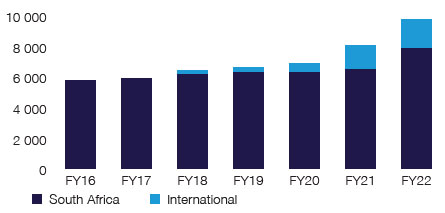
It is very comforting that the Group remains well positioned for additional growth and profitability, both in SA and internationally. The growing offshore profit share is expected to continue and will be aided by a maiden contribution from the recently acquired asset base in Australia.
Key markets are continuing to build momentum, strategic advances are defined and are being executed, enhanced efficiencies and cost controls are firmly in place and the Group’s growth pipeline is solid. Coupled with financial strength and a solid capacity for future organic and acquisitive funding, we look forward to delivering another pleasing set of operating and financial results.
My personal thanks are extended to the entire Bidvest family, specifically the finance teams across the Group, as well as my fellow executive and Board members for their support, assistance and guidance throughout the year. I look forward to another exciting year ahead.
Mark Steyn