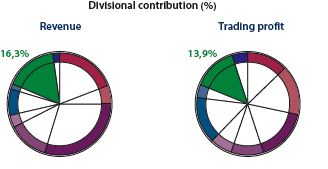
Major franchises – notably
McCarthy Toyota, VW/Audi
and Mercedes – made solid
profit contributions despite
lower retail activity as
large vehicle populations
support ongoing parts and
service business.
Used-car volumes were up
9,9% to reach a record high
of 42 182 units as pricing
differentials moved in favour
of this market. Burchmores
also had a record year, a
performance underpinned by
the exceptionally high rate
of vehicle repossessions
by banks.
Service bay utilisation
rose to 871 594 service and
repair jobs, up 10% from
last year’s high base of
792 479.
Yamaha Distributors delivered
good returns in tough trading
conditions, but at levels
well below those attained
last year. Our vehicle import
and distribution business
and our Value Centre/ValueServ
networks incurred substantial
losses.
Strategic drivers
The effect of higher interest
rates and the NCA was evident
in the first half of the
year, with vehicle sales
in December 2007 hitting
their lowest level in five
years. However, the full
impact of the consumer credit
squeeze and shrinking disposable
incomes was not felt until
January when trading volumes
declined dramatically.
Government’s clampdown on
credit extension and consumer
spending proved highly effective
in a surprisingly short time.
In macro-economic terms,
government’s high rate of
fixed investment and an increase
in the number of major construction
projects were positive for
the country. Unfortunately,
the only businesses of ours
directly exposed to this
strategic initiative are
a limited number of heavy
truck outlets and McCarthy
Heavy Equipment. This new
operation – launched a year
ago – is still building momentum,
but performed exceptionally
well, fully in line with
management expectations.
It is difficult to overstate
the strategic impact of NCA
implementation. Credit-based
consumer spending is being
controlled very tightly.
A fundamental shift has occurred
in the management of credit
and bank lending practices.
Recent concerns about credit
card securitisation in the
US will almost certainly
confirm the view of South
African authorities that
rigorous control of credit
has to be maintained. Our
conclusion is that the NCA
is not a once-off impact
to be absorbed through efficient
application and approval
processes. It is the new
reality for all consumer-facing
business.