Performance
The division comprises
three autonomous units,
Caterplus, Speciality and
Bidfood Ingredients. Overall,
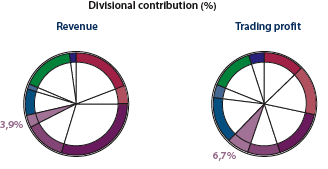
an 18,4% increase in revenue
to R4,4 billion was achieved
while trading profit went
up 31,4% to R358,8 million.
Caterplus grew operating
profit by 19,4%. Speciality
turned in a solid performance
with revenue up by 22,1%
while trading profit rose
34,5%. Bidfood Ingredients
also recorded pleasing
results with trading profit
growth of 46,6%.
Strategic drivers
Macro-economic factors
highlighted the built-in
balance of the Bidfood
business. High interest
rates, tighter credit and
the consumer’s shrinking
disposable income were
negative for out-ofhome
eating, creating considerable
challenges for Caterplus
in view of its restaurant-heavy
customermix. Consumer belt-tightening
led to more eating at home
and a preference for affordable
meal options. In relative
terms, this was beneficial
for Bidfood Ingredients
and Speciality.

Food inflation – the worst
in a number of years –
was a challenge for all
business units. Some prices
doubled. Increases of this
magnitude had to be passed
on. This highlighted Bidfood’s
role as a strategic partner
of its customers, suppliers
and principals. The affordability
challenge sharpened Bidfood’s
competitive advantage as
a broader range of alternative
products assisted customers
in managing food inflation.
Fuel price increases challenged
our businesses to develop
smarter schedules and routes
while creating the optimum
load per vehicle per trip
– another source of competitive
advantage for a nationally
based broadline supplier
across various temperature
ranges.
CATERPLUS
Our operations successfully
grew the value of the drop
while broadening our basket
of goods. We remain the
only national player in
the foodservice industry
reaching every part of
South Africa, Botswana
and Namibia at least once
a week with the broadest
product range. The value
of that proposition became
increasingly evident in
tighter economic conditions
and we remained strongly
cash generative.
Industry factors
Restaurants represent
a significant part of our
business and a post-Christmas
crisis in this sector had
material effects. From
mid-January, restaurateurs
faced a de-facto “stayaway”
by the public, a severing
of soft-credit, reductions
in their overdraft limits
and increasing food inflation
that squeezed margins.
Eskom load shedding in
January/February compounded
the situation.
The industry’s structural
weaknesses were exposed.
The restaurant market has
become overtraded following
five years of real income
growth and easy credit.
The market is characterised
by high rents, onerous
escalation clauses and
an influx of investor-restaurateurs
with limited industry experience.
First casualties occurred
in the third quarter and
have since accelerated.
Industrial caterers are
also under pressure. These
customers report fewer
feet in the canteen, lower
spend per head and the
return of the home-packed
lunch box. Unsurprisingly,
their volumes are down.
Solid turnover and trading
profit growth in the face
of these challenges reflect
the strength of our performance,
the importance of astute
stock buy-ins and the speed
of our response to a gathering
crisis.
Operational factors
The
Gauteng Chipkins, Sea World
and divisional office operations
were successfully relocated
to a single multi-purpose
site in Linbro Park, Johannesburg.
New premises for First
Foods and Blue Marine in
the Cape are currently
under construction, with
occupation planned for
January 2009. However,
capacity constraints persist
at several branches.
We continue to flatten
internal silos. Regions
increasingly share market
information while buying
and sales departments are
moving closer together
to ensure we manage stock
more efficiently and anticipate
needs.
Improved inventory management
and timely stock buy-in
ahead of inflation helped
to protect margins.