Performance
Businesses across the division
put in a generally pleasing
performance, meeting the
challenge of cementing the
gains made in the previous
period when a variety of
positive factors had combined
to deliver exceptional growth.
In a much less benign trading
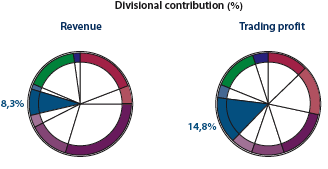
environment, revenue grew
12,4% off the previous year’s
high base to R9,4 billion
(2007: R8,4 billion). Trading
profit increased by 8,5%
to R790,1 million (2007:
R728,3 million).
Results reflect the energy
shown by management teams
in reacting promptly to a
much-changed environment.
Margins came under increasing
pressure as the year progressed.
Strategic drivers
Divisional diversification
cushioned some of the effects
of increasing pressure on
consumers. A business such
as Voltex has little direct
exposure to the consumer
economy; though operations
such as Waltons and CN can
be materially affected by
lower consumer spend. By
year-end, low consumer confidence
was echoed by negative business
sentiment and a sombre mood
was evident among both consumers
and commercial customers.
High interest rates and the
credit squeeze resulted in
cash-flow pressure for small
business and contractors
– important customer groups
for us.

Though the sales challenge
intensified for our stationery
and office furniture businesses,
trading performance remained
robust. A positive factor
is the non-discretionary
nature of many items in our
range. Stationery replenishment
is unavoidable. Furniture
and equipment items are often
essential purchases.
Rising rates sharpened the
asset management and cash
utilisation challenge. These
are areas of intense management
focus.
Higher inflation can be
a positive for a well-resourced
trading business able to
build inventory in appropriate
areas. However, proactive
stock build-up complicates
the task of working capital
management in an adverse
interest-rate climate.
High levels of infrastructure
spending provided a strategic
underpin for electrical supply
activities.
Copper and steel prices
drifted lower in the first
half of the year only to
rebound. The rand weakened
within a narrow range, but
daily fluctuations were often
significant. Changes in metal
and currency markets were
positive on some occasions;
negative on others.
The mix of upside and down
was evident in other areas,
too. For example, the electricity
crisis puts the focus on
our ability to provide energy-efficient
solutions and alternatives.
However, the impact on business
confidence and construction
sector approvals was negative.
For manufacturing and distribution
business, the strategic challenge
in an increasingly complex
environment is how to achieve
optimum balance. Local manufacture
may be supported by a weaker
rand only to become problematic
during a period of rand resilience.
Distribution of low-cost
Chinese imports has been
a viable option, but Chinese
pricing could firm in future.
Balancing variables such
as these has become mission-critical.
The net balance tipped in
favour of greater imports
at both our packaging closures
business and at Seating,
our specialised seating manufacturer.
Industry factors
Electrical wholesaling margins
were impacted by weak copper
prices in the first half
of the year while periods
of rand firmness against
the US dollar were negative;
especially for Kolok as its
entire range of computer
and printer consumables is
imported.
Major projects such as Gautrain
and 2010 initiatives supported
net volume growth in the
electrical supply business,
despite a dramatic fall in
new construction projects
in residential markets.
In a declining residential
building market, competition
among suppliers to construction
companies and contractors
intensified, resulting in
margin erosion.
Increased pressure on the
consumer accelerated the
deterioration of prospects
in the South African clothing
industry. Imports of low-cost
Chinese industrial sewing
machines put continuing pressure
on margins.
In recent years, several
mining companies and large
industrial groups have engaged
in major capital expenditure
projects. Private sector
infrastructure development
continued, with generally
beneficial effects for our
business as we have expanded
our business base across
the major industrial groups.
Generally positive corporate
sentiment for much of the
period was reflected by high
levels of project activity
at Dauphin Office Seating.
|