Sustainability
Our 2021 theme of “People and Products Behind a Brighter Future” guide our efforts to create value for each stakeholder group which in turn drives our focus on optimising the value of our products and services, at a sustainable cost to society.
Empowering entrepreneurship
We think like customers but act like owners. Every employee has the power to make our business better.
Driven by excellence
We value and respect the skills, time and intentions of all our people. We strive to provide an environment where they can do, and become their best.
Committed to customers
We make every decision and measure our performance on how well it serves our customers. When our customers succeed and grow, we succeed and grow.
Leading by example
We do the right thing, even when no one else is looking. What is right, is different to doing what is easy.
Creating social value
We take the long view and strive to make a sustainable difference in society. We are building something worth building, that will endure the test of time.
As the impact of climate change and inequality become more and more evident, the need for all stakeholders to ensure common cause, understanding and purpose, and to avoid damaging the environmental and social status for future generations, has become a critically important imperative. We recognise that people are the enabler of our business and a critical resource that needs to be nurtured, developed and supported. As one of the largest employers in the country, and as a Group that by nature covers virtually all industry sectors, it is our responsibility to ensure that we contribute to the success of our nation. We use the United Nation's 17 SDGs as a guideline. The SDGs provide a comprehensive definition of sustainability, ranging from good health and well-being, affordable and clean energy and climate action to quality education, peace, justice and strong institutions. We identified the SDGs that are most relevant to us and assess the impact we are making, through our basket of services and goods as well as our operations and corporate citizenship activities.
Despite a decentralised operating model, we have a unified understanding throughout the Group of what needs to be achieved to ensure ongoing success. Conducting profitable business in a responsible and sustainable manner is therefore integrated into our day-to-day activities. Given the decentralised and varied nature of the businesses, sustainability is managed at business level. From a Group perspective, we identified a set of material issues that are common throughout our businesses.
In FY2021, we worked on establishing the Bidvest ESG Framework in which we have set innovative, measurable and challenging targets for our leadership for FY2025. This will ultimately ensure the continued generation of long-term value for shareholders, for all other members of stakeholder society and for the planet we share.
Please refer to our comprehensive Annual Environmental, Social and Governance Report for more detail on our ESG Framework and performance in FY2021.


SOCIAL: Caring for the Bidvest family and driving positive change through partnerships and social dialogue
In line with SDGs aimed at good health and wellbeing and gender equality, the Group is committed to providing a safe and healthy workplace with equal opportunities conducive to learning and personal development. In particular, the Group will continue to promote and offer out-of-home hygiene services and integrated facilities management services in order to support safe and healthy occupational environments.
The Group is proud to be a deep-rooted corporate citizen in South Africa, as it is highly engaged in community development activities, with a particular focus on enhancing education, health, economic advancement and diversity. Investing in communities and human capital and supporting local suppliers, affords us the opportunity to operate, do business in and draw skills from the communities in which we operate.
The social element of ESG is of particular importance to Bidvest as it is one of the largest private sector employers and touches multiple sectors and communities.
COVID-19 specific
A special tribute must be directed toward the Bidvest family of employees that have worked consciously and faithfully through these difficult times. Our employees displayed tremendous dedication, often in difficult circumstances, to ensure the continuation and enhancement of value in the delivery of the Group's products and services. Bidvest's board of directors has acknowledged this commitment and expressed its thanks and gratitude to all employees on behalf of all stakeholders.
Sadly, we lost 122 Bidvest family members to the COVID-19 pandemic and extend our sincere condolences to the families and colleagues of these employees. Bidvest continues to provide support to employees and communities besieged by the harsh impacts of the pandemic.
The protection of Group employees, customers and communities was maintained over the past year. From the established Bidvest COVID-19 Fund (the Fund), some R230 million was spent toward easing the impact of COVID-19 on employees and communities. This includes compensation for employees, particularly those in the lower income brackets, who were impacted by lockdown restrictions. Risk benefits and pension fund contributions by employers remained in place for all these affected employees.
The progress of vaccination programmes globally and in particular in our key operating territories, South Africa, the United Kingdom and Ireland, is very encouraging. We are running a Group-wide COVID-19 vaccine awareness programme to encourage all our employees to be vaccinated. We are also improving access to the vaccine through the use of mobile vaccination clinics that are visiting our various operations. We encourage the Bidvest family to get vaccinated to protect themselves and their loved ones.
Transformation, diversity and employment equity
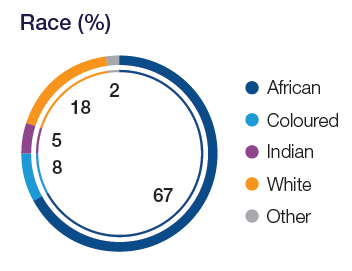
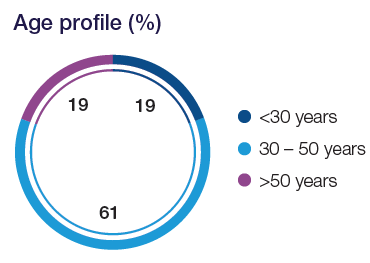
Our people form the backbone of Bidvest. The diversity of background, age, race, gender, religion, skills and experience undoubtedly contributes to a Bidvest that is relevant, innovative and future-fit. Our focus remains on advancing inclusion, diversity and equality.

790
employees have disabilities
38%
of employees belong to unions/ bargaining councils
13%
staff turnover
At middle, senior and top management levels 11.0%, 15.6% and 35.9% are African, respectively. Women represent 33.1%, 30.6% and 37.6%, respectively, at the three management levels. The overall increase in the representation of Black people across all three levels of management is very pleasing but the increase in Black people in top management is the most encouraging. This is probably the biggest shift we have seen over the past few years.
No material strike activity encountered at any of the Group companies during the year
Health, safety and wellness
Approximately 72,000 of the Group's employees in South Africa have benefitted from the Fund since its inception to date. The cost of COVID-19 testing for employees not on medical aid is also borne by the company. At the end of FY2020, the Group introduced an employee wellness programme, which was rolled out to all employees across South Africa, recognising the importance of mental, wellness, financial and trauma counselling, particularly in light of COVID-19. The utilisation of the program has been steadily increasing.
Bidvest is committed to investing in its human capital and ensuring that everyone receives support when they need it most
At the start of the financial year, we also introduced an Executive programme that was made available to the Group Exco as well as the divisional CFOs. The purpose of the programme is to provide support and guidance to the executive on a very holistic basis that covers both personal and professional aspects of their lives.
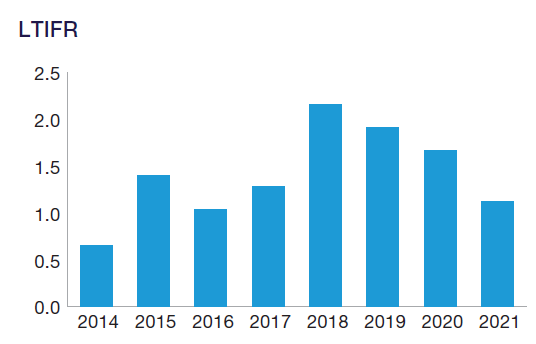
Consistent with the Group's aim to provide a safe and healthy workplace, an improved loss time injury frequency rate (LTIFR) of 1.12 was reported.
14,103
employees and
4,532
contractors were trained on health and safety standards
Learning and development
The Group endeavours to continuously develop the skills of its employees and in the industries in which it operate. Established training academies not only meet internal needs but also those of the industries in which we operate.
Skills development spend
6,866
Bidvest offered
R372m
learnerships, internships and apprenticeships. 440 of these beneficiaries were absorbed into the Group workforce post completion
Launched
Bidvest Technology Internship
This internship programme is run by the BidvestALICE Team under the auspices of Microsoft’s AppFactory
The Bidvest Education Trust, established in 2003, is aimed at children of Bidvest employees that fall with a certain income bracket. There are 582 beneficiaries from the bursary program across the various grades and three tertiary education students. A further 37 children of former employees, who passed away due to COVID-19 or who were retrenched as a result of business restructuring, benefited from bursaries extended for a year.
PHS joined Chwarae Teg, a charity inspiring gender equality in Wales, which offers leadership qualifications and mentoring opportunities for women in Wales.
Procuring local
Supporting local businesses in their growth aspirations is important to Bidvest. Across the Group's businesses, 52% of its local procurement spend was with suppliers holding a B-BBEE Level 4 and better rating. By moving all local procurement away from poorly rated, or even non-compliant, suppliers, the Group has the opportunity to direct more than R20 billion local procurement expenditure to transformed businesses.

Projects
The Group's businesses engage in a range of corporate social responsibility projects and initiatives to support the communities and the environments in which they operate and to leverage their respective operational capabilities in furthering these projects. A few examples include:
WOZA Bursaries
R2.5 million
As an extension to the WOZA Matrics programme, Bidvest awarded bursaries to 16 matriculants from disadvantaged backgrounds.
Gender-Based Violence (GBV) and Femicide Response Fund
R10 million
Despite substantial ongoing efforts to tackle the scourge of GBV, more work still needs to be done in South Africa. To play its part towards creating a better and safer South Africa, Bidvest donated to this GBVF Response Fund, which was launched by the President of South Africa, in conjunction with the International Women's Forum of SA, in February 2021.
"Women make up 44% of our employee base," said Bidvest chief executive, Mpumi Madisa, adding that they are the ones most affected by GBV. "We recognise that as business, we operate in an ecosystem that functions optimally when we are all safe, secure and protected."
Female Academic Leaders Fellowship Programme
R5 million
This is a fund established by Dr Judy Dlamini in her capacity as Chancellor at Wits University. The fund will be used to develop a pipeline of African and Coloured female academic leaders. Whilst this programme is being established at Wits University, the intention is to roll it out to all other universities across the country.
Food distribution programme
37,000 hampers, totalling R27 million



ENVIRONMENT: Conduct profitable business in a responsible and accountable manner
In line with SDGs aimed at affordable and clean energy and climate action, the Group is focused on energy and water efficiency, responsible waste management, and innovative solutions to aid customer sustainability.
Bidvest's environmental footprint is largely concentrated in its Freight operations, Bidair Cargo, laundries and the businesses with extensive networks, which collectively represent the vast majority of Group emissions and water usage.
Scope 1 and 2 emissions of 302,952 tons in the financial year ended 30 June 2021, was 14% more when compared to the financial year ended 30 June 2020. Excluding the impact of the acquired businesses, the Group's emissions increased 4%.
Environmental management systems are in place at businesses, representing 50% of Group revenue.
The Group is also committed to innovative customer solutions to aid sustainability. For example, the Richards Bay LPG terminal was commissioned in October 2020. Contributing to the facilitation of reliable availability of an affordable low-carbon energy alternative, it is expected that the Richards Bay LPG terminal will increase the current supply of LPG in South Africa by 50%.
Bidvest Prestige introduced Tersano, a highly effective, environmentally friendly alternative to disinfectant chemicals. It is a cleaning chemical system that turns ordinary tap water into Stabilised Aqueous Ozone, nature's most powerful cleaner. It is a highly effective cleaning agent that breaks down dirt, grease and other contaminants, safely replacing traditional chemical cleaners, deodorisers and sanitisers.
PHS historically offered a bin replacement service whereby they took sanitary bins back to depots where the waste was removed and the bins washed. Having moved to a liner service, bins no longer need to be washed and fuel consumption reduced as drivers no longer need to return to depots daily. Both water and emissions reduced.
During FY2021, the Group used 1.9 million kl of water, an increase of 2%. Excluding the impact of acquired businesses, the Group's water consumption declined 3%.
Almost all businesses have waste recycling plans. No environmental fines were incurred in FY2021.
Emission intensity decreased 6%
49% more electricity used was drawn from renewable sources
Water intensity decreased 15%
0.5m m3
of industrial wastewater was treated and discharged
Recycled 126,235 tonnes of waste


GOVERNANCE: Doing the right thing even when no one else is looking
Bidvest has a deeply entrenched functional governance structure that places significant reliance on the ethical behaviour of all employees. This places a very high hurdle of responsibility and accountability on everyone. Rather than having many policies and manuals, we have a Code of Ethics that sets out our behaviour. When someone missteps, decisive action is taken, and communicated back into the business. An authority matrix forms the backbone of day-to-day governance.
Formal reporting structures complement business-level processes resulting in dynamic and iterative risk assessment and mitigation actions. Relevant management and executive committees have been structured into each of the six divisions. These in turn report into divisional boards, represented by the divisional exco as well as representatives from Bidvest's corporate office executives. Matters from these divisional board meetings are escalated further to the Group Exco meeting, which is attended by the Group directors and functional executives (covering strategy, M&A, finance, transformation, ESG, business development) as well as the six divisional CEOs. The three executive directors in turn report into the main group board of directors, directly or through the established committees.
Ethics
The Group subscribes to a philosophy or transparency, accountability and integrity in all our business dealings, as captured in the Bidvest Code of Ethics.
There are established grievance and whistle-blower processes at individual businesses, in addition to an independently administered Ethics facility. This free-to-use facility administered by Deloitte provides whistle-blowers with three channels to raise their concerns, namely telephonic, email and a website form. Internal Audit also track, and log applicable calls received outside of the Ethics facility, for example, via social media, the website or emails.
Awareness campaigns are run across the Group, using mechanisms such as SMS and posters being prominently displayed in high traffic areas to encourage employees to "not support it, but rather report it".
During FY2021, a total of 146 calls were logged through the Ethics facility. Of these, 13 remain open with five relating to fraud, six human resource related, and one each, corruption and governance related. A further two from previous periods are also still open.
The oversight process was enhanced during FY2021. The Group CEO reviews calls and responses for further investigation with specific focus on calls relating to racism, discrimination and harassment. The Group executive director responsible for transformation and sustainability, together with the Head of Internal Audit also reviews quarterly calls and progress in detail.
As a consequence of calls received via the Bidvest Ethics facility, 47 internal control enhancements were implemented, nine disciplinary actions were taken, three employees were dismissed and two civil or criminal cases were opened.
Regulatory compliance
No regulatory fines
88%
of the Group’s businesses have a Level 1–4 rating and
58%
of the Group’s businesses have a Level 1–3 rating
Level 4
Group B-BBEE
The sale of Bidvest Car Rental and BidAir Services to Black owned entities will count towards the Group's Black shareholding, as will the transaction concluded for Bidvest Protea Coin.
The Group B-BBEE certificate and annexures are available on www.bidvest.co.za/sustainability-transformation.php.
The Group made significant progress in implementing Protection of Personal Information Act (POPIA) awareness campaigns and putting in place compliance processes, all done in time to meet the legislative deadline. POPIA compliance in the form of policies, procedures and training will be an ongoing process in the Group to ensure legal compliance with data privacy.
IT governance and security
The Internal Audit function is an independent, value-adding, progressive and responsive service to Bidvest shareholders. Given the ever-increasing dependencies of the business on IT, specialised IT audit and consulting skills have become a necessity in the function. Analytics and automation are well-entrenched into the mechanisms of the Internal Audit functions with further disruptive robotic initiatives being the focus for the future of Internal Audit.
An example of such initiatives is ALICE, Bidvest's digital auditor. She combines robotics and cognitive intelligence to provide audit-as-a-service to the Group companies. Much effort has been afforded to the digital assurance roadmap for Bidvest using the ALICE platform. The appetite for ALICE to connect remotely into data sources across the Group, coupled with the uptake to build remote monitoring and continuous testing capabilities on ALICE, increased significantly.
The board acknowledges technology as a mechanism to access, protect and manage information. In relation to the Group's IT Governance Framework, the board governs both technology and information so that these support the organisation in achieving its strategic objectives.
The scope of IT assurance provided by ALICE is listed below and is subject to integration (connector) limitations and data availability across the IT environments of the Group.

- User Administration
- Amendments to User Profiles
- New and Terminated User Profile Management
- User Access Policies and Procedures
- User Profile Data Accuracy
- User Profile Management
- Microsoft SQL Hardening
- Microsoft SQL Security Measures
- Cloud Security
- Generic Security Measures
- Azure-Specific Security Measures
- Technical Security
- Antivirus
- Asset Management
- Network Security Configuration
- Password Configuration
- Patch Management
- User Profile Management
- Website Security
- WordPress Specific Security
- Business Resilience
- Backup Management
- Backup Operations
- Business Continuity Planning
- Disaster Recovery Planning
ALICE runs on a scheduled frequency (continuously, daily, weekly, monthly or quarterly) as deemed fit for purpose based on the maturity, complexity and posture of the IT environment of each company within the divisions. IT findings are available to IT management on a continuous, remote and near real-time basis. Remediated IT findings are re-audited by ALICE upon receipt of updated audit evidence. The Internal Audit function is required to follow-up on unresolved IT findings with IT management on a monthly basis.
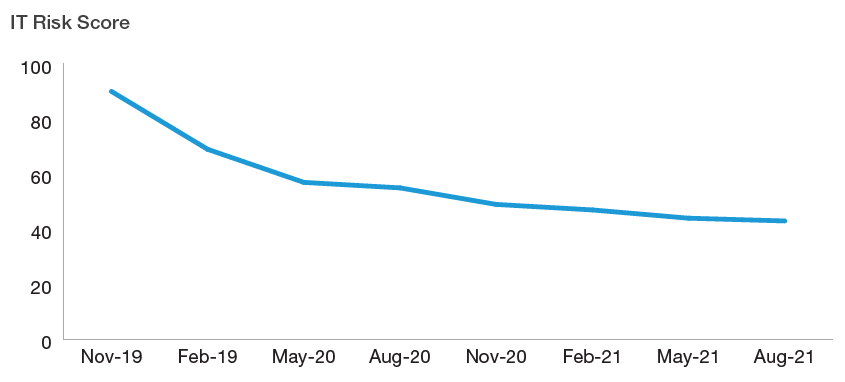
Since the deployment of ALICE in November 2019, the IT risk landscape across the Group has improved as illustrated below. Through implementation and continuous monitoring of basic security control disciplines, the Group has managed to lower their risk score determined by ALICE from 90 to 43 in a two-year period. The Group is aiming to achieve a risk score of 25, the lowest score achievable on ALICE. The risk score of 25 represents the residual risk that remains despite the controls and/or disciplines being in place and operating as expected.