Operational reviews – Bidvest Travel and Aviation review
Bidvest South Africa
Bidvest Travel and Aviation |
 |
Allen Kotze: Financial director |
| |
|
|
 |
| From left to right: Garry Marshall – Managing director Bidair Cargo, Irene Butterworth –
Financial director Bidair Cargo, Sandra Alfaiate – Financial director Bidair Services, Colin
Mitchley – Financial director Bidtravel, Kobus van Niekerk – Managing director Bidair
Services, Allen Kotze – Financial director Bidvest Travel & Aviation Services, Mariette Pienaar
– Financial manager Bidvest Premier Lounge, Gavin Bell – Managing director Bidvest Premier
Lounge, Allan Lunz – Managing director Bidtravel, Paulette McGhee – Managing director
Budget Rent a Car, Melanie Hodgson – Financial director Budget Rent a Car |
Bidvest Travel and Aviation provides industry-leading travel
management services to corporate businesses and leisure
travel market, delivers a wide range of services to the aviation
industry and offers car and van rental services. Aviation
activities include ground-handling, cargo services and airport
lounge hospitality at the country’s leading airports. Budget Car
and Van Rental operations include chauffeur drive, door-to-door
services and coach hire.
The travel business’s brand bouquet includes internationally
renowned names such as Carlson Wagonlit Travel, HRG
Rennies Travel, BCD Travel and Webjet. Award-winning
aviation teams serve some of the world’s leading airlines while
maintaining world-class operational standards and service
levels. The Bidvest Premier lounge is the only commercial
airport lounge brand with truly national representation.
Highlights
 |
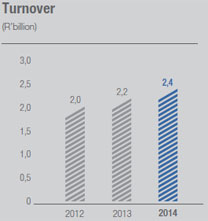
Turnover rose 9,4% to R2,4 billion (2013: R2,2 billion) |
|
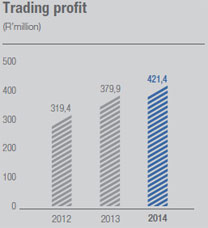
Trading profit rose to R421,4 million (2013:
R379,9 million), delivering pleasing double-digit growth off a
higher cost base despite challenging trading conditions |
|
Cash generation rose to R373 million (2013: R349 million),
representing 91,57% of operating profit |
|
All businesses achieved operational
efficiencies and continued to implement robust cost-containment
programmes |
|
Funds employed eased higher to R1 589,8 million (2013:
R1 475,3 million) while ROFE showed continued improvement
at 27,5% (2013: 26,0%) |
|
Ground-handling operations entrenched their position as
industry leaders, achieving top scores in industry
audits of service and efficiency |
|
Bidvest Premier Lounges performed strongly in a
largely stagnant market |
|
Budget achieved average rates growth despite continued
discounting across the sector |
|
Operations optimised the short-term business opportunity
presented by an uptick in charter flight and associated cargo
volumes – a consequence of the inflow of world leaders and
VIPs following the death of former President Nelson Mandela |
|
Strong focus on transformation ensured all
businesses maintained or improved their empowerment status,
with Budget Car and Van Rental moving up to level 3 |
|
IATA extended ISAGO accreditation to Cape Town operations
and the Johannesburg head office |
|
A stable industrial relations climate was maintained, with
decentralised managers staying close to local
issues. |
2015 targets, objectives and factors affecting future results
|
Our market will remain challenging, necessitating a continued
pursuit of efficiencies and savings. Further improvements in
ROFE have been targeted |
|
The launch of the Webjet online travel tools creates an
opportunity for growth in the leisure travel sector. Ongoing
customisation and enhancements to further improve the user
experience is a management priority |
|
Growth will be sought in the SME sector to complement our
established position as a leading provider of travel management
services to major corporates |
|
Our new global contact centre product will be energetically
rolled out |
|
Further efficiencies will be sought in the car and van rental
business following changes to the management team in the
prior period |
|
Opportunities for acquisitive growth will be explored by all
businesses in the division |
|
The prospect of taking selected products and services into
international markets will be investigated |
|
The bar has been set higher by more rigorous B-BBEE
requirements. Efforts will be stepped up to ensure we maintain
our empowerment status |
|
ISAGO accreditation will be sought at all operations that have
yet to be accorded this level of certification. |
Material issues and performance
 |
| People

Maintain rigorous safety
standards
|
|
 |
Safety is more than a compliance issue. Workers
require a safe working environment to perform
at their best. Morale improves when it is evident
everything is being done to ensure worker safety,
especially as some of our businesses operate in a
hazardous environment |
|
To improve safety record by enhancing our
certified safety procedures and training |
|
|
Lost-time injury
frequency rate |
|
Lost-day rate |
|
|
Injury rates at BidAir Cargo increased to 11,87
(2013: 7,63), BidAir Hospitality decreased to 1,24
(2013: 4,94) and Commuter Handling Services decreased
to 2,81 (2013: 5,03) (Injury rate is measured as number
of injuries per 200 000 hours worked) |
|
The lost-day rate (per 200 000 hours worked) due to
injuries dropped from 10 to 9 |
|
Promote employee
health and satisfaction
Enhance talent
attraction and retention |
|
|
People have a right to be healthy and happy. Team
spirit and cooperation improve in a happy, healthy
and productive environment |
|
To improve talent attraction and retention |
|
To use innovative approaches to improving the
health and wellbeing of all employees |
|
|
Resignation rates |
|
Absentee rates |
|
|
Various industries are covered within Travel and Aviation
therefore each company monitors their staff-number
movements according to their industry |
|
Promote skills development |
|
|
Skills are essential to drive growth and innovation
while improving the competitive position of our
business |
|
|
Training spend per
employee |
|
Training hours per
employee |
|
|
Average annual training spend per employee R4 633 |
|
41 hours per person |
|
| CSI |
|
|
Nation building builds pride in the business and
our role as a positive contributor |
|
|
CSI spend |
|
|
CSI spend decreased to R2,6 million |
|
|
|
| |
 |
Innovation and new investment |
|
New capital expenditure reached R60,3 million (2013: R22,6 million). A focus area was new ground-handling technology to further
improve operational efficiency |
|
We customised the Australian Webjet online travel agency technology to South African market conditions, creating a world-class travel
site and online booking tool – enabling the division’s first entry into the leisure travel sector |
|
Began the development of a new corporate online booking tool – a proactive response to growing demand for a smart solution to
deliver travel management efficiencies while allowing the corporate client to retain hands-on responsibility for bookings. The niche
product will be targeted at mid-size companies that don’t generate sufficient volumes to warrant a fully-fledged corporate on-site travel
management capability, but still require affordable assistance with executive travel arrangements. The design flexibility of the tool does,
however, also allow larger corporates to make use of the system should they so prefer |
|
Refurbished the Bidvest Premier Lounge at Port Elizabeth and extended the George lounge |
|
Developed the global contact centre concept – a product targeted at corporates with various operations in multiple jurisdictions. This
new travel management product creates a single point of contact, enabling cost and time efficiencies within the parameters set down by
the corporate client |
|
The cargo business bedded in its new fully integrated operational and financial platform. The system, which includes internet-based
tracking, delivered the anticipated efficiencies |
|
Restructuring and the appointment of a new management team at Budget Car and Van Rental had the desired effect as significant
efficiencies and savings were achieved. |
Disappointments and challenges |
|
Roll-out of the Webjet online travel site took longer than anticipated, but time was needed to develop a world-class product capable of
leading our strategic entry into leisure travel |
|
The airline industry remained under pressure. To contain costs, airlines continue to cut routes, reduce flight frequencies and downgrade
their aircraft, cutting passenger and cargo volumes. The effect is to limit the growth potential of Bidair Services at a time when
investment in training and systems has created an industry leader |
|
Corporates continued to cut executive travel budgets while leisure travellers also cut back |
|
Discounting remains a central feature of the vehicle rental industry, despite continued rises in the cost base. |
Changes in operational environment |
|
The trend to online convenience in the travel sector picked up pace, entrenching the division’s competitive advantage as a provider of
fully integrated solutions |
|
Price sensitivity remained intense in the ground-handling sector. However, a key change became apparent in decision making within
the airline industry on the issue of outsourced services versus the traditional in-house approach. By year-end it was apparent that
some airlines were ready to make broader use of our range of outsourced services, with focus on passenger handling. Our teams have
strongly communicated the message that specialists can not only lift service levels, but do so at very cost-effective rates. |
|
Limited market size accentuates competitive risk in the ground-handling business. Three major companies compete for a share of the
market for airport and airline services in an industry that is relatively small by world standards. Airlines therefore tender aggressively
to secure the lowest contract price. The risk is that a race to the bottom will become the norm. The division responds by constant
enhancement of its service offering, creating a highly competitive value proposition. The search for innovation and efficiency is constant
as new approaches and effective utilisation of assets facilitate cost containment – the key factor in winning airline tenders |
|
The travel industry is technology driven and technology risk is acknowledged. It is possible that an international breakthrough might
at some stage render some established systems obsolete. This risk is mitigated by constant scrutiny of the international technology
horizon and the adoption of leading-edge systems customised for the South African market. Risk awareness has contributed to
competitive advantage as the division has developed fully integrated systems and is known as a successful innovator |
|
As a major employer with a high percentage of unionised workers, there is a risk that a breakdown in labour relations may occur at
some stage. Mitigation measures include the provision of competitive wage and benefit packages complemented by strong focus on
training, people development and workplace health and safety |
|
In common with many large businesses, the division acknowledges policy risk, specifically black economic empowerment legislation. In
effect, acceptable BEE scores have become a licence to operate. The business responds by making ongoing transformation a business
imperative. Our CSI efforts have long included an enterprise development component. Bidvest Lounges helped a start-up bakery
business develop into a biscuit and confectionary supplier able to serve large retail chains. This grounding in ED will become increasingly
important as this aspect of the BEE scorecard becomes critical in 2015. |
|