Operational reviews – Bidvest Australia
Bidvest Foodservice
Asia Pacific |
 |
Rachel Ruggiero: Chief executive |
|
| Bidvest Australia is a one-stop supply solution
distributing wholesale food, hospitality equipment
and supplies, and fresh produce to the foodservice
and catering industry.
With access to all major national and many
international brands, our product range remains
current and diverse, and continues to successfully
meet the needs of our customers. Across our
divisions, our extensive range includes over
56 000 foodservice products, 3 000 core hospitality
products, and a comprehensive fresh offering of
between 400 and 600 lines depending on season.
|
|
 |
| Left to right: Peter Crowe – General manager: marketing, Grant Fairlie – General manager: procurement, Guy de Sylva – General manager: IT, Rachel Ruggiero – Chief executive officer, Lisa Vorano – General manager: national accounts, Barry Plit – Chief financial officer |
|
Highlights
 |
Sales growth up 3% to over AUD2,1 billion |
|
EBIT growth up 10% to over AUD100 million |
|
Further development of national network of Fresh businesses, offering meat and fruit and vegetables |
|
ROFE over 112%, excluding land and buildings |
|
Working capital management improvements |
|
Business wins a number of supplier awards |
|
e-commerce sales up 6,5% to AUD1,1 billion. |
2015 targets, objectives and factors affecting future results
|
National roll-out of our fresh produce division and fresh meat offering |
|
Substantial investment in facilities expansion and upgrades. |
Material issues and performance
| MATERIAL ISSUE |
|
WHY IT IS IMPORTANT AND
STRATEGIC OBJECTIVES |
KPIs AND TARGETS |
PERFORMANCE AGAINST TARGETS AND
ACTIONS GOING FORWARD |
 |
| Performance

Maintain consistent
financial performance
|
|
Why:
 |
Global economic challenges |
|
Lower consumer confidence |
Objective:
|
To maintain profitability |
|
|
Cost containment |
|
Trading profit |
|
|
Unsustainable high-volume, low-margin accounts continue
to be analysed |
|
Pursue “free trade” business yielding higher margins |
|
Explore expansion opportunities into regional areas |
|
|
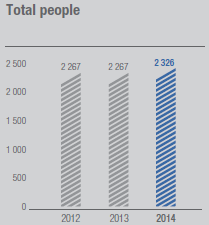
| People

Maintain rigorous safety
standards
|
|
Why:
|
It is our obligation to ensure the safety of our
employees |
Objective:
|
Ensure all businesses demonstrate exceptional
levels of safety performance |
|
KPIs:
|
Injury rate |
|
Lost-day rate |
|
Training spend per employee |
|
Training hours per employee |
|
|
All branches are ISO 14001 and AS/NZ 4801 certified |
|
Training and development of employees through the Bidvest Academy, to be re-launched FY15 |
|
Promote skills
development |
|
Why:
|
This is an important business issue |
|
|
|
|
|
| |
|
|
| Product

Minimise product impact
and ensure food safety
|
|
Why:
|
Foods have a high environmental and health
impact. It is important to ensure food products
are responsibly and safely sourced, manufactured
and distributed |
|
Ensuring product supply integrity (eg horse meat scandal) |
|
|
|
All branches are ISO 22000 certified |
|
Development of a fresh national network, including meat
processing and fruit and vegetables increases the risk of
food contamination liability |
|
|
|
|
|
|
Planet

Reduce environmental
impacts
|
|
Why:
|
Environmental issues, such as climate change, pollution and water scarcity |
|
These issues also potentially threaten food supplies |
Objective:
|
To reduce our impact, educate employees,
and work with suppliers and offer solutions to
customers to help them reduce their impacts |
|
KPIs:
|
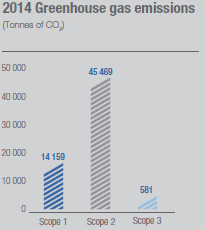
Carbon emissions (Scopes 1, 2 and 3) |
|
Carbon emission intensity
(revenue and possible
other) |
|
Water used and water
intensity |
|
|
Promote e-commerce options to enable customers to
reduce paperwork and increase efficiency |
|
The virtualisation of IT servers continues with the number
of physical servers and storage being reduced, resulting in
reducing the carbon footprint of the IT structure |
|
Energy-efficient LED lighting is being installed in new
warehouses |
|
|
| |
| |
2012 |
2013 |
2014 |
|
|
|
|
| Electricity usage (Scope 2) GJ |
175 415 |
189 812 |
198 893 |
| Fuel usage (Scope 1) (Mℓ) |
4,7 |
5,5 |
5,3 |
|
 |
|
Stakeholder engagement
Innovation and new investment
|
Investment in constructions in New South Wales, including foodservice facilities in Lismore and Tamworth and a Fresh site in Sydney |
|
In-house development and roll-out of a state-of-the-art customer relationship management software tool (CRM), Bid IQ |
|
Continual investment in cost-efficient environmentally friendly ammonia plant |
|
Sustained focus and investment in electricity savings methods, including installation of solar and energy-efficient lighting. |
Disappointments and challenges
|
Inadequate returns from the Logistics division |
|
Margin reductions in large corporate accounts |
|
Slower-than-anticipated roll-out of the Fresh division and lower-than-expected returns from the recent Fresh acquisitions. |
Risks and responses
|
Margin reductions in large corporate accounts – addressed by strong focus on “free trade” growth and seeking opportunities to import products |
|
Slowing of the mining resources boom – addressed by seeking other growth prospects such as fresh meat and produce |
|
Weak food price inflation – addressed by an aggressive drive on new business utilising the new CRM, Bid IQ. |
|