Operational reviews – Bidvest Services
Bidvest South Africa
Bidvest Services |
 |
John Taylor: Chief executive
Bina Gosai: Financial director |
|
| |
|
|
| The division fosters business efficiency and savings via a broad
range of outsourced corporate services, including cleaning, hygiene,
security, facilities management, interior and exterior landscaping,
and specialist services such as industrial cleaning and vacuumation,
road repair, water purification and reticulation, access maintenance
and insulation, industrial painting, outsourcing of warehouse and
distribution centres, catering, fleet management, vehicle tracking and
recovery and technical services and technology related to the security
of vehicles and other assets.
The business frequently operates as the partner of clients in pursuit
of a range of targets, including improvements in environmental
management. The customer base is extensive, covering the mining,
oil and chemicals, engineering, manufacturing, healthcare, hospitality,
retail, forestry, commercial sectors and parastatals. Operational
companies are industry leaders that set the benchmark for training,
measurable delivery, professionalism and the early adoption of new
systems and technology. |
|
 |
| Bidvest Services management team |
|
 |
Significant acquisitive growth was successfully managed
as businesses that were previously part of the Mvelaserve
Group – Total Facilities Management Company (TFMC), Protea
Coin Security, Royalserve Cleaning, RoyalMnandi, SA Water,
Velocity and Khuseti – King Pie – joined the division |
|
Newcomers made a positive eight-month contribution |
|
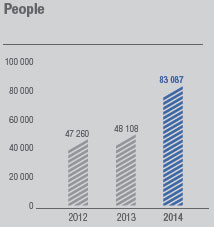
Staff numbers increased – up from 48 108 to
83 087– with minimal disruption |
|
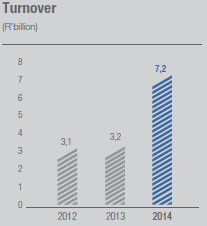
Turnover rose significantly at the greatly expanded business, up 123,8% at R7,2 billion (2013: R3,2 billion) |
|
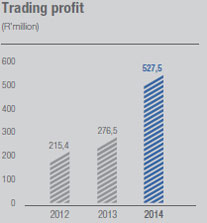
Trading profit rose 90,8% to R527,5 million (2013:
R276,5 million) |
|
Though margins were under pressure, margin management
was satisfactory, with gross margins at 24% (2013: 26%) while
the operating margin was 7,3% (2013: 8,5%) |
|
At 70% (2013: 62%) ROFE was very satisfactory |
|
Proactive strategies to maintain BEE status made
pleasing progress ahead of government’s implementation of
new, more stringent empowerment codes |
|
Good relations with staff and unions continued as the business
maintained its reputation as an industry leader in the field
of health and safety, professionalisation of services, staff
development, pay and conditions |
|
A major staff development initiative resulted in significant
increases in learnerships and apprenticeships. By year-end,
the division accounted for 70% of all learnerships
awarded to companies in the outsourced services
industry |
|
Integration of security businesses led to the creation of
Bidvest Protea Coin – South Africa’s secondlargest
security services provider |
|
Strong platform was put in place for strategic expansion
of the facilities management offering |
|
Ongoing cost control programmes achieved their
objectives. |
2015 targets, objectives and factors
affecting future results |
|
Double-digit growth in revenue and trading profit is forecast as
the business takes advantage of the full-year benefit of recent
acquisitions |
|
Economic conditions will remain challenging. Expense and
asset management remain priorities |
|
More rigorous BEE codes will have a material impact on
business as some contracts are linked to BEE status.
Maintenance of BEE status is imperative. Relationships with
industry Setas will be further strengthened to maintain the
division’s high level of funded and unfunded learnerships. This
initiative will ensure optimum effectiveness of a significantly
increased training budget. ED efforts will be intensified. The
recently established programme of small supplier identification
and development will be strengthened |
|
New partners will be sought in the security field to enable
wider roll-out of a new security bureau service offering vehicle
tracking and driver behavior monitoring, route optimisation,
CCTV site monitoring, perimeter security, alarm monitoring and
other services |
|
Further growth via an expanded mast management service will
be energetically pursued by TFMC. Mast maintenance in the
telecom sector will be complemented by an integrated service
offering to cover site security, technical support and other
services |
|
The Africa footprint of Bidvest Protea Coin will be widened and
selected components of the security product made available to
additional jurisdictions in sub-Saharan Africa |
|
A total corporate support service will be developed covering
facilities management, soft services and additional outsourced
services, creating an end-to-end solution that enables
corporates to concentrate on core competence |
|
Initiatives to promote industry professionalism will continue.
The division is working on a Decent Work Programme in
collaboration with various stakeholders, including the CCMA
and the International Labour Organisation. The blueprint – a first
in South Africa – is intended to clear the way for the creation
of a national bargaining council to ensure all workers receive
proper pay and benefits in the cleaning sector. The current
estimate is that less than half of cleaning companies are fully
compliant with legislation |
|
All businesses will step up their marketing efforts and
RoyalMnandi will pursue further hot food growth |
|
New CSI interventions are planned with the focus on youth
and sport. An integrated approach will combine community
assistance with jobs information and recruitment and input from
other Group contributors, including Bidvest Wits |
|
Further bolt-on acquisitions will be explored if opportunities
emerge to add complementary offerings to divisional services. |
Material issues and performance
 |
| People

Pressure on wage costs
|
|
Why:
 |
Staff in many operations are guaranteed a
minimum wage and annual gazetted increases
that are 2% above CPI. Pay is the biggest single
element in the cost base. Wage rises above
inflation are difficult to pass on to customers who
use CPI as their price increase ceiling |
Objective:
|
Provide employees with decent, market-related
wages, encourage other industry players to follow
this lead and contribute to the professionalisation
of the sector |
|
KPIs:
|
Wage benchmarking |
|
Performance:
|
Attendance systems and new technology |
|
Initiated contacts with official bodies, Setas, labour
organisations and international bodies to establish a basis
for decent wages across the industry |
|
Certificate of compliance |
|
| Exceed corporate
citizenship expectations |
|
Why:
|
Our staff are drawn primarily from low-income
groups. They often come from under-resourced
communities. Our community investment
demonstrates our commitment to help our people
and improve their home circumstances. CSI is
more than a compliance issue. It is part of who
were are as a business |
|
KPIs:
|
JSE SRI performance
standards |
|
CDP performance
standards |
|
Governance standards
(King III) |
|
|
Monthly measurement of initiatives and spend |
|
Leadership of the employer committee participating in
initiatives to establish Decent Work Programme |
|
Member of Green Council of SA |
|
Recruitment through local communities |
|
Career path planning for employees |
|
| Maintain rigorous safety
standards |
|
Why:
|
Workplace safety is a priority. Safety commitments
underline our status as an industry leader
determined to establish minimum professional
standards |
|
Safe environments support team morale and
productivity |
Objective:
|
Ensure all businesses demonstrate exceptional
levels of safety performance |
|
KPIs:
|
Lost-time injury
frequency rate (LTIFR) |
|
Lost-day rate |
|
|
Protea Coin had three work-related fatalities |
|
Most businesses maintained low injury rates |
|
The rate for lost days in TopTurf Mauritius regretfully
resulted in 136 lost days – the definition for Mauritius
includes items such as insect bites while on duty |
|
Magnum had a motor vehicle accident that involved
nine employees |
|
Increased awareness and measurement going forward |
|
| People
Promote employee
health and satisfaction
Enhance talent
attraction and retention |
|
Why:
|
People have a right to be healthy and happy.
Team spirit and pride in performance improve at
operations that give priority to employee health
and on-the-job satisfaction |
|
To improve talent attraction and retention |
Objective:
|
To use innovative approaches to improve the
health and wellbeing of all employees |
|
KPIs:
|
Resignation rates |
|
Resignation rates |
|
Performance:
|
The divisional resignation rate is dependent on terms
of contract |
|
The absentee rate is stable from last year |
|
Safety stats reported at every Exco and Board meeting |
Actions:
|
Employee wellness programme |
|
Improving quality of management and other initiatives to
become an employer of choice |
|
Balanced scorecard system to empower employees |
|
Skills development initiatives |
|
| Promote skills
development |
|
Why:
|
In a people business, individual skill levels are
a source of competitive advantage. Appropriate
skills also drive performance and innovation |
|
KPIs:
|
Training spend per
employee |
|
Training hours per
employee |
|
Performance:
|
Average annual training spend from R30,0 million to
R53,6 million |
Actions:
|
Balanced scorecard system to empower employees |
|
| CSI |
|
Why:
|
It is especially important at a people-intensive
business that we demonstrate that the concerns
of our staff are our concern as well. Investment
in our people has to be backed by investment in
their communities |
|
KPIs:
|
CSI spend |
|
CSI spend as percentage
of trading profit |
|
Performance:
|
CSI spend increased to R4,9 million from R2,3 million |
|
|
|
|
|
| |
 |
|
|
|
|
|
Product

Minimise product
impacts |
|
Why:
|
Some products and services may have human
safety and/or environmental impacts. Customers
for outsourced services demand product and
service safety – so do we |
Objective:
|
To continuously work at reducing negative impacts |
|
KPIs:
|
Convert to green
chemicals |
|
Train employees on the
use of such |
|
Performance:
|
Enhancing green chemical range and becoming a green
building supplier |
|
|
|
|
|
|
| Planet

Reduce environmental
impacts |
|
Why:
|
Society increasingly demands that steps be
taken to reduce environmental impacts, including
greenhouse gas emissions |
|
Relationships with customers can be strengthened
by giving a lead in this area and exceeding client
expectations |
|
Reducing the usage of materials and contributing
to recycling efforts improves our efficiency and
contributes to cost containment |
Objective:
|
To contribute by educating our employees, to
reduce our impacts and work with our suppliers
and to assist our customers in this process |
|
KPIs:
|
Carbon emissions
(Scopes 1, 2 and 3) |
|
Carbon emission intensity
(revenue and possible
other) |
|
Water used and water
intensity |
|
Performance:
|
Ongoing measurement of KPIs |
|
Carbon emissions have increased dramatically due to
acquisitions increased fuel and electricity usage |
|
|
|
|
|
| |
| Greenhouse gas emissions |
2012 |
2013 |
2014 |
|
|
|
|
| Scope 1 |
14 477 |
12 684 |
39 180 |
| Scope 2 |
3 851 |
3 308 |
18 552 |
| Scope 3 |
551 |
989 |
1 662 |
| Total carbon emissions (tonnes of CO2) |
18 879 |
16 982 |
59 394 |
| Diesel usage (Mℓ) |
2,5 |
2,0 |
8,3 |
| Electricity usage (GJ) |
14 005,5 |
12 153,5 |
68 325,7 |
|
Stakeholder engagement
| STAKEHOLDERS |
|
OBJECTIVE AND ENGAGEMENT
METHOD (AND FREQUENCY) |
KEY ISSUES IDENTIFIED |
KEY ACTIONS TAKEN AND PLANNED
(more detail may be provided in material
issues tables and elsewhere) |
|
| People
Employees (full-time and
contract) |
|
Objective:
|
Improve employee relationship and
satisfaction levels |
Methods:
|
Employee surveys (annual) |
|
Anonymous feedback forms (ongoing) |
|
Newsletters (quarterly) |
|
Key issues:
|
Remuneration and benefits, being
informed about corporate strategy,
employee skills development, employee
wellness, local economic development,
specific employer/employee relationship
issues |
Issues considered material:
|
Employee wellness, skills development
and retention |
|
|
Communication is on going through channels
available |
|
Monthly regional and national forums |
|
Proactive intervention to reduce absentee rate
through Alexander Forbes 24-Hour Assistance
to employees and families through Life Assist
dieticians, financial and legal advice |
|
| Unions and unionised
employees |
|
Objective:
|
Maintain good union and employee
relationship |
|
Key issues:
|
Remuneration and benefits |
|
Corporate strategy |
|
Employee skills development |
|
Employee wellness |
|
Local economic development |
|
Specific employer/employee relationship issues |
|
|
Remuneration in accordance with legislation |
|
Positive engagement with unions |
|
Bursaries and learnerships in place |
|
Medicals performed at site |
|
Employees sourced from local communities |
|
IR training of managers conducted by CCMA |
|
Industry representative
organisations
|
|
Objective:
|
Encourage that representative
organisations ensure a level playing field |
|
Create structures that will contribute to
the professionalisation of our industry |
Methods:
|
Lobbying representative organisations |
|
Working in tandem with various role
players to improve industry conditions |
|
Key issues:
|
Regulatory compliance across industry |
|
Knowledge of regulatory environment |
|
|
Regulatory compliance across industry
through active participation |
|
Regular audits |
|
Communities
 |
Local communities |
|
Particularly community
subsectors (eg sports,
education, infrastructure) |
|
|
Objective:
|
Better understand and collaborate with
the communities in which we operate |
|
Key issues:
|
Local economic development and
employment opportunities, education
(schools), skills development, health and
environment |
Material issues:
|
Socio-economic development and
community involvement |
|
|
CSI spend |
|
Local recruitment and skills development |
|
Enterprise development through support of
local business |
|
HIV/Aids awareness |
|
|
|
|
|
|
| Product
Suppliers |
|
Objective:
|
Maintain good relations |
|
Understand issues and resolve these
together |
|
Work together to create efficient solutions
that benefit our customers |
|
|
Performance management |
|
Sustainability of supply and pricing |
|
Agree B-BBEE plan |
|
|
Meet regularly and review performance. |
|
Non-conformance management |
|
Agree pricing |
|
Preference given to good B-BBEE credentials |
|
| Customers |
|
Objective:
|
Understand evolving needs, expectations
and issues |
|
Use customer insights to proactively
develop new or enhanced service
offerings that give us competitive
advantage |
|
|
Service levels |
|
Price sensitivity |
|
Adapt to customer requirement where
possible |
|
|
Key account managers |
|
Monitor service levels through technology |
|
Independent surveys to understand service
level shortcomings |
|
Tailor-made solutions offerings to clients |
|
Schedule meetings with client |
|
Client satisfaction surveys |
|
Complaint/compliment line initiated |
|
Innovation and new investment |
|
The acquisition of TFMC enabled energetic entry into the market for facilities management, with strong focus on technical, mechanical
and electrical support services such as maintenance of lifts, escalators, air conditioning and other installations |
|
Critical mass was achieved in the security cluster following the integration of Protea Coin Security with Magnum. The consolidated
business – the second-largest security services provider in South Africa – was rebranded as Bidvest Protea Coin, offering guarding,
cash in transit and security technology services, including monitoring and tracking, control rooms, CCTV systems and call centres |
|
Royalserve Cleaning was successfully integrated with BMS, creating one of the country’s largest cleaning businesses. The combined
operation employs 40 821 cleaners |
|
TMS was substantially enlarged as it now accommodates SA Water (provider of permanent and portable water purification systems),
Velocity (a specialist in fast, efficient pothole repair) and RoyalMnandi (a catering business with strong focus on parastatals). All new
units under the TMS umbrella retain operational autonomy |
|
At R178,2 million, new capital investment was up 8,7% from R163,9 million |
|
Training investment rose 149% to R79,3 million (2013: R31,9 million) |
|
Good progress was made with an enterprise development initiative designed to accelerate the identification and development of small
suppliers with the potential to provide complementary services. |
Disappointments and challenges |
|
Customer resistance to price increases resulted in the loss of some contracts |
|
Under-recovery of some cost increases affected margins, but this was difficult to avoid as divisional businesses needed to maintain
market share and achieve acceptable volumes |
|
Strikes in the mining industry had material impact on volumes as many divisional operations are major suppliers to mining companies |
|
The record duration of the biggest mining strike could not be predicted, playing havoc with budget forecasts |
|
Capital expenditure programmes at many client companies were on hold for a second year as business confidence remained at
low levels |
|
Spending on some large industrial projects was on and then off, making business planning difficult |
|
Official efforts to address administration problems at various industry Setas were slow to gain traction, making it difficult to put in place a
new training and development strategy as these plans call for close collaboration with training authorities |
|
Eskom outages created challenges for several teams |
|
The mismatch continues between the standards expected of industry leaders and the standards that are continually ignored by some
under-resourced, small-scale operators. A major outsourced service provider like Bidvest Services invests in proper systems and
staff development (with material impact on the cost-base) while some micro-operators make no investment at all, securing a pricing
advantage. Failure to effectively police industry standards across all industry players results in continuing frustration |
|
Challenges around corporate culture were successfully addressed. Bidvest’s decentralised, highly entrepreneurial culture gives
responsibility for local performance to local teams. Managers and their teams are accountable for results. Teams at former Mvelaserve
businesses were challenged to make a rapid adjustment to this new organisational culture. Great strides were made in the second half |
|
In a tough trading environment, debtors’ management remained a challenge. Provisions were increased in view of the take-up of new
books of business following recent acquisitions |
|
TopTurf remained under pressure. No significant investment was made in South Africa’s leisure industry infrastructure, cutting the flow of
project work. |
Changes in operational environment |
|
Compliance demands are growing in all sectors. Some companies respond by shifting responsibility for legislative compliance to
outsourced service providers. Working in partnership leads to good results, but in some cases companies try to contain their own costs
by passing responsibility entirely to the outsourcing specialist |
|
Proper preventive maintenance programmes have been curtailed by some customers in a bid to cut costs. This means demand
maintenance is now a significant driver of volumes at some divisional businesses. Clearly, any sudden breakdown of systems and
equipment cannot be predicted, making forward planning difficult. However, customer satisfaction depends on prompt resolution of any
problem. Managing client expectations in this environment is challenging. |
|
In a labour-intensive business, union and staff relations are an area of critical management focus. Industrial action could be highly
disruptive. The risk is addressed by constant engagement with employees and union representatives. Trust is a key issue. The business
has established a reputation as a proactive employer who is determined to ensure proper remuneration and employee benefits while
maintaining high standards of workplace safety |
|
Official policy risk is acknowledged. A reformist government with strong links to the trade union movement will clearly champion
improved working conditions for labour. The division’s response is to stay abreast of the legislative agenda and take a proactive
approach in all labour and HR matters. Empowerment policy is another focus area. Changes to the codes of good empowerment
practice are imminent. Management has responded by stepping up training initiatives. A new enterprise development programme has
also been structured. The risk of a constantly rising BEE bar is addressed by sincere commitment to transformation. The strategic
intention is to be ahead of the curve, rather than take a reactive approach and play compliance catch-up |
|
Contract renewal (or not) is another area of risk. Some contracts are conditional on BEE compliance, creating potential for contract
losses in the event of a change in empowerment status. Furthermore, price negotiations can be prolonged and intense. The division
supplies services to major corporates and parastatals. These customers are price sensitive and expect suppliers to achieve optimum
price efficiency. The issue is addressed by working in partnership with customers to develop cost-efficient solutions |
|
Barriers to entry are low in some sectors. Small operators with few overheads can mount an attack on some areas of our business
based purely on price – sometimes at uneconomic levels. This creates the risk of a price-driven “race to the bottom”. This is addressed
by a constant search for savings and efficiencies. Strong customer relationships are a further defence against these attacks. Constant
market education is also necessary. |
|