Operational review – Bidvest Rental and Products review
Bidvest South Africa
Bidvest Rental and Products |
 |
Alan Fainman: Chief executive
Trevor Scruse: Financial director |
|
| |
|
|
The division is a leader in the provision of products
and services that enhance the working environment
through hygiene rental equipment, consumables, laundry
services, indoor plants, drinking water and water coolers,
specialised clothing and workwear.
Operational businesses are leaders in their
chosen fields and include Bidvest Steiner,
G. Fox and Company, Giant Clothing, Boston Launderers,
First Garment Rental, Montana Laundries, Bidvest
Execuflora, Silk by Design, Puréau Fresh Water Company,
Bidvest Masterguard, Hotel Amenities Suppliers, Bidvest
Steri Pic and Promo Sachets and Bidvest Art Rentals. The
business is differentiated by the savings and synergies
it delivers to customers by creating a single source
for a wide range of complementary rental services
and products. |
|
 |
| Front row from bottom – Left to right: Alan Fainman – Chief executive,
Ms Gail Dludla – Commercial director, Rental and Products, Nathan Taitz –
Managing director, Bidvest Steri Pic and Promo Sachets, Savvas Xenophon –
Managing director, G. Fox & Company, Paul Levine – Managing director,
Puréau Fresh Water Company
Second row from bottom – Left to right: Trevor Scruse – Financial director,
Rental and Products
Third row from bottom – Left to right: Clive
Bedell – Managing director,
Bidvest Masterguard, Sue McNair – Managing director, Bidvest Silk by Design,
Rika van Rooyen – Sales and marketing director, Bidvest Steiner, Dierdre van
Tonder – Procurement and logistics director, Bidvest Steiner, Heather Strydom –
RGM, Region 1, Bidvest Steiner
Fourth row – Left to right: Louis Roux – Human resources director, Bidvest Steiner,
Hans Hunnink – Managing director, Bidvest Laundry Group,
Jan Dames – RGM, Region 2, Bidvest Steiner |
|
Highlights
 |
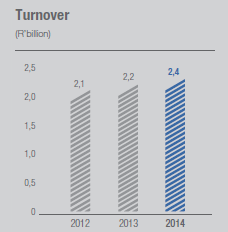
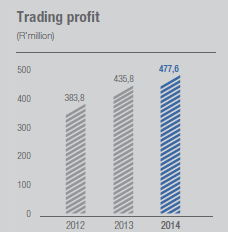
Trading profit increased by 9,6% to R477,6 million
(2013: R435,82 million) off of turnover of R2,4 billion
(2013: R2,2 billion) |
|
Strong cashflows were maintained in a challenging
trading environment |
|
Steiner put in a strong performance and achieved pleasing
growth with its newly introduced pest control services |
|
All businesses improved their black economic
empowerment scores. No business has a rating under level 4
and Steiner achieved level 2 status |
|
The newly acquired RoyalServe business and Sanicorp
performed to expectation and integration went well |
|
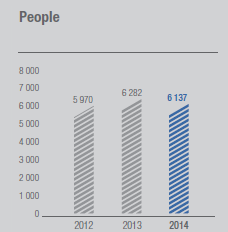
Jobs growth continued |
|
Africa growth strategy remained on track |
|
Despite customer resistance to price increases, margins were
maintained as a result of strong focus on internal savings and
efficiencies. |
2015 targets, objectives and factors
affecting future results
|
Double-digit revenue and trading profit growth is forecast |
|
All businesses will continue to aggressively manage costs and
seek efficiencies. Our Laundries business achieved notable
efficiency improvements in 2014 and continued gains are
expected in the coming year |
|
The division’s African expansion strategy, led by G. Fox and
Company, will gain further momentum while the business will
feel the full-year benefit of the recently launched operations in
Botswana, Swaziland, Zambia and Zimbabwe. New markets in
sub-Saharan Africa will be explored |
|
The full-year effects of management changes at Puréau
and Hotel Amenities Suppliers are expected to be positive,
while stronger momentum with Puréau’s entry into the coffee
segment is forecast. The full-year effects of Execuflora’s entry
into corporate art rental is also expected to be beneficial |
|
Management will step up the focus on skills training, employment equity and enterprise development – areas of the B-BBEE scorecard
that become critically important from May 2015. Supplier identification, support and development are priorities |
|
Pressure on the corporate sector as a whole will continue, but growth opportunities are expected in the mining industry as it recovers
from the 2014 strike |
|
Rand weakness may increase the attractiveness of South Africa as a long-haul destination for foreign tourists. Hopefully, the hospitality
industry may show some signs of recovery, creating opportunities for Laundries and Hotel Amenities Suppliers |
|
Opportunities for Public-Private Partnerships – especially in the hospital field – will be energetically pursued |
|
G. Fox and Company will launch an e-commerce solution, enabling customers to place orders electronically. Steiner will also look to
extend e-orders to some additional areas of its business |
|
Further supply chain efficiencies will be explored |
|
Opportunities for acquisitive growth will not be neglected. |
| MATERIAL ISSUE |
|
WHY IT IS IMPORTANT AND
STRATEGIC OBJECTIVES |
KPIs AND TARGETS |
PERFORMANCE AGAINST TARGETS AND
ACTIONS GOING FORWARD |
 |
| Performance

Maintain consistent
financial performance
|
|
Why:
 |
Strong revenue streams and profits are necessary
to fund growth, provide capital for investment in
new systems and sustain jobs |
Objective:
|
To maintain profitability |
|
|
Cost containment |
|
Diversification |
|
Service level
improvement |
|
Performance:
|
Product and service innovation, bundled services, shifting
from foreign to local suppliers, improved fleet and other
efficiencies |
|
Expanded into Africa |
|
|
| |
 |
|
 |
|
| People

Maintain rigorous safety
standards
|
|
Why:
|
It is our obligation to ensure the safety of our
employees |
|
It is important all employees understand that their
safety is a priority for all businesses |
Objective:
|
Ensure all businesses demonstrate exceptional
levels of safety performance |
|
KPIs:
|
Injury rate |
|
Lost-day rate |
|
Performance:
|
The injury rate has increased to 0,8 from 2,33 |
|
The lost-day rate (per 200 000 hours worked) due to
injuries dropped from 9 to 5 |
|
| Promote employee
health and satisfaction
Enhance talent
attraction and retention |
|
Why:
|
Healthy workers who are happy on the job are
highly productive |
|
To improve talent attraction and retention |
|
KPIs:
|
Resignation rates |
|
Absentee rates |
|
Performance:
|
The resignation rate increased to 8,4 (2013: 4,8) |
|
Absentee rates have increased to 1,7 |
|
| Promote skills
development |
|
Why:
|
Skilled people give us a competitive advantage,
they also enable innovation and the pursuit of
enhanced market share |
|
KPIs:
|
Training spend per
employee |
|
Training hours per
employee |
|
Performance:
|
Average annual training spend per employee was R815 |
|
| CSI |
|
Why:
|
It is the right thing to do. Social investment
underpins social cohesion and supports a climate
in which businesses and communities can grow
and prosper |
|
KPIs:
|
CSI spend |
|
CSI spend as percentage
of trading profit |
|
Performance:
|
CSI spend increased marginally |
|
|
| |
 |
|
| Planet

Reduce environmental
impacts |
|
Why:
|
Environmental concerns and our pursuit of
business efficiency. Reducing material, energy and
water usage and the reduction of waste helps us
cut costs while reducing environmental impacts |
Objective:
|
To reduce our impact, educating employees, and
working with suppliers and offering customer
solutions to help them reduce theirs |
|
KPIs:
|
Carbon emissions
(Scopes 1, 2 and 3) |
|
Water used and water
intensity |
|
Performance:
|
Total emissions increased |
|
Main contribution to total carbon stem from coal used
by Laundries |
|
Rental and Products is the largest water user, because of
its laundry businesses, usage at Laundries increased |
Actions:
|
Environmental sustainability and recycling initiatives are
well entrenched |
|
|
| |
| Greenhouse gas emissions |
2012 |
2013 |
2014 |
| Total (tonnes of CO2) |
59 789 |
57 860 |
62 388 |
| Coal usage (tonnes) |
17 652 |
16 064 |
16 576 |
| Water usage (Mℓ) |
641,1 |
698,8 |
1 241,9 |
| Tonnes of CO2 per FTE |
10,0 |
9,2 |
10,2 |
| Tonnes of CO2 per R million |
29,1 |
26,2 |
27,0 |
|
Innovation and new investment
|
G. Fox and Company opened new operations in Botswana, Swaziland, Zambia and Zimbabwe in collaboration with local partners.
Promising 12-month results were achieved in Botswana and Swaziland. The Zambia business did well in its first six months. The
Zimbabwe operation opened just before year-end |
|
The division continued to explore bundled service offerings, primarily in collaboration with Bidvest Services, to deliver a one-stop offering
to customers covering hygiene services, office plants, office cleaning and security |
|
Execuflora expanded into corporate art rental, supplying fine art, print, graphics and other items to corporate customers. Initial
indications are positive |
|
Puréau widened its services to include coffee machines and consumables |
|
Steiner innovated by supplying multimedia screens to retail customers, enabling in-store advertising by a wide variety of retail brands |
|
Laundries introduced direct sales of corporate clothing to its basket of offerings |
|
The division continued the roll-out of handheld scanners, reducing reliance on paper while providing customers with electronic proof
of service. |
Disappointments and challenges
|
Difficult economic conditions ensured that corporate customers continued to cut back, with direct impact on several of our businesses,
including Puréau and Execuflora. The water-cooler market was heavily impacted |
|
The automotive strike at the beginning of the period and the mining strike for most of the second half were negative for G. Fox and
Company, which has many mining companies and related businesses in its customer base |
|
Puréau’s entry into the coffee segment was slow to gain traction, though improvements were evident by year-end |
|
Inbound tourism remained at depressed levels, affecting hotel occupancy rates and volumes at our laundry businesses and Hotel
Amenities Suppliers |
|
Currency effects created pressure on costs and margins as many inputs are imported |
|
Significant increases in water rates, effluent rates and energy prices created a continuing challenge as increases of this magnitude
cannot simply be passed on to price-sensitive corporate customers. |
Changes in operational environment
|
The self-service trend among facility management companies reached critical mass, making it essential that we develop a compelling
bundled services capability. Good progress was made in this area |
|
Continued cost increases sharpened the need for efficiencies and cost savings and created competitive advantage for larger businesses
that could leverage scale to achieve cost benefits |
|
Strong commitments to effective service delivery by state institutions created potential for more public-private partnerships (PPPs) |
|
Pressure on the furniture sector and lower retail sales resulted in continued pressure on Masterguard. |
Risks and responses
|
The risk of industry entry by new competitors has diminished. Cost increases and intense competition between established industry
players have created an environment in which considerable scale is necessary if viability is to be assured. Substantial investment is
necessary to achieve the desired bulk – making opportunistic entry into the industry unlikely |
|
Periodic bouts of extreme rand weakness create currency risk. We respond by developing alternative sources of local supply, by taking
forward cover and by strategic buying in periods of rand stability |
|
In common with all major employers, we face the risk of an unstable labour relations environment. This is addressed by close contact
with unions and our employees and by offering competitive rates of pay and benefits while we lead our industry as providers of skills
training and opportunities for advancement |
|
Energy price increases remain a risk area. Vehicle monitoring systems and route planning help reduce the impact of fuel price increases.
Our laundries make use of borehole water whenever appropriate. For the longer term, we scan the technology horizon for alternative
energy solutions |
|
Policy risk applies primarily to two areas – economic empowerment and environmental regulation. Progress with transformation
has been strong across the division. It is imperative to retain good empowerment credentials and all businesses are addressing the
challenge created by the planned implementation of new B-BBEE requirements. Environmental regulation may create additional short-term
costs, but long-term strategic benefits accrue as smaller competitors may struggle to become fully compliant. Legislators typically
allow time for industry comment on planned changes to environmental legislation. This enables timely preparation. For example, it is
widely expected that sanitary waste will soon be redefined as medical waste, creating additional costs for those in the business of waste
disposal. The division is well prepared for the change of definitions and business opportunities that may subsequently arise. |
|

