Operational review – Bidvest Paperplus review
Bidvest South Africa
Bidvest Paperplus |
 |
Neil Birch: Chief executive
Colin Adendorff: Financial director |
|
| |
|
|
Bidvest Paperplus provides products and services across six
main categories
– print and related services, communications
solutions, packaging solutions, labelling solutions, stationery
products and office products. |
|
 |
| Front row: Neil Birch – Chief executive, Colin Adendorff – Financial director
Second row: Mojaki Finger – Commercial director, Allan Thompson – Managing
director, Kolok, Johann Neethling – Managing director, Lithotech Sales& Distribution, Kevin Swan – Managing director, Bidvest Packaging
Back row: Wicus Maritz – Managing director, Rotolabel, Hennie Mentz – Managing
director, Bidvest Data, Trevor Girnun – Managing director, Silveray Stationery
Company, Grant McWilliams – Managing director, Lithotech Manufacturing Cape |
|
Highlights
 |
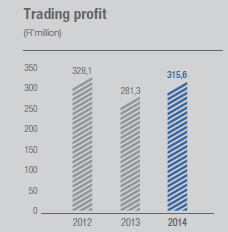
Trading profit rose 12,2% to R315,6 million (2013: R281,3 million) on the back of cost efficiencies and pleasing growth outside the traditional print sector |
|
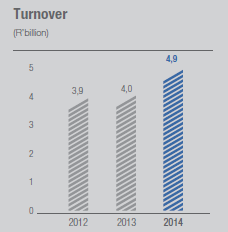
At R4,9 billion, turnover was up 21,1% (2013: R4,0 billion), a
function of strong marketing efforts by all teams |
|
The office products segment grew significantly, though
some growth was attributable to price inflation on imports |
|
National voter registration project in Mozambique contributed to
sizeable growth of the export business. |
|
Streamlining of stationery distribution was near completion
by year-end and drove an improved bottom-line
contribution |
|
Roll-out of the division’s integrated, computer-based
warehouse management system continued, with
resultant efficiencies |
|
Wide-ranging efficiency gains supported
successful positioning as a low-cost producer with a
quality profile |
|
The business successfully managed an accelerating industry shift out of paper-based postal material to
enhanced electronic solutions |
|
Bidvest Data rebounded strongly |
|
All those participating in the first Bidvest Paperplus academy
learnership programme were given full-time
positions |
|
Market feedback indicates that the Paperplus voter
registration solution has now become the standard
solution in Africa. Instead of simply supplying registration forms,
the division provides a complete, stand-alone unit complete
with solar panels to ensure efficient registration in areas without
mains power |
|
A major customer relations success was registered when
the division liaised closely with several major clients to help
them manage the transition from traditional postal
communication to digital and electronic platforms |
|
Copenhagen office entrenched its position as a solid
generator of export business, primarily small project work for
European customers |
|
Rand weakness and volatility in foreign currency markets was
well managed. |
2015 targets, objectives and factors
affecting future results
|
Macro-economic conditions in the coming year will have
significant influence on results. Business confidence hit new
lows in 2014. However, Bidvest Paperplus showed its resilience
by achieving solid growth. Management plans to maintain
momentum in 2015 |
|
Moderate topline growth and further growth in trading profit are
projected |
|
Stagnation or contraction of traditional print and the forms
business has become the norm. However, the overall impact
on the division will be cushioned by growth in other areas of the
business, notably digital and electronic formats |
|
Aggressive growth targets have been set for several silos |
|
The packaging business has been strengthened. Masterpack
has now been integrated into the division and will introduce
new product lines, including folded cardboard boxes for
the quick-service restaurant sector. A strengthened national
footprint will enable the packaging silo to further improve
service levels and pursue renewed growth |
|
In the stationery sector, Silveray Statmark Stationery is on track
to realise the full-year benefit of recent reorganisation |
|
The labels plant has been upgraded and the silo is well placed
to benefit from the investment |
|
Our full-colour digital printing business is market leader and will
seek growth opportunities in several areas, including high-volume
transpromo work |
|
The second half of 2014 saw growing take-up of Bidvest Data’s
product offering, indicating solid growth potential even in a
weak economy |
|
Further growth in export volumes into Africa will be aggressively
pursued |
|
Cost saving and waste reduction programmes will remain areas
of management focus |
|
All businesses will step up the work of transformation. The
success of our learnership programmes suggests meaningful
progress can be made on the development of black staff into
management positions |
|
Acquisition opportunities will not be neglected, with specific
focus on niche businesses offering smart, new technology
solutions |
|
The success of Kolok Mozambique shows the potential
for wider direct representation in Africa. Opportunities for
expansion into specific African markets will receive focused
attention. |
Material issues and performance
| MATERIAL ISSUE |
|
WHY IT IS IMPORTANT AND
STRATEGIC OBJECTIVES |
KPIs AND TARGETS |
PERFORMANCE AGAINST TARGETS AND
ACTIONS GOING FORWARD |
 |
| Performance

Maintain consistent
financial performance
|
|
Why:
 |
Profits sustain jobs and enable investment that
supports entry into growth sectors in an industry
that faces decline in traditional areas |
Objective:
|
To maintain profitability |
|
|
Cost containment |
|
Trading profit |
|
Performance:
|
Trading profit up 12,2% |
Actions:
|
Cost control, focus on accounts payable, streamlining
and efficiency improvements, plant relocation, distribution
efficiencies, improved accounting and administrative
processes |
|
| Declining business
sectors and growing
competitiveness |
|
|
Contraction of business forms and general print
work |
|
Print becoming a grudge purchase for many
businesses |
|
Increase of price-competitive imports |
Objective:
|
To maintain profitability |
|
|
|
Revenue increase of 21,1% |
|
Diversification and expansion of service offering, export
market growth, plant upgrades, integration of newly
acquired packaging business, growth of digital solutions |
|
|
| |
 |
|
 |
|
| People

Maintain rigorous safety
standards
|
|
Why:
|
A safe workplace is a productive workplace |
Objective:
|
Ensure all businesses demonstrate exceptional
levels of safety performance. |
|
KPIs:
|
Injury rate |
|
Lost-day rate |
| Performance:
|
The injury rate of 2,77 increased slightly |
|
The lost-day rate (per 200 000 hours worked) due to
injuries decreased from 20 to 17 |
|
Promote employee
health and satisfaction
Enhance talent
attraction and retention
|
|
Why:
|
People have a right to be healthy and happy.
Morale improves, staff retention rises, ensuring
continuity and higher productivity by cohesive
teams |
|
To improve talent attraction and retention |
Objective:
|
To use innovative approaches to improving the
health and wellbeing of all employees and createa positive work environment that enhances talent
attraction and retention |
|
KPIs:
|
Resignation rates |
|
Absentee rates |
|
Performance:
|
The resignation rate increased to 4,5 (2013: 1,7) |
|
Absentee rates decreased to 2,5% (2013: 3,1%) |
|
| Promote skills
development |
|
Why:
|
Skills enable innovation and business growth in a
highly competitive industry |
|
|
Training spend per
employee |
|
Performance:
|
Average annual training spend per employee decreased to
R3 868 (2013: R4 530) |
|
Average annual training hours per employee increased to
60 per person (2013: 31) |
|
| CSI |
|
Why:
|
Well-resourced communities with appropriate
infrastructure create an environment in which
business can grow |
|
Our status as a supplier of stationery and school
materials enables us to make a positive impact
by focusing CSI efforts on basic education and
disadvantaged schools |
|
KPIs:
|
CSI spend |
|
CSI spend as percentage
of trading profit |
| Performance:
|
CSI spend increased to R2,7 million |
|
CSI spend as percentage of trading profit 8,5% |
|
| |
| Planet

Reduce environmental
impacts |
|
Why:
|
Environmental issues, such as climate change,
pollution and water scarcity |
|
Good environmental practice is good business
practice and helps contain long-term costs |
Objective:
|
To reduce our impact, educating employees, and
working with suppliers and offering customer
solutions to help them reduce theirs |
|
KPIs:
|
Carbon emissions
(Scopes 1, 2 and 3) |
|
Water used |
|
Paper consumption |
|
Performance:
|
Total emissions increased marginally, main contributer to
carbon is Scope 2 |
|
Water usage decreased over three-year period and remain
constant over two-year period |
|
Paper/cardboard used: increased dramatically |
Actions:
|
Vehicle distribution route and planning optimisation |
|
Waste paper recycling initiatives and switch to electronic
communication |
|
|
| |
| Greenhouse gas emissions |
2012 |
2013 |
2014 |
| Total emissions (tonnes of CO2) |
39 295 |
36 969 |
37 596 |
| Scope 2, electricity usage (tonnes of CO2) |
34 836 |
31 228 |
31 625 |
| Electricity usage in (GJ) |
126 675,9 |
116 927,3 |
110 535,3 |
|
Innovation and new investment
|
New investment totalled R107 million (2013: R93 million) with the focus on new plant and technology |
|
The R32 million acquisition of Masterpack was finalised in July 2013. The packaging business has operations in Cape Town and
Johannesburg. The Cape Town presence has strategic importance as it strengthens the division’s packaging footprint in an important
metropolitan market |
|
The Masterpack brand is being supported as a vehicle for growth in the Cape Town packaging market, leveraging off Masterpack’s
established base in packaging for food, pharmaceuticals and nutritional products |
|
Constellation, the division’s online document capture, retrieval and archiving platform, was revamped to ensure data availability across
multiple data transmission formats. Reinvention also facilitates the inclusion of marketing messages when information is retrieved and
submitted to consumers – an offering that reinforces the division’s relationship with major retail chains |
|
Part of the paper napkin and paper bag producing plant in Isethebe, KwaZulu-Natal, was relocated to new premises at Pencil Park,
Johannesburg. Relocation delivers distribution efficiencies as the largest market for these products is in Gauteng |
|
The division built on the success of the first intake into the Bidvest Paperplus academy learnership programme by raising the entry
criteria. Initially, the focus was on matriculants. However, only university or college graduates were inducted into the class of 2014.
All places were filled |
|
Kolok Mozambique was launched in 2013 in collaboration with local partners. First-year results were in line with expectations |
|
Plant upgrades in the packaging business and label equipment upgrades in Spartan |
|
Development work continued on the Silveray Statmark Stationery self-covered school exercise book after a successful introduction
during the back-to-school season |
|
Consolidation of Lithotech Afric Mail (conventional mail) and Email Connection (the digital solutions provider) into Bidvest Data proved
successful, creating a platform for renewed growth into multiple-channel business communication. |
Disappointments and challenges
|
Falling demand in some market segments led to retrenchments in certain businesses. Regrettably, 72 jobs were lost in all |
|
Print emerged as a grudge purchase by businesses. Companies struggling to grow volumes in a stagnant domestic market are cutting
all costs. They reduce print quantities and delay order placement. Cuts to marketing budgets have also impacted the printing industry |
|
A small bolt-on acquisition was made to pursue niche opportunities in the labels market. Some gains were made but results fell short of
early projections |
|
The packaging industry remained ultra-competitive. Masterpack – acquired to drive further growth in this market – built momentum
towards year-end. However, integration into Paperplus took longer than anticipated and the new unit’s early results were below
expectation. |
Changes in operational environment
|
In the business-to-business environment, delaying and cutting expenses has become the new norm. The result is volatile workflow.
Volumes are erratic and demand fluctuates substantially |
|
Local supplies are no longer assured in some paper grades and product categories. Major South African corporates have
internationalised their operations and often focus on product lines for major overseas markets – lines that deliver the biggest volumes
and best margins. As a result, new suppliers have to be found. This frequently means bringing in low-cost imports from China. |
Risks and responses
|
Technology risk is growing. Management has to be constantly alert to new systems, applications and communication formats. The
product lifecycle is becoming shorter in the communication industry. This heightens the challenge of amortising technology investments
– which can be substantial in view of the rand’s sustained weakness |
|
People risk is constant and has traditionally been addressed by increases in the training investment. Industry contraction has sometimes
helped the business retain good staff. However, maintenance of team morale has emerged as an issue at businesses that are constantly
looking for efficiencies. Doing more with less has become standard practice, putting pressure on teams to deliver high quality when the
resources on call may be limited |
|
Foreign exchange risk is ever present. It is standard policy to take forward cover. However, exposure to forex risk is growing as the
division has to source more and more products from overseas as local supplies dry up. Bidvest Paperplus has become a bigger net
importer of stationery items, office consumables and certain grades of paper |
|
Planning risk has also come into sharp focus. Trading patterns can be erratic. New technology solutions are gaining ground. This means
historical data and previous experience with certain categories of customer are no longer a reliable yardstick when making projections.
The risk of over-stocking or under-stocking has grown. In response, management focuses on flexible responses by teams that are kept
deliberately lean. Closeness to customers is a priority |
|
The risk of material increases in unbudgeted expenses has also sharpened. The national power provider cannot maintain stable
electricity supplies as new capacity has yet to come on stream. In other cases, cable theft results in outages. As a result, investment is
necessary in standby generators and additional supplies of diesel, especially at operations that offer clients a 24/7 service. This adds to
the cost-base, a source of frustration when stringent cost management is necessary to ensure profitability. |
|


