Operational reviews – Bidvest Freight
Bidvest South Africa
Bidvest Freight |
 |
Anthony Dawe: Chief executive
Mark Steyn: Financial director |
|
| |
|
|
The leading private sector freight management group in
sub-Saharan Africa draws on more than 150 years of portside
experience.
Operations are underpinned by sustained investment in port
facilities and advanced systems to facilitate world-class solutions
in the storage, handling and movement of bulk materials, air
freight and ocean freight. A substantial customer base includes
importers and exporters of agricultural products, coal, manganese,
dry bulk, liquid bulk and commodities, gases, chemicals and
hazardous substances, fats, oils, steel and forestry products,
manufactured goods and motor vehicles. Bidvest Freight works
in partnership with major clients to ensure timely provision of
strategic storage and materials handling infrastructure. Services
include integrated logistics and supply chain solutions, transport,
warehousing, stevedoring, container and bulk handling, customs
clearing and forwarding and ships agency and insurance services.
Southern African solutions are complemented by access to a
global forwarding and clearing network. |
|
 |
| Left to right: Mark Steyn – Financial director (CFO) Bidvest Freight, Nosi Mbongwa
– Commercial director Bidvest Freight, Jannie Roux – Managing director BPO,
David Leisegang – Managing director IVS, Anthony Dawe – Chief executive
Bidvest Freight, Iain Geldart – Managing director Bulk Connections,
Craig Mountjoy – Managing director BPL, Luis Goncalves – Managing director
Naval, Hampie Lourens – Managing director SABT |
|
Highlights
 |
Trading profit tops R1,1 billion (2013: R979,4 million) |
|
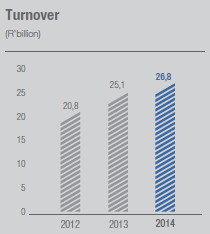
Turnover up 6,7% at R26,8 billion (2013: R25,1 billion) |
|
Stable business performance achieved in line with
expectations, despite volatile volumes in several
export and import categories |
|
Bulk Connection’s (BC) performance continues to impress,
confirming the strategic timing of upgrades and capacity
expansion in the prior period. The full-year effect of
BC’s upgrade took its annual terminal volumes to
4,5 million tonnes |
|
Bidfreight Port Operations (BPO) performed strongly, with
notable success by the stevedoring operations. Much improved
performance at the Durban warehousing business was driven
by higher steel, fertiliser and cement volumes |
|
IVS’s cost control, restructuring and continued management
focus helped drive pleasing year-on-year profit growth.
Durban’s revenue was under pressure due to capacity being
out of service as a result of an expansion project |
|
Solid performance at Bidvest Panalpina Logistics (BPL)
despite low ocean and air freight volumes. Dedicated solutions
secured replacement business for loss of large retail customers
minimising the impact. Good performance from transport and
warehouse division |
|
SACD revenue remained under pressure. Cape Town operations of SACD Freight posted positive results following a change
in strategy. Replacement volumes were secured after wine exports failed to reach anticipated levels, enabling better utilisation of
warehousing initially developed to serve the wine industry. SACD’s Johannesburg capacity was fully utilised and this business continues
to perform |
|
Despite a challenging operational environment, Naval had a good run on the back of strong magnetite volumes. Iron ore volumes were
maintained although export coal reduced |
|
B-BBEE progress was maintained. Our target was for all businesses to achieve a minimum of level 4 contributor status. This was
achieved |
|
Zero fatalities in activities that are often inherently hazardous – testimony to continued focus on safe working practice and investment in
modern systems |
|
A sustainability culture is taking root, embedding the quest for long-term efficiencies by teams that share common values |
|
BC won the annual International Bulk Journal customer care award. |
2015 targets, objectives and factors
affecting future results
|
Profitability growth target remains inflation plus 4% |
|
All businesses will address the challenge created by the
changes in the broad-based black economic empowerment
targets |
|
Transformation progress will be maintained, focusing the
number of black people at senior level |
|
Strategic investments in infrastructure will lead to increased
materials handling capacity |
|
Diversification and better asset utilisation are projected to drive
better returns |
|
We will continue to explore investment opportunities in east and
west Africa |
|
Upgraded handling equipment will modernise grain handling at
SABT’s Island View terminal. A new unloader and loader have
been commissioned and further landside expansion will be
done in the coming year |
|
Work to deepen Maydon Wharf Berths will soon begin – a
positive development in the long term, though short-term
disruption of our operations may occur, possibly impacting
some volumes. |
Material issues and performance
Sustainability processes are in place at all businesses. Decentralisation enables each business to drive its own process
and initiatives to identify and address material issues. Sustainability champions are nominated at each business.
Guidance is offered from the centre.
| MATERIAL ISSUE |
|
WHY IT IS IMPORTANT AND
STRATEGIC OBJECTIVES |
KPIs AND TARGETS |
PERFORMANCE AGAINST TARGETS AND
ACTIONS GOING FORWARD |
 |
| Performance

Maintain consistent
financial performance
|
|
Why:
 |
Provide funds to drive continued growth |
|
Support and grow jobs |
Objective:
|
To maintain profitability |
|
|
Cost containment |
|
Service level
improvement |
|
|
Trading profit up by 14%, topping our target of inflation
plus 4% |
Actions:
|
Upgrade facilities and systems |
|
Cost management and containment |
|
Restructuring of non-performing assets and operations |
|
Diversification |
|
|
| |
 |
|
 |
|
| People

Maintain rigorous safety
standards
|
|
Why:
|
Safe workers are productive workers |
|
Safe working conditions bolster morale |
Objective:
|
Ensure all businesses demonstrate exceptional
levels of safety performance |
|
KPIs:
|
Injury rate |
|
Lost-day rate |
|
Minor injuries |
|
|
The injury rate has decreased to 1,03 (2013: 1,81) |
|
The lost-day rate (per 200 000 hours worked) due to
injuries has increased to 17 (2013: 10) |
Actions:
|
Safety is a priority and comprehensive systems are
in place. All incidents are investigated and corrective
action taken |
|
Tool box talks are held daily and near-misses and minor
injuries are reported and investigated |
|
All businesses have senior personnel responsible
for safety |
|
Specific targets set at business level, with regular audits
of compliance |
|
| Promote and support a
healthy workforce and
employee satisfaction |
|
Why:
|
People have a right to be healthy and happy. This
contributes to a more productive and positive
work experience |
|
To improve talent attraction and retention |
|
KPIs:
|
Resignation rates |
|
Absentee rates |
|
Wellness programme
participation |
|
|
The resignation rate has decreased from 1,6% to 1,3% |
|
Absentee rates have remained the same at 0,8% |
|
Increase in wellness programme participation |
Actions:
|
Continuing investment in our people |
|
BC, BPO, IVS and SABT offer in-house clinics. Alternative
arrangements are made in businesses without the clinics.
Health awareness programmes and wellness days gaining
popularity |
|
BPL participates annually in the Deloitte Best Company to
Work for survey |
|
| Promote skills
development |
|
Why:
|
Appropriate skills are a key driver of business
performance |
Objective:
|
Empower our people through effective training
and mentoring, improving their earning capacity
and job satisfaction |
|
KPIs:
|
Training spend per
employee |
|
Training hours per
employee |
|
Learnerships as a % of
workforce |
|
|
Average annual training spend (excluding learnerships and
bursaries) per employee trained decreased to R2 756,00
in 2014 (2013: R3 856,00) |
|
Average annual training hours per employee decreased
from 152 to 83 hours |
|
Learnerships and learning programme-related initiatives
up 70% from prior year |
Actions:
|
Continuous investment in skills development, with
specific focus on bursaries, learnerships and graduate
programmes while building supervisory skills |
|
| Improve on diversity |
|
Why:
|
A diverse range of insights and life experience
contributes to solution finding |
|
Tapping the talents of all sections of the
population helps sustain long-term business
success |
Objective:
|
Increase diversity at senior levels |
|
|
B-BBEE rating |
|
Percentage senior
managers |
|
|
Our target is to achieve and maintain a level 4 contributor
status across all the businesses. This has been achieved |
|
% black people at executive management at 30,2%
(2013: 25,5%) |
|
% black people at senior management is 45,8%
(2013: 36,9%) |
Action:
|
Transformation driven at executive level |
|
| CSI |
|
Why:
|
Businesses can only succeed in the long term if
they operate in communities that have access to
resources and infrastructure. |
|
KPIs:
|
CSI spend |
|
CSI spend as percentage
of trading profit |
|
|
CSI up from R5,4 million to R6,6 million in 2014 |
|
CSI as percentage of trading profit up from 0,5% to 0,6%
in 2014 |
Action:
|
Overarching strategy with main focus on educationrelated
initiatives – sports coaching at school, providing
bursaries, rental of mobile classrooms, tutoring and
support programmes for needy schools |
|
Aligning bursary initiatives with the strategic objective of
increasing the skills pool and youth development |
|
Additional support offered to staff to better their lives via
healthcare facilities and transport |
|
Support of welfare organisations aligned to our strategic
objectives |
|
|
| |
 |
|
| Planet

Reduce environmental
impacts |
|
Why:
|
We have a duty to improve the general and
working environment |
|
Lower resource utilisation adds to efficiency and
contains costs |
|
Extreme weather conditions may have an impact
on shipping and port operations |
|
Fuels usage |
|
Water scarcity |
|
Pollution |
|
Handle highly toxic chemicals in sensitive location |
Objective:
|
To reduce our impact, educating employees, and
working with suppliers and offering customer
solutions to help them reduce theirs |
|
Ensuring compliance to environmental regulations
and standards |
|
KPIs:
|
Carbon emissions
(Scopes 1, 2 and 3) |
|
Water used |
|
Internal non-conformance |
|
Number of contravention
notices and fines |
|
Performance:
|
Total emissions decreased |
|
Water usage decreased by 12% (from 534 to 465 mega
litres in 2013) |
Actions:
|
BPL implemented systems to monitor and improve driving
patterns and tyre management to save fuel |
|
BC uses run-off water for on-site dust suppression |
|
|
| |
| Greenhouse gas emissions |
2012 |
2013 |
2014 |
|
| Emissions (tonnes of CO2) |
75 880 |
78 031 |
73 605 |
| Tons of CO2 per FTE |
15,8 |
16,3 |
16,2 |
|
| Fuel usage |
2012 |
2013 |
2014 |
|
| Petrol usage (Mℓ) |
0,69 |
0,65 |
0,4 |
| Diesel usage (Mℓ) |
7,75 |
8,05 |
9,3 |
|
Stakeholder engagement
Our stakeholders are engaged formally and informally which ranges from daily interactions to annual interactions as
dictated by the relationship. All issues under discussion are actioned and escalated appropriately.
| STAKEHOLDERS |
|
OBJECTIVE AND ENGAGEMENT
METHOD (AND FREQUENCY) |
KEY ISSUES IDENTIFIED |
KEY ACTIONS TAKEN AND PLANNED
(more detail may be provided in material
issues tables and elsewhere) |
|
| People
Employees (full-time and
contract)
|
|
Objective:
|
Improve employee relationship and
satisfaction |
Methods:
|
Employee surveys (ad hoc) |
|
Anonymous feedback forms (ongoing) |
|
Exit interviews |
|
Newsletters |
|
Intranet and social media interaction |
|
Key issues:
|
Remuneration and benefits, being
informed about company strategy,
employee skills development, employee
wellness, employment equity and specific
employer/employee relationship issues |
Issues considered material:
|
Employee wellness, skills development
and employment equity |
|
|
Ongoing interaction between management,
shop stewards and unions |
|
Employment equity and skills development
committees are in place and meet on a
regular basis to discuss training needs and
employment equity progress against goals
and targets |
|
Newsletters, interactive notice boards and
briefs |
|
Management has an open-door policy |
|
Performance appraisals and individual
development plans in most of the businesses |
|
| Unions |
|
Objective:
|
Maintain good union relationships |
Methods:
|
Quarterly meetings |
|
Annual wage negotiations |
|
As and when required |
|
Key issues:
|
Remuneration and benefits,
company strategy, employee skills
development, employee wellness and
employment equity |
|
Changes in union membership |
|
Multiple unions |
|
|
Ongoing interaction between management,
shop stewards and unions |
|
Employment equity and skills development
committees are in place and union
representatives forms part of the committees |
|
Address issues not related to wage
negotiations prior to the negotiations to speed
up process |
|
Communities
 |
Local communities |
|
NGOs |
|
Schools |
|
|
Objective:
|
Better understand and collaborate with
the communities in which we operate |
|
Youth development |
|
Key issues:
|
Local economic development and
employment opportunities, education
(schools), skills development, health and
environment |
Material issues:
|
Socio-economic development and
community involvement |
|
|
Engagement with communities, non-profit
organisations and qualifying beneficiaries
aligned with the division’s strategic objectives |
|
Continued support of nominated non-profit
organisations and qualifying beneficiaries |
|
Industry-specific forums
stakeholders |
|
Objective:
|
Understand issues, needs and
expectations |
|
Industry awareness |
Methods:
|
Participation in industry associations as
required by the business |
|
|
|
Participation in industry associations
as dictated by the business need and
requirement |
|
|
| Product

Transnet |
|
Objective:
|
Maintain good relations |
Methods:
|
Formal and informal engagements at
all levels |
|
Key issues:
|
Transnet is a competitor, customer,
supplier and landlord. Issues therefore
span a broad range |
|
Transformation |
|
Port efficiencies |
|
Road to rail and congestion in the port
precincts |
|
Capacity expansions and business growth |
|
|
Regular meetings held at all levels |
|
Ongoing engagement with transnet freight rail
on road-to-rail issues |
|
Quarterly interactions on performance against
Terminal Operator Performance Standards
with Transnet National Ports Authority |
|
Engagement on capacity expansion
opportunities |
|
| Suppliers |
|
Objective:
|
Maintain good relations |
|
Understand issues and resolve these
together |
Methods:
|
Service levels |
|
Key issues:
|
Service levels |
|
Pricing |
|
|
Engagements as and when required in line
with service level agreements. |
|
| Customers |
|
Objective:
|
Understand evolving needs, expectations
and issues |
|
Maintain service levels |
Methods:
|
As dictated by the service levels |
|
Annual customer interactions for key
customers |
|
Key issues:
|
Service levels |
|
Pricing |
|
Achieving efficiencies and high
productivity levels to drive cost |
|
|
Engagements as and when required in line
with service level agreements |
|
Annual customer interactions for key
customers |
|
Innovation and new investment
|
New investment of R326,0 million, maintaining the business’s track record for sustained investment in logistics infrastructure |
|
Successful completion of IVS’s Quarry 1 project brought on stream an additional 20,000m3 in Durban storage capacity for non-hazardous
and hazardous products. The new tanks at Quarry 1 came into use in June 2014 |
|
Capacity and environmental upgrade at SABT’s Island View terminal (Durban Bulk Shipping) is nearing completion with both the ship
loader and unloader being installed. The landside upgrade will be completed in 2015 |
|
The change from break-bulk to containers resulted in diversification and conversion of warehouses into bulk operations |
|
Increased volumes handled through Bulk Connections necessitate additional investment to increase the terminal capacity to
6 million tonnes |
|
BPL’s ongoing investment in technology to secure competitive advantage |
|
BPL continued its investment to increase the fleet of trucks as dictated by business needs |
|
Investment in stevedoring equipment and transport vehicles mainly for the BPO Saldanha operation. |
Disappointments and challenges
|
Ongoing growth in commodity cargoes creates the strategic long-term concern that bottlenecks may occur as a result of portside
capacity constraints |
|
Continuing growth in road rather than rail volumes. Rail remains the preferred high-volume, high-efficiency solution, but access to
significantly increased rail capacity is problematic. Ways of resolving the issue are continually explored with the relevant authorities.
Recent improvements in the rail delivery of agricultural products and the planned investment in additional infrastructure by the relevant
authorities indicate progress is being made |
|
Performance at South African Bulk Terminals (SABT) was under pressure due to lower-than-forecast maize volumes. Imports of wheat
for local consumption increased. Soya bean meal volumes continued to decline due to increased local crushing capacity, while fluorspar
volumes were flat. Rice volumes and sunflower seeds made up for some of the lost SABT cargo |
|
Revenue in SACDs Durban operations came under pressure due to low import volumes |
|
At IVS, out-of-service tank capacity put pressure on Durban performance while Richards Bay was impacted by low chemical volumes |
|
Reduced demand for sized coal due to an overflow from the Turkish market resulted in nearly no volumes for export in the second half of the year. Bulk Connections and Naval experienced a significant drop in volumes in this export category |
|
Reduced import container volumes, compared to previous years, impacted SACD and BPL’s ocean freight operations. Loss of major
accounts impacted dedicated solutions at BPL and performance was flat |
|
The Zimbabwe economy remained depressed and the Zambian kwacha was devalued, compounding the trading difficulties faced by
Manica. The business recorded disappointing results. Urgent and focused management attention is being applied to address these
challenges. Manica Malawi had a pleasing result. South Africa had a satisfactory run |
|
Margin management became a key challenge across all businesses. In a tough economy, all customers resisted price increases.
Meanwhile, fuel, utility and labour costs rose steadily |
|
Management of carbon emissions and fuel usage is an ongoing challenge. Our increase in fuel consumption was a function of increased
volumes (indicated by emissions per million rand of revenue). Carbon emissions increased as a result of higher diesel consumption and
electricity usage. Little progress was made with the strategic road-to-rail objective, though this is a national challenge rather than an
issue particular to our business. |
Changes in operational environment
|
The National Ports Authority is enforcing Terminal Operator Performance Standards as part of its licensing process. The process will
foster efficiencies and productivity, but adds to compliance costs. A well-resourced company with a strong compliance function like
Bidvest Freight is positioned to draw long-term benefit, but in the short term non-compliant operators can avoid additional costs and
pursue pricing advantages |
|
The introduction to a 24-hour shift system led to efficiency gains at IVS. Several other operational businesses have already implemented
24-hour shift systems, enabling operations to achieve higher volumes and maintain profitability. This development is timely in an
environment that is increasingly subject to sudden and material fluctuations in volumes. |
Risks and responses
|
Robust risk management processes remain in place. The divisional risk committee (also with responsibility for sustainability and
transformation) meets every quarter, chaired by the divisional chief executive |
|
Legal compliance in a highly regulated operational environment – a number of lawyers are employed within the division and call on
additional legal resources as required |
|
Long-term sustainability risk in an environment characterised by long planning horizons and sizeable investments requiring solid returns
over a prolonged period – addressed by building sustainability processes into every business. These processes are becoming a source
of competitive advantage. Decentralisation enables each business to drive its own process and address material issues. Quarterly
sustainability reports make use of the Group’s central reporting tool |
|
Reputational risk linked to hazardous working conditions is addressed by making worker safety a business imperative. All incidents are
investigated and corrective action taken. SHERQ committees and managers meet regularly |
|
As a large employer, the business is exposed to industrial relations risks. Robust channels of communication are maintained with all
unions and worker representatives. Days lost due to strikes are generally low |
|
Health issues can create performance risk as ill health can affect on-the-job efficiency while increasing the level of absenteeism and the
number of days lost to sickness. In-house clinics are operated at SABT, BPO, IVS and BC. Employee assistance programmes focus on
health awareness, HIV/Aids education and voluntary counselling and testing |
|
People risk is a focus area. Skilled, well-trained and well-motivated people are needed to maintain efficiency and high levels of capacity
utilisation. Investment in skills development is continuous, complemented by strong focus on bursaries, learnerships and graduate
programmes. The number of black people participating in learnerships and learning programmes rose from 230 to 370, with 58%
representation by black women |
|
Skills development, specifically supervisory skills, is a focus area. Achievement of employment equity targets and goals is a priority. The
Bidvest Panalpina Logistics Academy received accreditation in 2013 and now conducts its own learnership training |
|
Reduction of environmental risks remains a key focus. All IVS operations and BPO’s Saldanha operation have ISO 14001 accreditation.
No major environmental incidents were reported in the current year |
|
Talent attraction, development and retention is a risk area. In view of more rigorous B-BBEE requirements (to be implemented in the
coming year), the attraction and development of black talent is an area of focus. Ongoing transformation initiatives are on track to
increase black representation in senior and middle management. ED initiatives are aligned to strategic objectives. |
Risks and responses
|
Our B-BBEE ratings are: |
| |
| |
Company |
Rating |
| |
Bidfreight Port Operations |
Level 3 |
| |
Bidvest Panalpina Logistics |
Level 3 |
| |
Bulk Connections |
Level 2 |
| |
Ensimbini Terminals |
Level 2 |
| |
Island View Storage |
Level 3 |
| |
Manica Africa |
Level 4 |
| |
P&I Associates |
Level 4 |
| |
Rennie Murray |
Level 3 |
| |
Rennies Ships Agency |
Level 3 |
| |
SACD Freight |
Level 2 |
| |
South African Container Stevedores |
Level 1 |
| |
South African Bulk Terminals |
Level 2 |
|
|


