Operational review – Bidvest Industrial review
Bidvest South Africa
Bidvest Industrial |
 |
|
Howard Greenstein: Chief executive
Craig Turnbull: Financial director |
| |
|
|
|
 |
| Left to right: Cliff Rostowsky – Managing director Bidvest Afcom, Howard
Greenstein – Chief executive Bidvest Industrial, Pieter Fourie – Managing director
Bidvest Materials Handling, Craig Smith – Managing director Academy Brushware,
Margaret Crawford – Managing director Vulcan Catering, Craig Turnbull –
Financial director Bidvest Industrial, Mike Hardy-Brown – Managing director
Yamaha, Shanilla Chuturgoon – Commercial manager Bidvest Industrial, Wayne
Pollak – Managing director Bidvest Buffalo Tapes |
Bidvest Industrial comprises manufacturing and trading businesses
and is the South African representative of strong global brands
such as Yamaha, Nissan forklifts, ITW Signode, Rational ovens and
Tesa Tapes.
Domestic sales are supported by exports to selected markets.
Activities include the manufacture of packaging products, fasteners
and closures, self-adhesive tape, catering equipment and the
manufacture and distribution of brushware. The division is also
engaged in the distribution of machinery and accessories to the
clothing industry. The business is the sole South African importer
and distributor of the full Yamaha range of products and spares.
Rapidly expanding materials handling operations focused on the
Nissan brand are supported by an extensive dealership network.
Highlights
 |
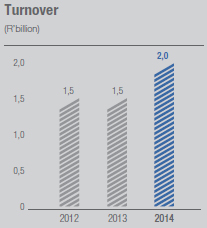
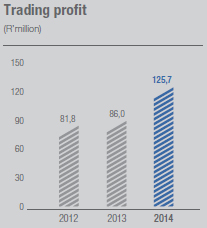
Turnover, boosted by acquisitive growth, rose 30,8%
to R2,0 billion (2013: R1,5 billion) while trading profit moved
46,1% higher to R125,7 million (2013: R86,0 million) |
|
Successful integration into the division of newly acquired
Academy Brushware |
|
The brushware business performed at pleasing levels, ensuring
significant growth in line with expectations |
|
Strong performance by Yamaha, Vulcan,
Afcom and Bidvest Materials Handling in a challenging trading
environment |
|
Solid market share gains in several sectors |
|
Good expense management across all
businesses |
|
Return on funds employed rose to 19,2% (2013: 13,3%) |
|
Strong focus on debtors’ management proved beneficial
in an environment in which several business casualties
occurred |
|
Jobs growth was achieved, principally the result of acquisition |
|
B-BBEE ratings remained stable |
|
Strong cash generation was maintained, but working
capital moved out slightly. |
2015 targets, objectives and factors
affecting future results
|
Economic activity is expected to remain sluggish and pressure
will remain on the industrial and manufacturing sectors |
|
Revenue and profit growth will be pursued as we continue to
seek market share gains |
|
Debtors’ management and expense control will remain focus
areas |
|
Further expansion of the materials handling network is planned |
|
Implementation of the Yamaha IT system will enable greater
efficiency, smart utilisation of market data and further customer
service improvements |
|
The full-year effect of new investment in the Babelegi factory
will support continued growth by the Academy Brushware
business |
|
The new management team will drive performance
improvements at Berzacks |
|
Further opportunities for acquisitive growth will be explored |
|
African growth opportunities will receive focused attention |
|
Further jobs growth will be pursued. |
Material issues and performance
Innovation and new investment
|
Capital expenditure rose 38,0% to R29,8 million (2013: R21,0 million) as the business invested in sustained growth and operational
efficiency |
|
Successful entry into the brushware sector following the acquisition of Academy Brushware (effective July 1 2013) – a manufacturer
and distributor of brooms, mops, paint brushes and related products |
|
Significant investment in new plant and revamped systems at the Babelegi factory of Academy Brushware |
|
Afcom installed a new state-of-the-art strapping line late in the first half |
|
Training investment rose, with the upskilling of Academy Brushware personnel a point of focus |
|
Development work on a new Yamaha IT system was largely complete by year-end |
|
Vulcan’s launch of a new bakery range for domestic and export markets was well received |
|
Continued investment in the growth of the materials handling business |
|
The Yamaha dealership base was rationalised and augmented, contributing to pleasing gains in market share. Improvements were
particularly evident in the motorcycle and marine market segments. |
Disappointments and challenges
|
Continued pressure on consumers and the manufacturing sector created challenges for all teams |
|
Pressure was acute in the clothing and associated industries, contributing to disappointing results by Berzacks. Significant changes to
management were implemented |
|
Margin pressure continued as cost-sensitive customers resisted price increases necessitated by higher labour, utility and fuel costs and
significant rises in the cost of imported products and inputs |
|
Continued rand weakness and occasional bouts of currency market volatility complicated the task of inventory management and
procurement. |
Changes in the operational environment
|
Difficult trading conditions in several industries resulted in the failure of some businesses, including some customers and suppliers.
Debtors’ management and prompt collections became focus areas |
|
Our strategy of added-value selling continued to deliver good results in an environment in which customers demanded optimum service.
Business retention was pleasing in a trading climate in which customer loyalty cannot be assumed |
|
Tough decisions had to be taken when certain contracts and accounts became uneconomic. In some cases we walked away from
unprofitable business. |
Risks and responses
|
Risk of business failure by a customer – even a substantial one – sharpened as the economy remained sluggish. We remain vigilant for
danger signs and stepped up our debtors’ management process. Back-office staff performed well in this challenging environment |
|
Currency volatility remains a risk area as many products and inputs are imported. Our businesses have successfully managed these
risks for many years. Continued vigilance is necessary to avoid loss and protect margins |
|
Loss of a brand principal is acknowledged as a possible risk, though relationships are well entrenched. We stay close to all brand
principals. Our businesses are often industry leaders with a strong national footprint. This enables us to support all our brands and
achieve a strong presence in the marketplace. Market share gains were achieved by many of our brands, despite tough trading
conditions |
|
Competitive risk is ever present. Barriers to entry are relatively low in some sectors. Attack by new competitors can occur. In response,
we ensure all our products are price competitive. Customer relationships are strong, underpinned by our customer-centric approach to
every market in which we operate |
|
Depressed industry conditions for prolonged periods create pressure on margins and volumes, especially when consumer spending is
also constrained. Diversified product and service offerings enable the division to seek opportunities in various areas. The acquisition of
Academy Brushware has further diversified our range of services. |
|