Operational reviews – Bidvest Food SA
Bidvest Foodservice
Bidvest Food SA |
 |
|
Klaas Havenga: Chief executive
Ryan Licht: Financial director |
|
| |
|
|
| Bidvest Food Division Southern Africa is a distributor of
food products and ingredients. It serves customers across
the total food value chain and comprises Bidvest Bakery
Solutions, Bidvest Food Ingredients, Bidvest Foodservice
South Africa, Patley’s and Bidvest Food Exports. |
|
 |
|
 |
| Klaas Havenga – Chief executive |
|
Ryan Licht – Financial director |
|
 |
Overall sales were in line with expectation and some gains in
market share were achieved |
|
Trading profit showed a pleasing increase in extremely
difficult trading conditions |
|
Bidvest Foodservice SA and Bidvest Food Ingredients made
significant contributions |
|
Roll-out of the multi-temp strategy at Foodservice
continued and contributed to ongoing efficiencies and savings |
|
Exports showed good growth and expansion into Africa
gained traction |
|
All businesses made progress with transformation,
with focus on employment equity and procurement |
|
Good progress was made with implementation of
succession planning and people development |
|
Arrangements to secure future yeast supplies – finalised in the
prior period – proved their worth |
|
Bidvest Food Ingredients further diversified its product
offering, widening its dairy range |
|
Working capital was well utilised and targeted improvements in
service levels were achieved |
|
Though the quest for efficiencies and savings was rigorous, the
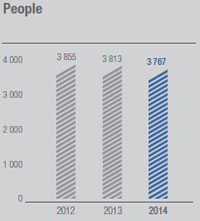
division’s overall head-count remained stable. |
2015 targets, objectives and factors
affecting future results |
|
Trading conditions are expected to remain challenging. |
|
Real revenue and trading profit growth are projected despite
pressure on the consumer’s disposable income. Investment in
IT and management information systems have enhanced our
ability to service the customer better. At the same time, the
roll-out of the multi-temp strategy has reached critical mass.
This will enable distribution and operational efficiencies and
provide a platform for continued growth. The full-year benefit of
recent facility upgrades also creates the potential for improved
performance and increased efficiencies. |
|
African growth will accelerate. In addition to the Zambian
business, new branches are scheduled to open in Mauritius
and Malawi – stepping stones to a much broader footprint
across sub-Saharan Africa. |
|
Strong focus on transformation will be maintained. |
|
Patley’s will look to further expand its brand bouquet. |
|
Opportunities for acquisitive growth will be further explored. |
Innovation and new investment |
|
New investment continued R114,5 million (2013: R121,0 million) |
|
Investment in information management and IT systems was maintained, specifically in the BFS 247 business-to-business online trading
platform. Customer take-up of the online ordering system showed continued growth, contributing to savings and efficiencies while
reinforcing customer relationships |
|
New multi-temperature sites at Polokwane and Bloemfontein went into operation, ensuring that ambient, chilled and frozen products
can be delivered efficiently to more customers, who benefit from optimal routing and distribution |
|
Investment also focused on factory upgrades at Bidvest Food Ingredients in Cape Town and Bidvest Bakery Solutions in Edenvale |
|
Bidvest Food Exports opened its first operation in Zambia, in collaboration with local partners |
|
New multinational brands joined Patley’s brand basket |
|
Changes to our procurement model resulted in more direct sourcing from suppliers and delivered cost efficiencies. |
Disappointments and challenges |
|
The sluggish economy and pressure on the disposable income of sometimes heavily indebted consumers had material effect on growth
potential and the product mix. Eating out has become an occasional treat. Many categories of consumer are down-trading. This
impacts the appeal of some imported brands and contributes to ongoing pressure on margins. The challenge is to achieve operational
efficiencies to reduce costs while developing affordable eating solutions |
|
Bureaucratic delays and slow approvals at municipal and regional level create a continuing challenge as planned efficiencies are often
contingent on the speedy roll-out of new or expanded facilities |
|
Expected efficiencies flowing from the Bidvest Food Ingredients factory upgrade were initially slow to be realised. |
Changes in the operational environment |
|
Major retail chains continue to develop their private label offerings |
|
Consumer down-trading and intense competitive activity ensure constant pressure on margins |
|
Food safety compliance along the supply chain has become a key issue for regulators. All management teams focus on close
collaboration with suppliers. Foodservice has made significant progress, with its suppliers to comply with food safety standards |
|
Greater customer and consumer awareness of health and nutrition issues has made it vital to constantly develop healthy eating options.
Product development work and testing by the division’s food technologists and close collaboration with international partners have
become a source of competitive advantage |
|
Sizeable increases in fuel prices and the introduction of Gauteng e-tolling made it imperative to achieve optimum distribution efficiency
– emphasising the importance of the multi-temp strategy undertaken by Bidvest Foodservice South Africa. The strategy is now entering
its final phase. |
|
Currency risk is a recurring feature of the business, primarily affecting Patley’s (a distributor for leading imported brands) and the
ingredients business as many inputs are imported. The businesses have managed the risk for many years. Though the price of imports
may rise, the increase affects all members of the industry at the same time. This means competitive advantage is not lost, though
consumer buying behaviour may change. The breadth of the division’s range ensures that affordable alternatives can be supplied |
|
All crops are subject to the risk of failure, disease and loss due to weather conditions. This affects prices and supplies. Again, all sectors
of the food business are impacted equally so no member of the industry derives advantage at the expense of others. The division’s
international supply network is broad, ensuring alternative foods and ingredients can be sourced as required |
|
Changes to government policy tend to create opportunities for competitive advantage rather than risks. New protocols or regulations
are notified well in advance, enabling well-resourced businesses to implement changes in product engineering in good time.
Government’s intention to reduce the permitted level of brine injected into poultry products was communicated to the food industry
in good time, enabling the division to develop alternatives. Government also plans to lower the permissible level of sodium in certain
products. The business has in-house capacity to re-engineer affected products well ahead of the introduction of new regulations |
|
Depressed economic conditions for a prolonged period create a material risk as many consumers then move to lower priced foods, cut
down on out-of-home eating and reduce holiday travel (impacting hospitality industry volumes) and take a lunchbox to work (affecting
industrial catering volumes). The breadth of the division’s range and scope of the customer-base ensure that volumes are maintained,
though margins may be squeezed |
|
Changes to anti-dumping and safeguarding duties in the fourth quarter have been challenging. |
Material issues and performance
| Product

Minimise product
impact and ensure food
safety |
|
Why:
 |
Foods have a high environmental and health
impact. It is important to ensure food products are
responsibly and safely sourced, manufactured and
distributed |
|
KPIs:
|
Customer complaints |
|
|
Constant investment in new technology and systems to
ensure products are safe, nutritional and comply with
health regulations |
|
Collaboration with international partners and brand
principals to stay abreast of the latest developments in
food safety, packaging and nutrition. |
|
 |
|
|
|
|
| Planet

Reduce environmental
impacts |
|
Why:
|
Good environmental practice is good business
practice and is a core component of our quest for
efficiency and savings |
|
Pollution and wasteful practices potentially
threaten food supplies. As a food business we
have to set a good example |
Objective:
|
To reduce our impact, educate employees,
and work with suppliers and offer solutions to
customer to help them reduce their impacts. |
|
KPIs:
|
Carbon emissions (Scope
1, 2 and 3) |
|
Performance:
|
Total water usage 0,15 Mℓ |
|
|
|
|
|
| |
| Greenhouse gas emissions |
|
2012 |
2013 |
2014 |
|
|
|
|
|
| Electricity usage (Scope 2) GJ |
Electricity usage (GJ) |
134 117 |
106 632 |
111 435 |
| Fuel usage (Scope 1) (Mℓ) |
Diesel and petrol usage (Mℓ) |
4,7 |
5,5 |
7,6 |
| |
2012 |
2013 |
2014 |
|
|
|
|
| Total CO2 |
60 401 |
52 772 |
57 030 |
|
|