Operational reviews – Bidvest Financial Services review
Bidvest South Africa
Bidvest Financial Services |
 |
Japie van Niekerk: Chief executive
Thinus Liebenberg: Financial director |
| |
|
|
 |
| Back row (left to right): Duncan Nkosi – Head: human resources, Jodi Raviv –
Head: marketing, Brett Jury – Head: transactional banking, Di Crawley – Company
secretary, Thinus Liebenberg – Financial director
Front row (left to right): Byron Corcoran – Head: leasing and lending, Neil
Capazorio – Head: customer solutions, Japie Van Niekerk – Managing director,
Russell Fogg – Head: IT |
The division, comprising Bidvest Bank, Bidvest Insurance,
Master Currency, Botswana and Namibia Forex operations,
offers a comprehensive range of financial products and
insurance services.
Bidvest Bank, holder of a full banking licence since 2000, is
South Africa’s leading foreign exchange specialist, serving
retail and corporate customers via 100 branches nationwide.
Foreign exchange and global payment expertise is
complemented by deposit-taking, loans and fleet and asset
finance. The bank provides the country’s widest range of
foreign bank notes and the biggest selection of prepaid foreign
currency cards. The bank is South Africa’s third-largest vehicle-leasing
business.
Bidvest Insurance is aligned with leading underwriters and
provides a wide range of insurance covers, supported by
customer-friendly aggregation services. It offers a variety of
warranty, life, vehicle and value-added insurance products.
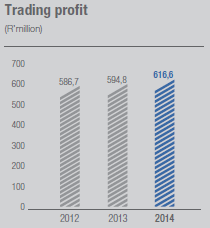
In a highly competitive market, Financial Services put in
a satisfactory performance, achieving trading profit of
R616,7 million (2013: R594,8 million). Revenue was up
14,1% at R1,7 billion (2013: R1,5 billion). The division
remains strongly capitalised and highly cash generative.
BANKING
Highlights
 |
Profit before tax down by 4,5% to R346,5 million (2013: R362,9 million), as contract with a major leasing client comes to an end |
|
Operating income moved 0,2% higher to R862,6 million
(2013: R860,8 million) |
|
Continued growth was achieved in transactional banking
and treasury volumes |
|
Solid cash generation saw cash and cash equivalents rise 6,7% to R2,1 billion |
|
At R2,1 billion, deposits were up 0,8% |
|
Credit quality remained good, with low impairment
provisions |
|
Increased brand and product awareness was achieved |
|
New and enhanced products were launched |
|
Moody’s reaffirmed the bank’s rating as A3.za/P-2.za
with a stable outlook |
|
The customer base continued to grow |
|
Strong progress was evident with the evolving
strategy of securing new partners as a means of accelerating
the bank’s penetration of new niche markets. |
2015 targets, objectives and factors affecting future results
|
Securing replacement business after the loss of a major FML client remains a strategic priority |
|
The task of bulking up the business and widening our previously
narrow franchise will be energetically addressed. This may
require the acquisition of a bank that offers complementary
services in the investment banking and private banking fields.
In a significant post-balance sheet event, Bidvest signed a
memorandum of understanding intended to clear the way
for the acquisition of Grindrod Bank and Grindrod Financial
Services |
|
Further diversification of income streams will be pursued. Efforts
will be made to increase our transactional banking business.
Significant growth in trade finance volumes has been targeted
as the bank enjoys the full-year effect of the recent joint venture
with the Lausanne-based Tower Trade Group |
|
Early in the new period, Bidvest Bank was selected as the
banking platform for Vodacom’s Mpesa mobile banking
service – a key element in our evolving strategy of forming
strong partnerships with leaders, local and international. The
partnership will contribute to strategic efforts to diversify the
Bidvest Bank franchise in 2015 and going forward |
|
Acquisition opportunities will continue to be explored while the
process of identifying and securing additional partners will gain
further traction |
|
Efficiencies will continue to be sought as the competitive environment will remain challenging. However, staff numbers will increase, particularly in the sales sphere, as growth in all our niche markets is pursued. Product innovation will be stepped up |
|
Back-office processes will be reviewed to ensure continued
service efficiency |
|
Launching of a new business banking offering to our business
and corporate clients including a transactional account as well
as acquiring functionalities |
|
A review of retail strategy will be undertaken to ensure Bidvest
Bank has a high-profile presence in the appropriate locations |
|
Double-digit revenue growth is projected. |
Material issues and performance
| People

Enhance talent
attraction and retention
 |
|
Why:
 |
It is important to demonstrate our
commitment as good corporate
citizenship credentials are essential in
an industry where ethical standards
must be unimpeachable. Good corporate
citizens attract good customers and good
employees. Reputation is a source of
competitive advantage |
Objective:
|
To keep pace with new regulations |
|
Compliance monitoring and
implementation to ensure banking
businesses do not contravene regulations |
|
KPIs:
|
JSE SRI performance standards |
|
CDP performance standards |
|
Governance standards (King III) |
|
Actions:
|
Compliance, risk and forensics teams have been strengthened |
|
Investment in the compliance function was stepped up |
|
Promote employee health and satisfaction
Enhance talent
attraction and retention
|
|
Why:
|
People have a right to be healthy and
happy. A healthy workplace is a productive
workplace |
|
To improve talent attraction and retention |
Objective:
|
To use innovative approaches to improving the health and wellbeing of all employees |
|
KPIs:
|
Resignation rates |
|
Absentee rates |
|
Performance:
|
The resignation rate has improved from 17,9% in 2013 to 15,0% in 2014 |
|
Absentee rates, after a low of 0,9% in 2012, have increased
slightly to 1,5% in 2013, and 1,6% in 2014. Our targeted market
benchmark for absenteeism of 1,5%, which is lower than the
group average of 2,0% |
Actions:
|
Remuneration of employees is based on regular performance
reviews and is informed by industry guidelines and prevailing
market conditions, rewarding and retaining superior quality
employees, and motivating them to equip the division to achieve
sustained growth. Focus has also been placed on exit interviews
in order to identify clearly stipulated reasons for resignations. The
division is committed to employee development and retention |
|
The Bank provides a 24-hour confidential support service
through ICAS (Independent Counselling and Advisory Services
Organisation) to employees and their immediate families to assist
them to deal with personal problems impacting on their personal
and work lives. In addition, the Bank subscribes to online health
and wellness programmes for employees and their families |
|
During the year, wellness days were held nationally, at which
various health assessments were conducted. Employee response
was good in all regions. Altogether 252 employees completed
VCT testing during the year, comprising 25% of the staff
complement, and of those tested, four employees tested positive
for HIV, some of which were newly diagnosed. Affected employees
are eligible for assistance from the Bank’s employee support
programme, ICAS |
|
Promote skills development |
|
Why:
|
Skills enable service excellence and innovation – key drivers of sustained growth |
|
Personal development opportunities assist in talent retention |
|
KPIs:
|
Training spend per employee |
|
Training hours per employee |
|
Performance:
|
Average annual training spend per employee decreased from
R17 491 in 2013 to R13 464 in 2014, with a focus on improved
in-house and on-the-job training to staff, and less external
training |
|
Average annual training hours per employee increased
considerably from 55 hours in 2013 to 85 hours in 2014, with all
staff being trained during the year, demonstrating the increased
investment in time spent upskilling staff |
|
CSI |
|
Why:
|
This is important at national and regional level |
|
Sustained growth can only be achieved in well-resourced communities |
|
KPIs:
|
CSI spend |
|
CSI spend as percentage of net profit after tax |
Targets:
|
1% of net profit after tax |
|
Performance:
|
CSI spend decreased slightly from R4,8 million in 2013 to
R4,4 million in 2014 |
|
CSI spend as percentage of net profit after tax remained constant
at 1,8% |
|
Notwithstanding the above decrease in rand value of spend,
our contributions continue to exceed our annual targeted 1%
of net profit after tax, and the business continues to focus on
its sustainable involvement and interaction with disadvantaged
communities |
Our focus areas are as follows:
Education
|
By assisting in the education of disadvantaged communities we
believe we can contribute to the development of our future clients
and employees. |
Conservation
By investing in the preservation of our environment and wildlife, we
can help to establish South Africa as superior and global eco-tourism
destination. Growth in the tourism industry will play a major role in
reducing unemployment and stimulating economic recovery.
Crime prevention
Our country suffers from alarming rates of crime, which impact
negatively on efforts to attract foreign investment. This inability to
attract foreign investment interferes with the country’s need to curb
the exceedingly high unemployment challenge.
Children
Children are our future employees. We will contribute towards
their development in order to increase the potential of our future
workforce.
Charity organisations
Charity collections include:
|
On Red Nose Day noses are purchased and resold to increase the donation. The money goes directly to Johannesburg Child Welfare. |
|
On Spring Day casual wear is worn for a donation which is then given to the Association for the Physically Disabled. |
|
On World AIDS Awareness Day there is a sale of Red Ribbons in support of Friends for Life. |
|
|
|
|
|
|
| Planet

Reduce
environmental
impacts
|
|
Why:
|
Reducing environmental impacts and waste is not only good for society but also for business efficiency |
|
Society’s response to climate change may
have a significant impact on the vehicle
rental industry |
Objective:
|
To contribute by reducing our impact,
educating employees, and working with
suppliers and offering customer solutions
to help them reduce theirs |
|
KPIs:
|
Paper purchased |
|
Electricity used |
|
Gasoline (petrol) used |
|
Performance:
|
Paper purchased remained constant at 49 999kg in 2014 and 49 912kg in 2013 |
|
Electricity usage decreased from 23 658,5 GJ in 2013 to 19 889,2 GJ in 2014 |
|
Gasoline usage decreased from 179 935 litres in 2013 to 167 556 litres in 2014 |
|
Stakeholder engagement
| STAKEHOLDERS |
|
OBJECTIVE AND ENGAGEMENT
METHOD (AND FREQUENCY) |
KEY ISSUES IDENTIFIED |
KEY ACTIONS TAKEN AND PLANNED
(more detail may be provided in material
issues tables and elsewhere) |
|
|
|
|
|
| People
Employees (full-time and
contract)
|
|
Objective:
|
Improve employee relationship and
satisfaction |
Methods:
|
Employee surveys (annual) |
|
Anonymous feedback forms (ongoing) |
|
Newsletters |
|
Key issues:
|
Remuneration and benefits, being
informed about corporate strategy,
employee skills development, employee
wellness, local economic development
and specific employer/employee
relationship issues |
Issues considered material:
|
Employee wellness, skills development
and retention |
|
|
Salary structures have been benchmarked
against the market, and adjusted where
necessary |
|
Focus has been placed on engaging our
employees |
|
Employees have been informed on the
corporate strategy |
|
Focus has been placed on robust employee
exit interviews, with clearly stipulated reasons
for resignations |
|
| Financial regulators (SARB
and the Financial Services
Board) |
|
Objective:
|
Enhance reputation for probity and fair
dealing |
|
Compliance with all regulations and
responsible banking practices |
Methods:
|
Robust governance structures |
|
Key issues:
|
Compliance with regulatory requirements |
|
Corporate governance
The boards of directors (the boards) recognise
the importance of the principles of good
corporate governance, and conduct themselves
in accordance with the entities statutes, the
Banks Act, the Companies Act, the King Report
and Code on Corporate Governance for South
Africa (King III) and its own code of conduct
The compliance, risk and forensics teams have
been strengthened.
Internal audit acts as an independent appraisal
function. |
| Industry representative organisations |
|
Objective:
|
Stay abreast of industry developments
and any planned changes to the policy
environment |
|
Key issues:
|
Regulatory change and heightened
regulatory scrutiny may affect the manner
in which our products and services will be
produced or delivered |
|
Actions:
Continued interaction with financial services
representative organisations. |
Communities
 |
Local communities |
|
Previously disadvantaged
communities |
|
|
Objective:
|
Better understand and collaborate with
the communities in which we operate |
|
Key issues:
|
Local economic development and
employment opportunities, education
(schools), skills development, health and
environment |
Material issues:
|
Socio-economic development and
community involvement |
| Socio-economic development
The bank acknowledges its place in the
community and every year donates funds to
worthy causes. The bank spent R4,4 million
(2013: R4,8 million) in the current year on social
economic development. In addition, employees
perform charity work in their own time.
Learnerships
A total of 49 (2013: 135) learners from
previously disadvantaged communities
participated in the Bank’s learnership programme
during the year. Total spend on learnerships was
R1,5 million (2013: R3,5 million).
Bursaries
A total of 80 (2013: 77) bursaries totalling
R894 000 (2013: R703 000) were granted to
permanent employees. |
| Product

Suppliers |
|
Objective:
|
Maintain good relationships and explore
efficiencies |
Methods:
|
Know your supplier |
|
Key issues:
|
Good governance over procurement
processes and functions |
|
Good governance over related-party
transactions and potential conflicts of
interest |
|
A robust know-your-supplier process in
place |
|
Performance:
|
The procurement process and control
environment is well designed and adequate to
address risks |
|
Related-party transactions and potential
conflicts of interest are monitored regularly,
and formally on a quarterly basis |
|
A robust know-your-supplier process is in
place to ensure that procurement meets the
banks objectives |
|
Internal audit is an independent appraisal
function, and reviews the procurement
processes regularly |
|
| Customers |
|
Objective:
|
Bidvest Bank aspires to be a specialist
financial services partner that provides
efficient solutions to business and
consumers internationally |
Methods:
|
Maintain good relations |
|
Understand issues, resolve them together
and examine opportunities for needs-driven
product innovation |
| Key issues:
|
Developing a common understanding of
customers/offerings and defining points of
customer interaction |
|
New external alliances have been established
during the period, including for complex formal
emigration applications, with a range of account
options, payment methods and safe custody
services.
New travel solutions have been implemented,
by integrating with travel partners’ processes
and developing a common understanding of
customers/offerings and defining points of
customer interaction.
Competitive payment solutions have been
developed during the period, including foreign
exchange online ordering with delivery to our
customers’ doors.
Trade solutions have been developed during the
period, including a new structured trade finance
offering.
Continued focus on the information technology
strategies of the bank to harness competitive
advancements in technology.
Vodacom Mpesa. |
| Partners and potential
partners |
|
Objective:
|
Diversify the business base and
accelerate the penetration of new niche
markets |
|
Key issues:
|
Early identification of areas of future
growth and development of new solutions
that complement current products and
services |
| |
Innovation and new investment
|
Launched the Tradeflow joint venture in partnership with the Lausanne-based Tower Trade Group – a vehicle for delivering structured trade finance services to our clients |
|
Developed new relationships in the mobile telephony sector and demonstrated the suitability of our systems as a robust platform for
mobile banking services |
|
Established a partnership with Cashkow, the financial emigration brand. International financial transfers on behalf of Cashkow’s
customer base of South African emigrants will now be facilitated by our global payment systems |
|
Rolled out an online foreign exchange portal, an ordering system that brings cash to the customer’s door |
|
Created new travel forex solutions for the benefit of travel businesses, enabling service improvements while responding to demands
from corporates for convenient, time-efficient solutions |
|
Continued upgrades of IT systems and initiated the process of rewriting the core branch Forex system. All upgrades were on track at
year-end |
|
Investment was stepped up in the marketing and sales fields to counter the threat of inroads by competitors and maintain growth in our
areas of specialisation |
|
Vodacom Mpesa. |
Disappointments and challenges
|
Continuation of a difficult trading environment characterised by sluggish demand for travel forex by outbound leisure travellers and cut-backs on corporate travel |
|
Our inability to secure a major leasing contract that had the potential to offset some lost volumes in the full maintenance leasing (FML) market |
|
The lack of a robust tender pipeline in the fleet sector as parastatals and other organisations delayed the tender process or cut-back on their requirements |
|
Continued caution in the corporate sector, reflected by slower-than-expected growth of our loan book. Some corporates have delayed
investment in new infrastructure or prefer to fund capital expenditure from their own resources. The effect is to constrain our ability
to mobilise liquidity, impacting our return on capital. This complicates the strategic task our growing our corporate lending and FML
business. |
Changes in operational environment
|
Regulatory changes and heightened regulatory scrutiny added new costs and heightened the challenge of securing ongoing savings
and efficiencies. The recently introduced treating customers fairly (TCF) regulations affect the entire organisation, not merely customer-facing
personnel. All new initiatives, established practices and new product developments have to be scrutinised to ensure absolute
fairness. Fairness and respect for customers are built into the bank’s culture, but TCF formalises the approach and imposes a duty of
proven compliance. One effect is to increase the time spent on meticulous record keeping |
|
Trading conditions remained challenging. Many South African consumers are heavily indebted. Low business confidence is reflected in
corporate unwillingness to spend or take on new debt. Both factors impact vehicle leasing and car buying. Pressure is also felt by our
asset-based finance business, the corporate lending book and our forex operations. These factors sharpen the strategic need to secure
wider diversification of revenue streams while broadening the customer base |
|
Competition intensified from major banks in the foreign exchange, travel and leasing markets as these institutions redefined what
they consider to be core and non-core activities. The effect was to intensify competition in niche markets. In addition, competitors are
increasingly aware of the bank’s activities, making it essential that we continuously improve service levels while maintaining the pace of
product innovation |
|
Attacks by non-traditional competitors on our business base have increased. Fleet management companies are transforming
themselves into leasing businesses while retailers are moving into the cash transfer field. |
Risks and responses
|
Client concentration remains a strategic risk and is addressed by creating new product offerings across broader sales and distribution
channels, thereby diversifying our income streams |
|
Traditionally, the bank has relied on a narrow revenue-generating franchise. This is addressed by securing new alliance partners (a
platform for growth into new areas of opportunity) and constant development of new products and services |
|
Legacy of long-established IT systems – addressed by system upgrades and the implementation of new back-office solutions |
|
Reliance in some areas of activity on volumes that are driven by discretionary spending. In tough times, travel is cut back by both
families and companies. Vehicle replacement cycles may also be extended. Again, the bank’s response is to diversify its services while
stepping up its marketing efforts. |
|
|
Mark Paton : Managing director
Neil Wolno : Financial director |
| |
|
|
INSURANCE
Highlights
|
Profit before tax rose by 19,3% to R266,8 million |
|
Gross written premiums increased by 42,8% to R317,3 million |
|
The net underwriting result was in line with expectation although the penetration rates
of some products were under pressure |
|
Good claims management was evident in both
Bidvest Insurance and Bidvest Life |
|
Expenses increased following the introduction of new products and new channels |
|
The investment portfolio delivered impressive returns, with total
investment income up by 46,9% at R206,7 million |
|
Total assets under management rose to R1,6 billion |
|
Travel insurance was launched |
|
Various new products were developed (service plans,
interior guard and tyre defender) |
|
Bidvest Insurance Brokerage expanded its call centre capacity and opened a Johannesburg office |
|
The corporate insurance premiums grew
following the Mvelaserve and Protea Coin acquisitions |
|
Both the life and short-term insurance businesses maintained high solvency levels. |
|
|
 |
| Mark Paton – Managing director |
|
2015 targets, objectives and factors
affecting future results
|
The insurance market will remain highly competitive,
necessitating continued innovation while assuring the
affordability and relevance of all products |
|
Further growth in profit before tax and gross written premiums
will be sought, specifically, diversification of the sources of
premium away from automotive insurance |
|
New sources of income will be established via product
innovation and developments |
|
Significant growth of our travel insurance product will be
achieved via the roll-out through the Bidvest-owned travel
agents and Bidvest Bank |
|
The tyre defender product will be piloted and rolled out
including an innovative tablet sales system |
|
Increase funeral insurance sales through multiple channels |
|
Develop a strategy to sell additional, voluntary Group Life via
the Bidvest Group |
|
Increase sales in the outbound call centre via lead generation
and database leads |
|
Investment portfolio performance will be optimised by
appropriate asset allocation in an environment which may
experience periods of volatility and market softness |
|
Marketing efforts will receive continued focus as we heighten
the brand visibility of Bidvest Insurance |
|
Back-office processes are being outsourced, resulting in
process and cost efficiencies. |
Material issues and performance
| MATERIAL ISSUE |
|
WHY IT IS IMPORTANT AND
STRATEGIC OBJECTIVES |
KPIs AND TARGETS |
PERFORMANCE AGAINST TARGETS AND ACTIONS
GOING FORWARD |
|
|
|
|
|
| Performance

Maintain consistent
financial performance
|
|
Why:
|
The insurance industry is highly
competitive. It is essential to grow
premium income and market share |
Objective:
|
To maintain profitability |
|
|
Cost containment
benchmarking |
|
Revenue diversification |
|
Performance:
|
Insurance profit before tax R266,8 million |
|
Gross written premiums up 42,8% to R317,3 million |
Actions:
|
Diversification of revenue streams through enhanced and
expanded product offering |
|
Efficiency gains |
|
|
| People
Exceed corporate citizenship expectations |
|
Why:
|
It is important to demonstrate our
commitment as a good corporate citizen
to reinforce our links with the communities
we serve |
Objective:
|
To keep pace with new regulations |
|
Compliance monitoring and
implementation to ensure that the
insurance businesses comply with
regulations and responsible financial
service practices |
|
KPIs:
|
Regulations and
responsible insurance
practices |
|
Governance standards
(Insurance Laws
Amendment Bill, TCF,
SAM) |
|
Actions:
|
Compliance, risk and actuarial teams have been strengthened |
|
Promote employee
health and satisfaction
Enhance talent
attraction and retention |
|
Why:
|
People have a right to be healthy and
happy. Their wellbeing and peace of mind
help ensure our teams are cohesive and
productive |
|
To improve talent attraction and retention. |
Objective:
|
To use innovative approaches to improving
the health and wellbeing of all employees |
|
KPIs:
|
Resignation rates |
|
Absentee rates |
|
Performance:
|
The resignation rate is 27% |
|
The absentee rate is 1,6% |
|
Promote skills
development |
|
Why:
|
Skilled personnel help ensure high levels of
customer satisfaction |
|
Sustained innovation and service
excellence can only be leveraged from a
high skills base |
|
Personal growth through skills
development fosters talent retention |
|
KPIs:
|
Training spend per
employee |
|
Training hours per
employee |
|
Performance:
|
Average annual training spend per employee is
R3 580 |
|
Average annual training hours per employee is
8,8 hours |
|
| CSI |
|
Why:
|
This is important at national and regional
level and business can play a vital role. |
|
KPIs:
|
CSI spend |
|
CSI spend as percentage
of trading profit |
|
Performance:
|
CSI spend is R611 000 |
|
CSI spend as percentage of operating income is 0,2% |
|
|
| Planet
Reduce environmental
impacts |
|
Why:
|
It is imperative to reduce environmental
impacts |
|
Reducing waste reduces costs and
improves operational efficiency |
Objective:
|
To contribute by reducing our impact,
educating employees, and working with
suppliers and offering customer solutions to help customers reduce their own
environmental impacts |
|
KPIs:
|
Paper purchased |
|
Electricity used |
|
Gasoline (petrol) used |
|
Performance:
|
Paper purchased of 5 913kg or R91 675 |
|
Electricity usage 1 741,1GJ or R587 220 |
|
Gasoline usage 31 174 litres or R354 721 |
|
Stakeholder engagement
| STAKEHOLDERS |
|
OBJECTIVE AND ENGAGEMENT
METHOD (AND FREQUENCY) |
KEY ISSUES IDENTIFIED |
KEY ACTIONS TAKEN AND PLANNED
(more detail may be provided in material
issues tables and elsewhere) |
|
|
|
|
|
| People
Employees (full-time and
contract) |
|
Objective:
|
Improve employee relationship and
satisfaction |
Methods:
|
Employee surveys |
|
Anonymous feedback forms |
|
Newsletters |
|
Key issues:
|
Remuneration and benefits, being
informed about corporate strategy,
employee skills development, employee
wellness, local economic development
and specific employer/employee
relationship issues |
Issues considered material:
|
Employee wellness, skills development
and retention |
|
|
Salary structures have been benchmarked
against the market, and adjusted where
necessary |
|
Focus has been placed on engaging our
employees |
|
Employees have been informed on the
corporate strategy |
|
Focus has been placed on robust employee
exit interviews, with clearly stipulated reasons
for resignations |
|
Financial regulators
(Financial Services Board) |
|
Objective:
|
To ensure compliance with all regulations
and responsible banking practices |
Methods:
|
Robust governance structures |
|
Key issues:
|
Compliance with regulatory requirements |
|
Corporate governance
The board of directors recognises the importance
of the principles of good corporate governance,
and conducts itself in accordance with the
insurance statutes, the Insurance Acts, the
Companies Act, the King Report and Code on
Corporate Governance for South Africa (King III)
and its own code of conduct.
The compliance, risk and actuarial teams have
been strengthened.
Internal audit acts as an independent appraisal
function. |
Communities
|
Local communities |
|
Previously disadvantaged
communities |
|
|
Objective:
|
Better understand and collaborate with
the communities in which we operate |
|
Key issues:
|
Local economic development and
employment opportunities, education
(schools), skills development, health
and environment |
Material issues:
|
Socio-economic development and
community involvement |
|
|
|
| Product
Suppliers |
|
Objective:
|
Maintain good supplier relationships |
|
Seek efficiencies |
Methods:
|
Know your supplier |
|
Key issues:
|
Good governance over procurement
processes and functions |
|
Good governance over related-party
transactions and potential conflicts of
interest |
|
A robust know-your-supplier process in
place |
|
|
The procurement process and control
environment is well designed and adequate to
address risks |
|
Related-party transactions and potential
conflicts of interest are monitored regularly,
and formally on a quarterly basis |
|
A robust know-your-supplier process is in
place to ensure that procurement meets our
business objectives |
|
Internal audit is an independent appraisal
function, and reviews procurement processes
regularly. |
|
| Customers |
|
Objective:
|
Ensure the business provides products
and services that meet or exceed
customer expectations |
|
Create a robust new product pipeline
by staying close to customers, thereby
anticipating needs |
|
Key issues:
|
Developing a common understanding of customers/offerings and defining points of
customer interaction |
|
Implementing the six outcomes of treating
customers fairly (TCF) |
|
New products have been developed and
expanded call centre capabilities have been put
in place to keep us close to customers.
A review of the processes in dealing with
customers has been undertaken to ensure that
the customers’ needs are top priority. |
Innovation and new investment
|
Developed several new insurance products (travel insurance, service plans, interior guard, and tyre defender) |
|
Products implemented in the previous year neared critical mass and began to generate profits in line with expectation |
|
Continued brand-building via retail marketing campaigns, turning Bidvest Insurance into a TV brand |
|
Launched travel insurance and the initial focus is on the roll-out within Bidvest-owned travel agents as well as Bidvest Bank |
|
Expanded the outbound insurance call centre and opened a call centre in Johannesburg |
|
Added new motor comprehensive underwriters onto the insurance brokerage panel |
|
Implemented a lead management system in insurance brokerage in order to streamline processes |
|
A decision was made to outsource the policy administration and claims handling of the business. This will result in a more flexible back
office, expense savings and will avoid a major capital expenditure on a new IT platform. |
Disappointments and challenges
|
The diversification strategy is gradually gaining traction, but reliance on the automotive distribution channel remains. Reduced reliance
on any single channel remains a strategic priority |
|
The roll-out of Nissan Insurance was disappointing |
|
A suitable commercial broker acquisition was identified but has been placed on hold pending the finalisation of the outsourcing project |
|
The insurance regulatory requirements intensified. |
Changes in operational environment
|
Competition for customers’ share of wallet intensified – addressed by improving the value proposition of our |
|
Continued high debt levels of consumers – addressed by ensuring the product line-up is relevant and adds value to the consumer |
|
Increased compliance monitoring by the Financial Services Board – addressed by stepped-up training, improved internal audit coverage
and strengthening of the compliance team |
|
Customers becoming less loyal – addressed by focus on retention strategies while product pricing and benefits were revisited. In
addition, vigorous client follow-up processes have been introduced to keep us close to client needs following the purchase of vehicle or
other equipment items |
|
Some motor manufacturers have stepped up their efforts to secure more spin-off business for various financial and insurance products
through their national dealerships. This creates a showroom floor challenge as several Bidvest Insurance offerings are value-add
products that are sold to new vehicle owners at the time of purchase |
|
More insurers have entered the market (intensified competition) while direct insurers have reinforced their efforts to make inroads in a
price-sensitive market. The challenge has been addressed by ensuring products are competitive from a price and benefits perspective
while further increasing the level of customer service. |
Risks and responses
|
Insurance has traditionally been regarded as a grudge purchase. In difficult times there is a danger some categories of consumer will
regard insurance as non-essential, cut premium commitments from their monthly budget and join the ranks of the uninsured. In effect,
the level of implicit self-insurance goes up. This risk – common to all insurers – is addressed by constant market education on the issues
of non-insurance and under-insurance |
|
New regulatory requirements – addressed by strengthening the compliance team |
|
Volatility of equity market returns – addressed by a balanced cash weighting in our investment portfolio |
|
Vital to have an appropriate IT platform in place to meet consumer purchasing trends/needs – addressed by the outsourcing project |
|
Fraudulent claims – addressed by improvements to our claims processes. |
|