Operational reviews – Bidvest Automotive review
Bidvest South Africa
Bidvest Automotive |
 |
Steve Keys: Chief executive
Carla Seppings: Financial director |
|
| |
|
|
| Bidvest Automotive is one of South Africa’s largest and
most respected motor retailers, with a trading history
going back more than 100 years. The multi-franchise
offering covers leading passenger car, SUV and truck
brands. Quality service and parts support is provided
to both private and fleet buyers. Retail operations
via a nationwide network of more than 100 dealers
are complemented by vehicle auctions to the public
and motor trade. On-site access to financial services
underpins one-stop positioning. Bidvest Automotive
is an industry leader and innovator, known for setting
the national standard in technical training, its rapid
adoption of online motor retailing and the development of
sophisticated systems to drive customer service. |
|
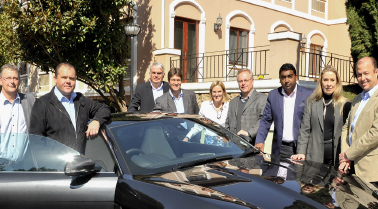 |
Bidvest Automotive – Left to right: Steve Keys, Alan Duncan, Colyn Nel, Hendrik
Vermaak,
Carla Seppings, Trevor Herbert, Preeban Munian, Jane Stirling,
Gert Prinsloo |
|
Performance
 |
Satisfactory progress in a declining motor market |
|
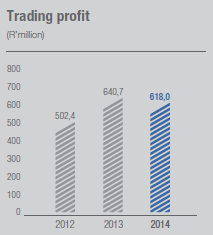
Trading profit dipped by 3,6% on last year |
|
Return on sales acceptable at 2,8% |
|
Mercedes, LandRover and Jaguar made
good contributions |
|
Expanded pre-owned network |
|
Used vehicle unit sales up 17,3% |
|
Improved manufacturer relations and recognition
including Dealer of the Year Awards from Audi, UD Trucks,
Lexus and Mini |
|
Favourable staff satisfaction survey |
|
Completed migration to the Autoline dealer
management system |
|
Launched an interactive virtual dealer showroom |
2015 targets, objectives and factors
affecting future results
|
Continued growth is planned notwithstanding a slowing market |
|
Strong focus on after-sales and pre-owned vehicles will mitigate
the slowing new vehicle demand |
|
The division has now completed its rationalisation efforts and is
well poised to capitalise on growth opportunities |
Material issues and performance
| MATERIAL ISSUE |
|
WHY IT IS IMPORTANT AND
STRATEGIC OBJECTIVES |
KPIs AND TARGETS |
PERFORMANCE AGAINST TARGETS AND
ACTIONS GOING FORWARD |
 |
| Performance

Maintain consistent
financial performance
|
|
Why:
 |
Global economic challenges results in more
cautious customer spend. New vehicle demand
is slowing, which places pressure on financial
performance |
Objective:
|
To maintain profitability |
|
KPIs:
|
Customer satisfaction ratings |
|
Cost containment benchmarking |
|
Revenue diversification |
|
Performance:
|
Decrease in trading profit of 3,6% |
Actions:
|
Focus on after-sales and pre-owned vehicles |
|
Focus on cost base and efficiencies throughout the
business |
|
Focus on customer centricity |
|
|
| |
 |
|
 |
|
| People

Promote employee
health and satisfaction
Enhance talent
attraction and retention
|
|
Why:
|
People have a right to be healthy and happy. As
employers we assist our staff in this regard, which
contributes to a more productive and positive
work experience |
|
To improve talent attraction and retention |
Objective:
|
To use innovative approaches to improving the
health and wellbeing of all employees |
|
KPIs:
|
Resignation rates |
|
Absentee rates |
|
Staff retention rate |
|
Staff satisfaction survey |
|
Performance:
|
The divisional resignation rate has continued its fouryear
increase from 21,4% last year to 22,7% in 2013.
Further increased this year to 25,58% – mostly due to
rationalisation in some areas of our business |
|
Favourable staff satisfaction survey |
Actions:
|
Employee Satisfaction Survey to be conducted in
November 2014 |
|
Wellness of employees |
|
| Promote skills
development |
|
Why:
|
This is an important national issue that is felt
acutely at business level |
|
KPIs:
|
Training spend per
employee |
|
Training hours per
employee |
|
Technical training
(learnerships) |
|
Performance:
|
Average annual training spend per employee increased
from R4 505 to R5 115 in 2013, which excludes technical
learnerships. The amount further increased to R6 025 for
this financial year |
Actions:
|
Remain a national leader in technical training |
|
Meet all the Manufacturer training requirements to ensure
competent and well presented workforce |
|
| Invest in CSI |
|
Why:
|
This is important at national and regional level and
business can play a vital role |
|
KPIs:
|
CSI spend |
|
CSI spend as % of
trading profit |
|
Performance:
|
CSI spend decreased from R7,7 million to R4,2 million in
2013. Spend further decreased to R3,6 million in 2014.
This is mainly due to the Rally to Read project. We only
had three out of eight rallies this year as the remainder
will happen in September 2014 |
|
CSI spend as % of trading profit decreased from 3,3% to
1,0% in 2013. The percentage of trading profit remained
at 1,0% for this financial year |
|
|
| Planet

Minimise product
impacts |
|
Why:
|
Vehicles are high impact goods, in their
manufacture, distribution and after-sales use |
|
|
|
Reduce environmental
impacts |
|
Why:
|
The imperative to reduce environmental impacts,
including greenhouse gas emissions. Automotive
is a high fuel, electricity and water user within the
Bidvest Group |
|
Society’s response to climate change may have a
significant impact on the vehicle rental industry |
Objective:
|
To contribute by reducing our impact, educating
employees, and working with non-OEM suppliers
and our customers to help them reduce theirs |
|
KPIs:
|
Carbon emissions (Scope
1, 2 and 3) |
|
Carbon emission intensity
(revenue and possible
other) |
|
Water used |
|
Performance:
|
Carbon emissions intensity per FTE increased slightly to
8,75 (2013: 8,29) |
|
Emissions intensity per revenue decreased marginally to
2,28 (2013: 2,33) |
|
|
| |
| Fuel usage |
2012 |
2013 |
2014 |
|
| Diesel (Mℓ) |
3 |
2 |
2 |
| Petrol (Mℓ) |
6 |
6 |
6 |
|
| Water usage |
2012 |
2013 |
2014 |
|
| Mℓ |
374,5 |
375,0 |
380,0 |
|
|
| Carbon emissions
(tonnes of CO2) |
2012 |
2013 |
2014 |
|
| Total |
58 863 |
48 344 |
49 881 |
| Scope 1 |
21 345 |
18 854 |
19 067 |
| Scope 2 |
36 404 |
27 834 |
28 392 |
| Scope 3 |
1 115 |
1 656 |
2 422 |
|
|
Stakeholder engagement
| STAKEHOLDERS |
|
OBJECTIVE AND ENGAGEMENT
METHOD (AND FREQUENCY) |
KEY ISSUES IDENTIFIED |
KEY ACTIONS TAKEN AND PLANNED
(more detail may be provided in material
issues tables and elsewhere) |
|
| People
Employees (full-time and
contract)
|
|
Objective:
|
Improve employee relationship and
satisfaction |
Methods:
|
Employee surveys (annual) |
|
Anonymous feedback forms (ongoing) |
|
Newsletters (quarterly) |
|
Key issues:
|
Remuneration and benefits, being
informed about corporate strategy,
employee skills development, employee
wellness, local economic development,
specific employer/employee relationship
issues |
Issues considered material:
|
Employee wellness, skills development
and retention |
|
|
Business Unit Consultative Committee
meetings deal with skills development and
employment matters |
|
Monthly staff meetings address employee
wellness and any other relationship issues etc |
|
Annual employee satisfaction survey is
conducted |
|
| Unions |
|
Objective:
|
Maintain good union relationships |
|
Key issues:
|
Remuneration and benefits, corporate
strategy, employee skills development,
employee wellness, local economic
development |
|
Actively involved in union negotiations. Maintain
good relations with unions by ensuring full
involvement where required i.e. rationalisation
exercises etc |
Industry representative
organisations |
|
|
|
Represent employer industry body (RMI) at
merSETA Chamber Committee |
Communities
 |
Local communities |
|
Particular community
subsectors (e.g. sports,
education, infrastructure,
etc.) |
|
|
Objective:
|
Better understand and collaborate with
the communities we operate in |
|
Key issues:
|
Local economic development and
employment opportunities, education
(schools), skills development, health,
environment |
Material issues:
|
Socio-economic development and
community involvement |
|
Kgabo Cars training initiative – Technical training
is offered free of charge to informal community
to ensure qualification is obtained |
|
| Product

Suppliers |
|
Objective:
|
Maintain good relations |
|
Understand issues and resolve these
together |
|
|
Supplier Dealer of the Year awards from Audi,
UD Trucks, Lexus and Mini |
| Customers |
|
Objective:
|
Understand evolving needs, expectations
and issues |
|
|
Continued focus on improving customer
satisfaction index scores. Group consistently
above national average for FY 2014 |
|
| Planet
Environmental stakeholders
(environmental NGOs,
government agencies,
communities, research/
academic organisations) |
|
Objective:
|
Understand issues, needs and
expectations |
|
|
|
Innovation and new investment
|
Migration onto a new dealer management computer system completed |
|
The expansion of the McCarthy Pre-Owned network of used car retail outlets |
|
The launch of an interactive virtual dealer showroom |
|
Customer-centricity programme |
Disappointments and challengess
|
Declining new vehicle market |
|
Reorganisation of dealer network and continued cost rationalisation |
|
Performance and reorganisation in Multi Franchise |
Changes in operational environment
|
Exited Mahindra, Ssanyong and Tata brands |
|
Increased focus on after-sales and used vehicle activities |
Risks and responses
|
Industry sales growth is expected to slow in response to pricing pressures as a result of currency weakness, rising interest rates and
contracting credit |
|


