


Bidpaper Plus
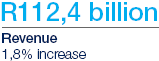
PerformanceA creditable performance was recorded in extremely challenging conditions. Revenue was flat at R1,9 billion (2008: R1,9 billion) and trading profit marginally higher at R222,8 million (2008: R220,2 million). Expenses were well managed and our businesses remained strongly cash generative. BenchmarksBenchmarking takes two forms – versus international best practice and against process management targets set at operational level. Bidpaper Plus is South Africa’s stakeholder in Eforma, an international association of communication industry leaders based in Switzerland. Members from 21 countries share information on profitability, quality, management information issues and market trends. Comparison against world norms confirms that Bidpaper Plus is a consistent leader in terms of profitability and expense management. International information-sharing not only enables measurement against global benchmarks, it sounds an early alert. For example, our interpretation of leading-edge experience with digital colour technology was that early adoption was a risk. We delayed adoption. Global experience then indicated that the technology added most value in the area of sheet-by-sheet personalisation on mail runs. This has become a profitable area for our business, largely because early loss was minimised. Hard-and-fast process management targets are difficult to set because job specifications vary on each production run. Climatic conditions can also affect quality and throughput. Within these constraints, benchmarks are set locally on all processes, covering waste factors, running speeds, plate-making and quality. Variance from local norms is strictly controlled. Performance against cost control benchmarks and local operational benchmarks was satisfactory. However, we fell below both revenue and trading profit targets for the year as the severity of South Africa’s recession was not anticipated.
Traditionally, a presidential election is good news for the printing industry as political parties, state agencies and other bodies place substantial orders for election materials and posters while advertising spend increases. Our business felt almost no benefit during the South African elections as those placing orders applied their own print procurement criteria with focus on black ownership. Broad-based black economic empowerment credentials were largely ignored. We stepped up export efforts in the realm of election support as this is an acknowledged strength and won the United Nations Development Programme (UNDP) contract for the supply of voter registration forms ahead of elections in the Democratic Republic of Congo. Work for international agencies is largely recession-proof and towards year-end we tendered successfully for the UNDP Tanzanian voter registration contract. These successes could not cushion the full effects of falling local demand. Lower manufacturing and export output hit demand for packaging and labelling solutions. Big cuts to marketing budgets and reduced spending by large retail groups also had a material effect. We responded to industry pressures with a “big-basket strategy”, suggesting alternative solutions across all the division’s technologies and skill-sets whenever a contract or relationship was under threat in any area. Brand dynamicsWithin our stationery business, the rebranding of Croxley is complete and its position as sector leader has been entrenched. In the business-to-business environment, “Lithotech” is a strong brand after many years as a printing industry leader and innovator. The strength of the name is reflected by its use as a prefix for a specialist high-volume mail business such as Lithotech Afric Mail. We couple premium and competitively priced brands; for example, Croxley with Lion and Top Form with Econo Form. The strategy is made possible by the breadth of our range and positions us as a responsive supplier able to offer a full spectrum of solutions. Operational dynamicsIn South Africa’s worsening economy, utilisation levels fell to 40% in some operations. Staffing levels had to be cut back, though this was normally through non-replacement. Short-time working became common. Unfortunately, retrenchments were unavoidable in one of our Cape Town printing plants and the Johannesburg-based label paper manufacturing operation. Fifteen jobs were lost. Customer resistance to price increases was intense and margin management became a focus area. To counteract pressure on volumes, every opportunity had to be optimised and businesses achieved some notable successes in a challenging environment; for instance, the quest for replacement business in the labels field, with new contracts being secured for wine label production. New business was also won in the pharmaceutical industry. Optimisation of the Confederations Cup opportunity was a priority. Competition is intense for soccer ticketing contracts, keeping margins slim. We changed our focus to hospitality packages, VIP packs, mail pieces, info packs, personalised identity packages and their various components. This helped us maintain volumes at acceptable margins. The strategy also helped us position ourselves as the trusted time-critical print partner of event organisers and sports promoters. On the run-up to the Confederations Cup kick-off we demonstrated our ability to meet new demands or changes in job specifications at short notice. The positioning will be crucial as we look to maximise opportunities flowing from the FIFA World Cup. |


Bidvest's vision lies in the realm of possibility
“Bidvest people put in a resilient performance and the Group achieved a creditable result.”
statement
“We refuse to participate in the recession and salute our employees for their efforts in exceptionally difficult trading conditions.”