Bidfreight is Africa ’s
leading private sector freight management company
with a presence in every major port in southern
Africa. Port operations are reinforced by strong
distribution and airfreight capabilities. Bidfreight
focuses on terminal operations and logistics in
southern Africa, international clearing and freight
forwarding and marine services.
►
Met challenging
targets as South Africa ’s
consumer-led boom underpins
import activity
►
Growth
of 15,4% takes revenue to R15,8
billion
►
Trading
profit rises to R536,4 million
– up 13,4%
►
Bidfreight
exits European cross-Channel
ferry and terminal business
through
advantageous sale of Dartline
►
R226,5
million investment in infrastructure
across the division with a strong
focus
on port operations
►
Leaner
structure adopted, with focus
on 10 principal business activities
Anthony
Dawe Chief
executive
Introduction
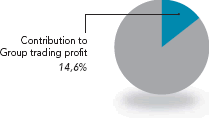
Revenue showed satisfactory growth of 15,4% to
R15,8 billion while trading profit increased by
13,4% to R536,4 million. These figures are in
line with challenging targets and reflect robust
efforts to optimise the opportunity presented
by continued growth in global trade and a largely
buoyant national economy.
South Africa has trading relationships with more
than 200 countries and territories. The national
strategy of rapid reintegration with the global
economy has achieved remarkable success, creating
unprecedented opportunities and challenges for
the freight management sector.
Record volumes of freight were handled by Bidfreight’s
portside operations. High-value imports by air
increased by 8% for the year, topping 30 000 tons
for the first time.
In this environment, the throughput and productivity
per individual and per asset have to be constantly
enhanced, requiring appropriate investment. At
just one infrastructural project, Bidfreight has
committed R44 million for upgrading bulk-handling
capacity at Maydon Wharf. In addition, we spent
R12,1 million on the training and development
of our staff.
Improved freight-handling efficiency is in the
national interest and we are happy to applaud
the recent success of Transnet which recently
reported a 57% increase in profit from operations
to R8,5 billion and is currently engaged in a
R64,5 billion capital investment programme to
extend and upgrade national transport infrastructure.
A significant portion of this investment will
be made at South Africa ’s ports to expand
container and vehicle terminals, deepen berths,
improve infrastructure and buy new equipment.
South Africa continues to achieve significant
growth in container volumes. Containerised traffic
at South Africa ’s ports grew by 54% between
1998 and 2005. Last year, more than three million
containers were handled and this growth should
continue.
Safcor
Panalpina
is a global network spanning six continents and
the oceans to meet freighting and
logistics requirements
Island
View Storage is South Africa’s
leading provider of liquid bulk storage
Manica provides total freight
management systems across southern
Africa
Bulk
Connections operates from a strategic
site in the port of Durban
In some respects,
Transnet are competitors of Bidfreight,
but they are also our partners. Modern
logistics is characterised by mutual
dependence. All players in the freight
management sector have a shared interest
in the growth and development of transport
infrastructure. Growth in trade translates
directly into growth in national prosperity.
It is also heartening to report that
improved understanding has been achieved
with the National Ports Authority
(NPA), our landlord at many portside
operations, notably in Durban where
we are the biggest private sector
tenant of harbour premises. New consolidated
Durban harbour leases were signed
in the previous year, giving the security
of tenure that is a prerequisite for
strategic investment.
National planners have consistently
indicated that South Africa cannot
remain a commodity-reliant economy.
The country’s manufacturing
base has to expand and diversify.
Bulk-handling efficiency remains a
key requirement, but the ability to
move finished high-value products
will become increasingly important
as South Africa transforms itself
into a value-adding economy.
Modern facilities are crucial at the
portside while airfreight for time-sensitive,
high-value imports and exports will
become a vital part of the nation’s
freight management mix.
It is pleasing to record that
the first phase of Safcor Panalpina’s expansion
programme at Johannesburg International Airport
has been completed. The second phase is now in
progress. This expansion involves close co-operation
with another national agency, the Airports Company
South Africa.
Bidfreight Port Operations (BPO) in Durban have
completed a new 12 500 square metres warehouse.
In addition, South African Bulk Terminals are
completing the on-site construction of a R44 million
ship unloader on Maydon Wharf. This will significantly
enhance Bidfreight’s handling capacity and
efficiency. The infrastructure investment at Bulk
Connections continued.
Inland distribution capacity has been improved
in the chemical sector following the purchase
by Rennies Distribution Services (RDS) of a chemical
warehouse in Denver, Johannesburg.
Macro-economic
factors
Business and consumer sentiment
remained positive thanks to low inflation, relatively
low interest rates, strong credit extension and
continued economic growth.
The 2006 National Budget included a three-year
government allocation of R372 billion to capital
projects. Strong imports of electronic and automotive
products and other consumer appliances were evident.
The energy needs of industry and buoyant car sales
were also reflected in strong imports of petroleum
products.
Industry-related
issues
The resilient rand supported
demand for imported consumer goods. The strong
appetite for technology items and consumer electronics
confirmed the soundness of the Bidfreight strategy
of investing in expanded airfreight-handling capacity
and container pack-unpack activities. These container
services assist importers looking for seamless
progression from the wharf to their warehouse.
The downside of rand strength was the pressure
on exporters trying to remain price-competitive
on world markets. This has a knock-on effect on
Bidfreight margins as exporters press for pricing
efficiencies along the logistics chain.
Maize exports in 2006 were disappointing, following
strong growth in the previous year. A substantial
maize export programme was anticipated, but did
not occur due to increases in domestic prices.
Business risks
Efficient freight management
is dependent on co-operation and support from
all the participants in the chain. Bidfreight
is dependent to some extent on the performance
of other players in the national logistics and
transport sector. All contributors have the same
objectives, but priorities can vary and optimum
advantage can only be gleaned when national transport
infrastructure operates to maximum efficiency.
This not only requires significant investment
to which government has committed, it also demands
prompt implementation of strategic plans. Government,
however, is simultaneously committed to broad
consultation and inclusive processes. This break
with the authoritarian past is applauded, but
it can slow on-the-ground delivery and create
strains on existing capacity. Realising our potential
as a trading nation requires fast action, but
realising our democratic potential demands deliberation.
Major decisions on port operations and facilities
are imminent and grow more urgent by the month.
Pressures on transport infrastructure increase
as the economy moves toward the goal of 6% GDP
growth a year.
A policy review is urgently required to create
a strategic framework that would encourage greater
utilisation of the rail network. Our roads would
benefit; so would port efficiency and throughput.
The more government succeeds in driving economic
growth, the greater the volume of goods South
Africa has to handle. A volume challenge requires
a volume solution. Railways are designed for the
safe, continuous movement of big volumes of freight.
Our rail network is a national asset. Let us optimise
it.
Capacity utilisation levels can never be predicted
with certainty, but investment has to be made
to support strategic industries and important
customers. This business risk is inescapable,
but can be managed through strong relationships
and constant exchange of information between partners.
All logistics and ports operations are exposed
to the risk of dramatic downturns in the economy.
At Bidfreight, this risk is mitigated to some
degree by long-standing relationships with major
groups. They engage in long-term planning and
make strategic commitments that ensure continuing
volumes, even when the business cycle turns.
Some exchange rate risk is acknowledged. It is
sometimes assumed that a business, active in both
imports and exports, is rand-neutral. This is
not entirely true. A degree of rand weakness favours
Bidfreight as it tends to increase the income
from disbursement business.
Bulk
Connections
operations are based on a strategic site in
the port of Durban
Sensitivity analysis
Strategic risk is the key risk
factor for Bidfreight. Our business prospects
are inescapably entwined with the prospects of
South Africa as a trading nation. Policies that
foster commercial contacts across Africa and with
the rest of the world are positive for Bidfreight.
Any policy shifts that affect trading relations
could have a material effect on the business.
Similarly, at a macro-economic level Bidfreight
is affected by changes in the business cycle and
policy initiatives that affect trade volumes.
A major recession or a significant shift in international
investor or business sentiment toward South Africa
would affect the business. Some of these possibilities
are not manageable at a company level. However,
regular communication with policymakers, ongoing
co-operation with state agencies and good relationships
with customers provide some “comfort”
and enable planning.
Structures and
growth
The main structural change
involved the disposal of the Dartline business
in the UK. The sale of these cross-channel ferry
and terminal operations was concluded on advantageous
terms and provided us with a suitable exit.
Disposal of these overseas operations in no way
implies that Bidfreight will not explore further
international opportunities. We remain an acquisitive
business.
Internally, Bidfreight has flattened structures
still further by focusing on 10 major business
units: Safcor Panalpina, Island View Storage,
Bulk Connections, South African Bulk Terminals,
SACD Freight, Bidfreight Port Operations, Rennies
Distribution Services, Rennies Ships Agency, Manica
and Naval.
The restructure led to the closure of some sub-divisional
offices and has created cost savings. There were
no major job losses. The staff complement is stable
at 5 334.
One feature of the restructure is the close integration
of Bidfreight Intermodal with SACD Freight, leading
to improved service for customers looking for
an all-in-one offering from the container, via
road or rail, to the customer’s door.
Safcor Panalpina has benefited from a brand repositioning
exercise to improve awareness and communicate
the brand mission to its customers and staff.
The repositioning coincided with the launch of
expanded operations at Johannesburg International
Airport.
Increases in revenue and profitability are largely
the result of organic growth. No significant acquisitions
have taken place.
Bidfreight works closely with
several state agencies and a wide variety of large
corporate groups. BEE status is increasingly important
to both public and private sector bodies. At a
Group level, Bidvest’s broad-based BEE approach
is well publicised. Within every business unit
at Bidfreight, there is strong commitment to BEE
and some notable successes have been achieved.
Safcor Panalpina and Rennies Ships Agency have
achieved an “AA” empowerment rating
and South African Bulk Terminals an “A”
rating. Rennies Ships Agency has appointed Bidfreight’s
first black managing director. The six black financial
directors who were appointed in previous years
at various businesses within the divisions are
performing well, so much so that four of them
have been appointed to the Bidfreight board.
New investments
In total, Bidfreight committed
R226,5 million to new premises and facility upgrades.
This included spending by Bulk Connections in
Durban, investment by Safcor Panalpina at Johannesburg
International Airport, a new ship unloader at
South African Bulk Terminals, spending on BPO’s
new Maydon Wharf warehouse and the cost of the
new chemical warehouse in Denver.
Innovations
Higher imports of liquid products
have significantly increased the demand for bulk
liquid capacity. IVS responded with an innovative
programme to optimise available assets. New berth
lines and new loading points were established
while an electronic access and product receipt
and release system was put in place. As a result,
IVS has achieved increased throughput through
the same tanks.
Bulk Connections launched several innovative approaches
to achieve further improvements in operational
efficiency. The terminal was reconfigured into
rail-, stockpile- and vessel-handling zones and
a mobile stacking machine for efficient stockpile
building was designed and produced.
The business also introduced automated bottom
discharge containers for the soft loading of products.
These are carried on specially designed trailers
and loaded by converted container cranes. In addition,
by changing the way we move products around the
site, Bulk Connections has halved ship handling
times.
More innovations are planned, including the modification
of container cranes to discharge bulk products
from vessels.
Challenges
HIV/Aids remains a major challenge
and Bidfreight businesses have expanded their
HIV/Aids programmes. These initiatives typically
include a strong educational component, awareness
campaigns, peer-group input, condom distribution
and voluntary counselling and testing.
In addition, some business units provide anti-retrovirals
through in-house clinics.
Bidfreight is responsible for the safe, environmentally
secure handling of a wide variety of products,
commodities and chemicals. Employees working in
hazardous environments receive appropriate training
and attend regular refresher courses. Safe and
efficient materials handling is a core competence
while employee health is regularly monitored.
One notable success was the one million disabling-free
hours recorded by the Richards Bay operations
of IVS.
Bidfreight not only strives to be a good neighbour
in an environmental sense, we also try to foster
close ties with the communities in which we operate
and from which we draw our people. The level of
corporate social investment continues to increase
and tends to focus on health, education or infrastructure.
Development of our people is a priority at Bidfreight.
In all, 7 015 training days were logged. The training
investment of R12,1 million is up 18,5%.
The future
There has been no sign of any
slackening in business activity or demand for
Bidfreight capacity. The import of consumer goods
remains buoyant. However, higher interest rates
and a weaker rand may affect the consumer’s
appetite for imports.
The effect of government’s commitment to
major capital and infrastructure projects may
also affect the nature of the import-mix. Should
local cement manufacturers be unable to meet the
surge in demand, we may see the import of significant
volumes of bagged cement. Major infrastructure
projects are in prospect until at least 2010.
This import category may, therefore, represent
a growth opportunity.
Continued economic growth will also sustain demand
for petroleum imports.
Growth in international trade is expected to continue
and will underpin further gains by our freight
forwarding and distribution businesses. The strategy
of growing our value-added services for importers
has proved its worth and will be continued.
A weaker rand – predicted by many commentators
– will tend to favour export activity and
will assist Bidfreight’s disbursement activities.
Bidfreight foresees similar and continued growth
in revenue and operating profit. Rigorous expense
management will be crucial if we are to achieve
appropriate returns on the increase in our level
of new investment.
Capacity has already been enhanced at the port
and at our airfreight operations. This provides
a platform for new growth. The pace of new investment
will not slacken; nor will our efforts to deepen
our relationships with our clients and with public-sector
agencies.
As Bidfreight grows its infrastructure, efforts
will be made to ensure that SMEs with the appropriate
BEE profile are among the contractors employed
on these projects.
Negotiations with the NPA for renewal of the Bulk
Connections lease are nearing conclusion. A successful
outcome will enable Bidfreight to commit to further
improvements at the bulk-handling terminal. Our
strategic intent is to work in close collaboration
with state agencies to foster continued growth
of the country’s freight management capacity.
BIDFREIGHT TERMINALS
Bulk Connections
Pleasing increases in volume
throughput and operating profit have been achieved
by this bulk-handling specialist. Volume improvements
have been seen in both sized and unsized coal.
Good progress has been made on the upgrade to
the bulk-handling terminal. This has not only
improved operational efficiency on current contracts,
but has attracted the attention of prospective
customers. Opportunities for marketing the new
facility to a wider range of industry users will
be pursued.
Further improvements to the facility are envisaged
with the intention of handling a wider variety
of bulk products. Bulk Connections can move rapidly
on the implementation of these plans once certainty
over the new lease conditions is achieved.
South
African Container Depot has representation
at all major
ports and the inland port of
Johannesburg
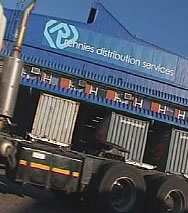
Rennies
Distribution Services creates logistics
solutions for a
blue-chip client base
Island
View Storage
Improvements in
tank capacity usage and throughput
have been achieved, resulting in satisfactory
growth in revenue and trading profit
at this leading provider of liquid
bulk storage and handling services.
Strong demand is expected to continue,
particularly from the petro-chemical
industry. Tank occupancy rates were
particularly high at IVS’s Durban
and Isando operations.
Additional capacity is required at
Durban and a R200 million plan for
new tankage has been drawn up. A new
facility is planned at Richards Bay
to provide storage capacity for a
major customer in the petro-chemical
industry. Construction work has begun.
Bidfreight
Port Operations
Growth in both
revenue and profitability was achieved
despite the pressure on key exporters
in the steel and forest products sectors.
BPO provides quayside services and
is a specialist in the handling of
steel, forest products, containers
and break-bulk cargo. These operations
have achieved efficiency gains and
are making a growing contribution
to BPO results.
BPO’s new 12 500 square metres
warehouse at Maydon Wharf went into
operation in May.
Rennies
Distribution Services
Competition remains
intense in the inland distribution
sector and RDS was challenged to maintain
its margins and volumes in a flat
year. Distribution services for exporters
performed well, but other activities
came under pressure. Expansion in
the chemical industry began at Denver
in May.
SACD Freight
SACD Freight, the leading container
depot in South Africa, and Bidfreight Intermodal
achieved notable revenue and profit growth. Good
volume increases have been seen at the new Durban
warehouse. Bidfreight Intermodal has also achieved
good volume growth, though margins have been under
continued pressure as a result of rand strength
and intense competition for business. The strong
rand had a braking effect on export pack business.
Investment in new capacity continues. Construction
will begin on a new R70 million Cape Town warehouse
as soon as final council approval is received.
South African
Bulk Terminals
The business – a strategic
partner of clients in the agricultural and mining
industries – was adversely affected by the
low level of maize exports, as high prices caused
some international buyers to cancel orders. Despite
this setback, overall volumes were maintained,
though margins came under pressure.
Improvements to plant efficiencies are a point
of focus for management. Construction of SABT’s
news ship unloader will improve the speed of operations
on the berth and reduce costs.
Naval
Mozambique ’s leading
private-sector provider of stevedoring services
enjoyed a much-improved year, achieving higher-than-anticipated
growth in revenue and operating profit.
INTERNATIONAL
CLEANING AND FORWARDING
Safcor Panalpina
Billings showed strong growth
at the South African market leader in freight
forwarding, though margins were under pressure.
Even so, rigorous expense management enabled good
profit growth. Activities are underpinned by the
longstanding relationship with the Panalpina World
Transport Group and its extensive network of overseas
offices. We congratulate our global partners on
their successful listing as a public company in
September 2005.
There was pleasing growth in business from new
clients while operational efficiencies were achieved
following the restructuring of Gauteng operations.
These operations have been consolidated under
a single management team.
Growth was assisted by our re-branding as a provider
of complete supply chain solutions. This is in
contrast to our former traditional clearing and
forwarding services. One regional driver of growth
was our relationship with clients in the Western
Cape oil and gas industry. The sector is experiencing
strong growth, reflected in higher demand for
imported equipment and consumables.
The first phase of new premises at Johannesburg
International Airport has been completed, adding
10 000 square metres in warehouse capacity. The
second phase (another 10 000 square metres) is
under way and should be completed by April 2007.
Efforts to further improve our BEE credentials
were rewarded when a “AA” rating was
achieved.
MARINE SERVICES
This leading ships agency business
put in a strong performance on the back of an
increase in liner volumes and growth in principals’
global trade portfolios. Though volumes are pleasing,
pressure is being felt on margins as freight rates
are subject to intense competitive activity, primarily
as a consequence of excess vessel capacity. The
non-liner and freightbulk businesses continue
to stake their claim in this highly competitive
market. New opportunities are being pursued. Marine
insurance turned in satisfactory earnings.
MANICA
Manica – a provider of
total road and rail freight solutions across southern
Africa – recorded pleasing growth in operating
profits. This trend is expected to continue, despite
difficult trading conditions, particularly in
Zimbabwe.
Routes into Zimbabwe were well utilised to maintain
the supply of humanitarian aid from international
donors. Botswana operations (largely geared to
through-transport) performed well.
Facilities are being upgraded while increasing
focus falls on the development of alternative
trade routes via the ports of Dar-es-Salaam and
Walvis Bay to facilitate the handling of large
cargo volumes. Increased traffic is anticipated
in view of the opening of new mines and the refurbishment
of existing mines in Zambia and southern Democratic
Republic of Congo.
New opportunities are being explored in some national
markets. Zambia ’s success in reducing its
former reliance on commodity exports may enable
Manica to widen its offering by targeting the
agricultural and commercial sectors centred in
Lusaka. This will complement Manica Zambia ’s
traditional focus on minerals and the Copperbelt.
 ►
►