Material focus areas, risks and responses
There are certain material matters that might disrupt Bidvest’s ability to continue creating value for its stakeholders. Bidvest has long acknowledged its duty to share the value created, fulfilling a responsibility to contribute to economic and social development among its group of stakeholders, including investing in the Bidvest team of people, and the environment. Our decentralised, assetlight and everyday essential products and service business model is, in itself, an effective risk management tool.
As external factors emerge and evolve, the key matters that may interrupt the operations of the Group’s business are carefully assessed through a controlled process, which includes the board’s Risk committee, divisional Risk committee and Internal Audit (IA). The meaning of material is defined and clarified across the Group. Those matters that may have an impact on the effective and successful future operations are assessed and the risk management thereof, including mitigating action, integrated into day-to-day activities. On an enterprise–wide level the key material matters are shown below, and discussed in more detail in Material focus areas and risk and highlighted in varying detail throughout this report:
- Rapidly rising inflation;
- Challenging economic outlook;
- Supply chain constraints;
- Cyber assaults;
- Climate change; and
- Impaired SA infrastructure.
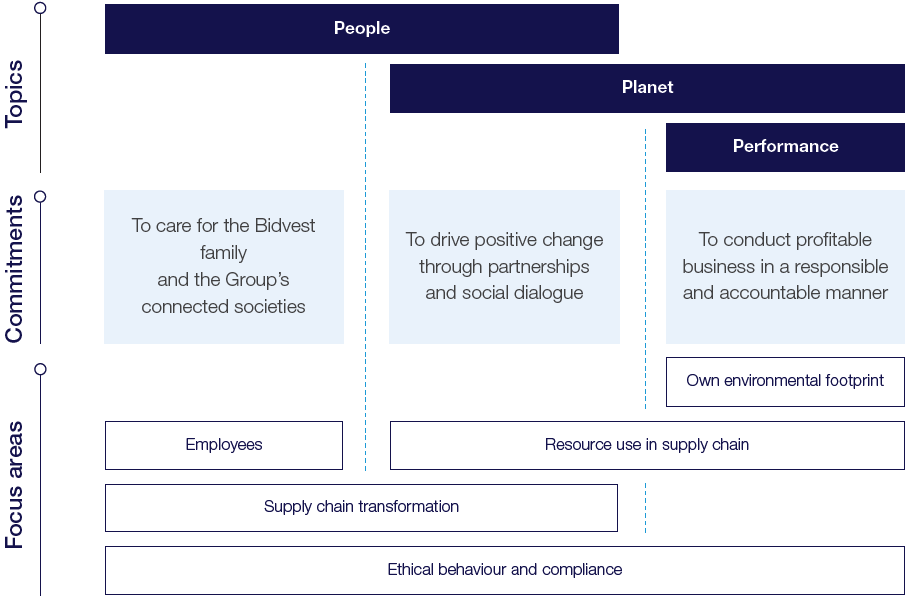
In addition to climate risk which is included as a global risk for the Group, Bidvest as a large employer, is focused on treating its diverse and inclusive employee base fairly and provide a safe and healthy workplace. All of the below was taken into consideration when designing our ESG Framework.
In addition to the above common focus areas, regulatory risk management, professional integrity as well as financial inclusion and capacity building are key matters that require active management in the Financial Services division. Data security is also a matter that receives continuous attention in Financial Services and Automotive divisions, where vast amounts of personal data reside.
Climate change
The common denominator between water wars, climate change, social unrest and other direct and indirect consequences of environmental damage is economic risk. In other words, it means recognising that a drought isn’t just an environmental issue, but rather a fundamental business risk involving processes such as raw material and product procurement or people in impacted markets.
Own environmental footprint
Risks – Energy, waste and water management
The World Economic Forum’s Global Risk Report 2022 identified climate inaction as the biggest threat to humanity in the next decade. Inaction could lead to a global GDP loss of 4-18%. Climate change is global, but climate impact is local. As an international services, trading and distribution group, unchecked energy intensity and sourcing as well as water scarcity can expose the operations to materially higher operating costs, expenses stemming from regulatory shifts and compliance as well as reputational damage. It also poses serious threats to human lives, livelihoods and business stability.
In SA, the electricity crisis became part of everyday life, negatively impacting sentiment and impeding growth, as supply was severely impeded. In Europe and the UK, the Russia/Ukraine war resulted in a significant reduction in gas supply. With winter looming, this could become a full-blown crisis for the region.
SA is classified by the World Resources Institute as having medium-high baseline water stress. Water stress is measured as the differential between water withdrawn by irrigated agriculture, industries and municipalities and the available water supply. A narrow gap, i.e. high stress, leaves a country vulnerable to fluctuations like droughts and increased water withdrawals. Aging and unmaintained infrastructure could further exacerbate the situation. After Cape Town faced Day Zero in 2019, Gqeberha in the Eastern Cape is now in the same position.
The impact of inclement weather is the greatest in Bidvest Freight. Reliable energy is essential in most of the trading and distribution activities of the Group while water availability is a key in Bidvest Services South Africa’s allied cluster’s offerings and Adcock Ingram’s manufacturing facilities.
Mitigating actions – clear measurements and targets
In December 2021, Bidvest became a signatory to and a participant in the United Nation’s Global Compact. Bidvest Group chief executive, Mpumi Madisa, was appointed chair of the board of the Global Compact Network South Africa. Bidvest nominees are also participating in the Climate Acceleration and Women Empowerment initiatives. Both Noonan and PHS have committed to net zero by 2045 and 2040, respectively. Konica Minolta has been carbon neutral since 2013 using natural offsets. Learnings are being shared across the Group.
The Group has set targets to reduce emission intensity, water intensity and waste footprint by 20% by 2025. Incremental annual targets are set and included in both short- and long‑term incentive scorecards, cascaded down from executive director to operational management levels. During FY2022, the initiatives to reduce our operational footprint and ensure operational continuity, as far as commercially viable, included solar installations at Bidvest properties, water saving and recycling processes as well as the introduction of electric vehicles in certain fleets internationally and route optimisation.
Opportunities identified – environmentally friendly products and lower-emission products and services
Opportunities include the sale and distribution of solar energy equipment, disposal of hygiene waste to energy recovery facilities, chemical-free cleaning and janitorial products, installation and wholesale of water efficient washroom and plumbing products, distribution of energy-saving household appliances, investing in a world-class terminal to handle significantly more volumes of lower-emission LPG as an alternative energy source in the southern Africa region, among other activities. The revenue generated from these amounts to an estimated R1 billion.
The Voltex partnerships with two commercial banks to offer solar solutions to home loan clients yielded almost 2 000 leads. Interact, a Noonan company, are in discussions with a large ICT company in Ireland with regards to a pilot solar project while Bidvest Bank is strategically intent on direct financing and insurance of renewable energy assets. Croxley also launched its eco counter books, which does not require plastic book covers and Interbrand launched branded handbag models that include recycled plastic and wheat grass. Noonan introduced cobotic cleaning and mobile water recycling systems and PHS designed a digital water FLOWSAVER that measures water used and saved compared to pre-installation levels and displays this.
Supply chain
Risks – environmental and social sustainability of a supply chain that spans hundreds of thousands of products from thousands of local and international suppliers
Bidvest sources globally and locally. Throughout Group supply chains, scarce natural resources are used as inputs in logistics and factories operated by employees whose human rights need to be upheld. Product and packaging lifecycles also have environmental consequences and regulations need to be adhered to.
This is particularly pertinent to the Commercial Products, Branded Products as well as Automotive divisions as distributors and traders of product. Reputation, brand equity and product quality are critical demand drivers for end consumers.
Mitigating actions – clear measurements and targets
Since FY2021, Bidvest purposefully increased its local supplier support. The first step was to actively shift local procurement away from poorly rated, or even non-compliant B-BBEE suppliers. Secondly, the Group adopted a Code of Ethical Purchasing. The focus in FY2022 was to ensure that offshore suppliers acknowledge and commit to the principles of human rights and responsible environmental behaviour, as set out in the mentioned code.
The Group has set itself the target to become SA’s leader in supply chain transformation and is targeting more than 90% local sourcing from suppliers that have a Level 4 or better B‑BBEE rating by 2025. In addition, relevant businesses have introduced and want to expand recovery/take-back product programmes at the end of life as well as increase recycle material content in products and packaging.
Opportunities identified – supply chain transformation, circular economy
The Bidvest Group Integrated Supplier Diversity Programme, a comprehensive SA supplier development programme, was initiated and well underway. Forty-seven participants have been onboarded, partnered with coaches, business mentors as well as executive sponsors from within Bidvest. This programme should enable our and other SA businesses to source closer to end demand, contributing to broader economic prosperity and reducing the environmental footprint of the supply chain. Our international businesses identified key suppliers and are working with them to reduce the environmental footprint of the entire supply chain.
Various ongoing initiatives that derive value for all across various supply chains include, for example, security guard uniforms, manufactured by G Fox and used by Noonan employees when delivering a service to a customer, now contains a recycled material component; Kolok introduced the take-back of empty print cartridges; a ‘paper wrapped in paper’ approach to PHS’ consumable product range resulted in eliminating plastic use and utilising bamboo or sugar cane materials, to name but a few.
Inclusive, healthy and safe employee base
Risks – employee diversity, labour practices; health and safety
Bidvest has a large employee base, with many deployed at customer premises, assembly/light manufacturing operations and warehouses/distribution centres. Worker safety is highly regulated and workplace incidents may lead to perceptions that employee well-being is not prioritised and can also result in reduced productivity. Failure to fairly treat and enhance employees’ livelihoods may lead to legal action, protests and detrimentally affect hiring.
Inequality and unemployment in SA are amongst the highest in the world. This poses additional broad social risk.
As 79% of our employee base is in Services South Africa and Services International, decent work, labour practices as well as diversity and inclusion are particularly relevant. Employee health and safety is paramount in our manufacturing operations in Branded Products and Commercial Products, terminal operations in Freight as well as at customer sites where most of our service employees report for daily duty.
Mitigating actions – clear measurements and targets
Embedded in the Bidvest Purpose are the elements of creating social value and empowerment entrepreneurship. This can only be achieved by empowered people. Living this principal, means we provide opportunities that exceed personal ambitions, and we encourage teamwork.
Diversity is one key enabler and Bidvest set itself the target of its SA management comprising 45% females and 50% African by 2025. Country-appropriate targets are set in our offshore operations. Bidvest also committed to a 5% reduction in workplace injuries per annum.
Bidvest is committed to a sustainable, fair and responsible remuneration and is explicit in its commitment to income parity. Both Noonan and PHS reported negative gender pay gaps. In SA a project is on the go to gather data from hundreds of payrolls across the operations to work towards meaningful disclosure and appropriate interventions.
Opportunities identified – safe and healthy occupational environments
The Group continues to promote and offer out-of-home hygiene services and integrated facilities management services in order to support safe and healthy occupational environments. Products innovation is continuous. For example, PHS launched air purifiers which are both proven to eliminate germs, allergens and particulates from the air indoors.
Efforts to tackle period equality was also stepped up. PHS purpose-designed a free-vend dispenser in response to the growing challenges surrounding period inequity. There is a particular programme on the go with the Department of Education in the UK in this regard.
The Carbon Disclosure Project (CDP) is a non-profit organisation that evaluates the world’s largest companies for their response to its official request to disclose their environmental data. In line with the increasing demand from stakeholders, Bidvest disclosed its climate change response. Refer to www.Bidvest.co.za