


Remuneration report
Executive summary
Bidvest performed exceptionally well over this past financial year, reporting a very strong operating and financial result, notwithstanding the ongoing impacts of COVID-19 and the resultant significant changes in its operating environment. It is indicative of the financial strength of the Group, a reflection of the dedication and commitment of the Bidvest family, whilst simultaneously recognising our responsibility to the societies in which we operate. During FY2021, revenue, trading profit and normalised headline earnings grew by 15%, 48% and 26%, respectively. Bidvest also dispersed R230 million in support to employees and communities through various initiatives. The team also established an ESG Framework that is appropriate and inclusive of specific targets.
After receiving less than 75% support for the remuneration policy and the implementation thereof, Bidvest engaged with dissenting
shareholders. The key matters included the
non-disclosure of non-financial measures and targets to clearly demonstrate the
alignment between management and stakeholders; earnings growth hurdles that could fall below South African real growth;
longer vesting periods for long-term incentive (“LTI”) instruments; and the appropriateness of ROFE as a return metric.
The Remuneration committee considered these matters and responded by suggesting changes in the Remuneration policy
as set out in Part 1 of the document.
The key improvements and changes suggested in the policy are:
- HEPS growth hurdles being in excess of real GDP growth;
- ROFE, as an entrenched management tool, remains the key return measurement with higher performance hurdles that appropriately reflects the changed balance sheet mix as a result of recent acquisitions. In addition, a specific return improvement measurement on acquisitions has been introduced in the strategic metric;
- The absolute medium-term targets set out in the ESG Framework are used to determine specific, measurable performance hurdles relating to the environmental, social and governance elements constituting the sustainability metric; and
- The strategic metric remains objective but incorporates specific aspects that are critical to building a business that is worth building and will endure the test of time, for example innovation which is paramount in today’s rapidly changing world.
Table 1: FY2022 short-term incentive (“STI”) score card
| Weighting | Threshold 30% |
Target 65% |
Stretch 100% |
||
| HEPS growth | 40% | GDP+CPI | GDP+CPI+1% | GDP+CPI+4% | |
| ROFE | 30% | 24% | 25% | 30% | |
| Sustainability | 15% | ||||
| Environmental | |||||
| Reduction in Scope 1 and 2 emissions and water intensity (FY19 base; focus businesses) | 0-5% | 5%+ | |||
| Code of Ethical Purchasing (or equivalent) declarations (based on # of offshore suppliers) | 50% | 70% | 80% | ||
| Social | |||||
| African appointments (top and senior management) | 40% | 45% | 50% | ||
| Local procurement with B-BBEE 1 – 4 suppliers | 55% | 60% | 65% | ||
| Governance | |||||
| B-BBEE rating for 80% of all operating business | min L5 | min L4 | min L3 | ||
| ALICE score (quarterly aver) | 50% | 40% | 30% | ||
| Strategic | 15% | ||||
| Execution of strategy | Assess against portfolio of evidence. Scoring table | ||||
| Return uplift on major acquisitions (3 yrs) | Sequential improvement in return | ||||
| Innovation and technology | Assess against portfolio of evidence. Scoring table | ||||
| 100% | |||||
Table 2: FY2022 LTI score card
| Weighting | Threshold 30% |
Target 65% |
Stretch 100% |
|
| 100% | ||||
| Weighting | Threshold 130% |
Target 165% |
Stretch 100% |
|
| HEPS growth (three-year compound) | 30% |
GDP+CPI |
GDP+CPI+1.5% |
GDP+CPI+5% |
| ROFE (three-year average) | 30% | 24% | 25% | 28% |
| Sustainability | 20% | average annual calculated outcome over 3 yrs | ||
| Strategic | 20% | average annual calculated outcome over 3 yrs | ||
| 100% | ||||
In the implementation of the policy tabled last year, the achieved performance during the year to 30 June 2021 was measured against the agreed metrics in deriving incentive outcomes and personal performance considered in awarding salary increases. The team achieved 98% and 58% scores for STI and LTI, respectively. This outcome was cascaded into incentive schemes across the Group.
Bidvest endeavours to proactively and effectively engage with all stakeholders, on a regular basis, to build a constructive dialogue with regards to remuneration.
Introduction
Bidvest’s remuneration philosophy is to drive exceptional and sustainable long-term performance for all stakeholders, in support of the well-entrenched entrepreneurial culture of the Group.
“It is with pride that Bidvest has achieved a stellar set of operating and financial results. What we did really well this year, was to translate a strong trading profit of R7.9 billion into cash generation of R13.6 billion, which we utilised to reduce debt. And at the same time, we maintained our growth focus, concluding four international acquisitions, and we were able to provide additional support to our employees, the people within our immediate communities, and fellow South African citizens, that have been impacted by the pandemic and social unrest.” Mpumi Madisa
The Proudly Bidvest team has performed exceptionally well over this past financial year, reporting a very strong operating and financial result, notwithstanding the ongoing impacts of COVID-19 and the resultant significant changes in its operating environment. The Group remains mindful of our transitioning world and is well positioned to making a positive contribution to the three Ps – People, Planet and Profit.
The FY2021 results are an indication of the Group’s financial strength, and a reflection of the dedication and commitment of the Bidvest family. It is also an indication that the individual businesses’ have been successful in providing employees reporting for work with COVID-19 safe environments.
Over the last 18 months, Bidvest provided assistance to ensure that employees, communities and countries have some form of support as the COVID-19 pandemic continues to cause turmoil in our societies. The Group has dispersed R230 million to support employees and communities through, for example, ex-gratia payments to employees unable to work due to lockdown restrictions, the distribution of over 37,000 food hampers, televised learning for grade 12 learners amongst others.
Management’s actions to stimulate trading, manage margins, contain operating costs and convert profit to cash have been remarkable, resulting in enhanced returns for all stakeholders. It became clear in November 2020 that Bidvest will indeed emerge stronger, and the management team set an objective of achieving trading profit growth on the pre-COVID 2019 financial year. Deferred incentive payments were made to all employees in the form of 13th cheques and in terms of other schemes. As the Group closed out on FY2021, it was clear that the performance was a great success and tremendous team-effort, with the objective successfully achieved.
All employees received their incentives and salary increases, effective 1 July 2021, in recognition of the considerable effort by every single Bidvest family member.
During the year, Bidvest’s ESG priorities were also amplified and formalised in a framework that is appropriate and inclusive of specific targets. These priority areas have been included in the sustainability and transformation metrics for incentives, from Group-level extending into the numerous individual businesses. The Group recognises that ESG is a journey and is committed to continuous improvement. An example of this is the growing call for disclosure of the gender pay gap. While Bidvest is explicit in its commitment to income parity we are not yet able to report on this in a meaningful manner at an aggregated level.
The impact of the pandemic is by no means behind us however the Group is confident in its ability to navigate this uncertainty and reaffirms its duty and commitment to building inclusive societies, particularly in South Africa, and to conduct business in a responsible manner. As a consequence, the Remuneration committee has proposed measurements for both short- and long-term incentives that balances profit and purpose.
The committee has also considered the impact of the King IVTM on the remuneration policy as well as the amended Listings Requirements. This report is, therefore, presented in two parts: The remuneration policy and the implementation of the policy during the year.
At the annual general meeting (“AGM”) on 27 November 2020, our FY2020 remuneration report was presented and voted on in two parts, namely:
Part 1: Remuneration policy – endorsed by 71.83% of shareholders that voted; and
Part 2: Implementation of policy – endorsed by 72.52% of shareholders that voted.
In response to receiving less than 75% support for the remuneration policy and implementation thereof, Bidvest issued a SENS inviting shareholders who voted against the policies to provide comment to the Company. Three responses were received and meetings were held with two shareholders. The key matters included the non-disclosure of non-financial measures and targets to clearly demonstrate the alignment between management and stakeholders; earnings growth hurdles that could fall below South African real growth; longer vesting periods for LTI instruments; and the appropriateness of ROFE as a return metric.
The Remuneration committee responded to these matters as follows:
- With the establishment of a Group ESG Framework, absolute targets have been set with regards to specific focus areas. This allows for measurable ESG metrics to be incorporated into STI and LTI performance measures from FY2022 onwards. Please refer to Table 3.
- Over the past few years Bidvest has considered the predicted macro backdrop, either in absolute percentages or more recently, by explicitly referencing GDP and CPI, when setting performance hurdles, as its aim is to consistently outperform. The target earnings growth hurdles now being set for both STI and LTI are in excess of real GDP growth in the key countries of operation, being South Africa, the United Kingdom and Ireland. Please refer to below.
- ROFE is an entrenched management tool that has helped drive superior returns since the inception of the Group. The Remuneration committee and management recognises that ROFE only measures the return earned on net tangible assets under the control of each business. The ROFE targets set in our various businesses adequately compensates for the higher levels of intangible assets where they are prevalent. Considering the stepchange in the Group balance sheet mix as a result of recent acquisitions, the ROFE performance hurdles have been appropriately adjusted. We also incorporated a specific return improvement measure in the strategic metric. Please refer to Table 3 and Table 4.
- The Remuneration committee reviewed the vesting period
of the LTI schemes in place and view them as appropriate
in achieving the objective of incentivising management to
create
long-term sustainable value for stakeholders while at the same time serving as an effective retention tool. The vesting period Bidvest uses also aligns with current best practice.
Given the diversified nature of the Group, the intention of the remuneration report is to provide an overview and understanding of Bidvest’s remuneration philosophy and focuses on executive and non-executive director remuneration and further provides an overview of the share plans used across the Group.
Part 1 – Remuneration policy
In this part of the report, Bidvest sets out the driving focus behind the Group remuneration policy and how the impact on all stakeholders is considered and taken account of, to strike an appropriate and sustainable balance.
Key principles of our philosophy
The key principles that shape our policy are:
- A critical success factor of the Group is its ability to attract, retain and motivate the entrepreneurial talent required to achieve positive operational outcomes and strategic objectives while adhering to an ethical culture and good corporate citizenship. Both STI and LTI are used to promote this end;
- A delivery-specific STI is viewed as a strong driver of performance and a significant portion of senior management’s through-the-cycle reward is designed to be variable and aligned with stakeholder interests. This is prescribed by the achievement of realistic financial and non-financial targets together with, where applicable, the individual’s personal contribution to the growth and development of their immediate business, their division or the wider Group. Only when warranted by exceptional circumstances are special bonuses considered as additional awards;
- Allowing appropriate flexibility as a consequence of the Group’s dynamic and fast-moving nature. Management is often redeployed to take on new challenges and address poor performing divisions and in such cases, subjective criteria may need to be applied when making an evaluation of performance;
- A LTI that aligns the objectives of management, shareholders and other stakeholders for a sustainable period; and
- The Group is committed to a sustainable, fair and responsible remuneration policy, from both an external competitiveness perspective as well as an internal equity perspective, which satisfies the requirements of all our stakeholders.
Policy principles
The Remuneration committee functions as a committee of the board in terms of an agreed mandate and evaluates and monitors the Group’s remuneration philosophy and practices to ensure consistency with governance principles and corporate strategy. The Remuneration committee further implements the board-approved remuneration policy to ensure that:
- Salary structures and policies, cash as well as sharebased incentives, motivate superior performance and are linked to realistic performance objectives that support sustainable long-term business growth;
- Stakeholders can make an informed assessment of reward practices and governance processes; and
- Compliance with all applicable laws and regulatory codes.
The Remuneration committee has discretion, when warranted by exceptional circumstances and where considerable value has been created for shareholders and stakeholders of Bidvest by specific key employees, to award special bonuses or other ex gratia payments to individuals. In exercising this discretion the Remuneration committee must satisfy itself that such payments are fair and reasonable and are disclosed to shareholders as required by remuneration governance principles.
Both long-term share-based incentive schemes have “bad leaver” clauses. If, while an award remains unvested and employment is terminated by reason of dismissal on grounds of misconduct, poor performance or proven dishonest or fraudulent conduct, all unvested awards will lapse unless the remuneration committee in their absolute discretion determine otherwise.
A claw-back policy is also applicable to both STI and LTI. If a trigger event arises after variable remuneration has been paid or settled, the remuneration committee can demand the repayment of an amount equal to the pre-tax value of any STI or pre-tax amount equal to the market value of any LTI received. Trigger events include, amongst others, gross misconduct and proven dishonest or fraudulent conduct.
Governance and the remuneration committee
Board responsibility
The board carries ultimate responsibility for the remuneration policy. The Remuneration committee operates in terms of a board-approved mandate. The board will, when required, refer matters for shareholder approval, for example:
- New and amended share-based incentive schemes and their design;
- Non-executive board and committee fees; and
- Endorsement of the annual remuneration policy and implementation report.
The remuneration policy (Part 1) and remuneration implementation report (Part 2), will be put to separate non-binding shareholders’ votes at the AGM of shareholders.
Composition, mandate and attendance for Remuneration committee
The members of the Remuneration committee are independent non-executive directors as defined by King IVTM. The Remuneration committee is scheduled to hold four meetings per year but also meets on an ad hoc basis when required.
The attendance for these meetings is contained on Governance.
The chief executive and chief financial officer attend meetings by invitation, to assist the Remuneration committee with the execution of its mandate. Other members of executive management are invited when appropriate. No executive participates in the vote process or is present at meetings of the Remuneration committee when his/her own remuneration is discussed or considered. DG Capital is the Remuneration committee’s standing independent adviser.
The chairman of the Remuneration committee or, in his absence, another member of the Remuneration committee, is required to attend the AGM to answer questions on remuneration.
The terms of reference as set out in the mandate of the Remuneration committee include:
- Reviewing of the Group remuneration philosophy and policy and assisting the board to establish a remuneration policy for directors and senior executives that will promote the achievement of strategic objectives and encourage individual performance;
- Ensuring that the mix of fixed and variable pay in cash, shares and other elements meet the Group’s needs and strategic objectives;
- Reviewing incentive schemes to ensure continued contribution to stakeholder value;
- Reviewing the recommendations of management on fee proposals for the Group chairman and non-executive directors and determining, in conjunction with the board, the final proposals to be submitted to shareholders for approval;
- Determining all the remuneration parameters for the chief executive and executive directors;
- Reviewing and recommending to the board the relevant criteria necessary to measure the performance of executives in determining their remuneration;
- Agreeing to the principles for senior management increases and cash incentives;
- Determining LTI allocations (Conditional Share Plan) and awards for executive directors and reviewing all allocations for senior management;
- Overseeing the preparation of the remuneration report (as contained in this Annual ESG report) to ensure that it is clear, concise and transparent;
- Ensuring that the remuneration policy and remuneration policy implementation be put to two non-binding advisory votes by shareholders and engaging with shareholders and other stakeholders on the Group’s remuneration philosophy; and
- Annually evaluating the performance of the committee against its charter and on any formal feedback received from shareholders.
Role of benchmarking
To ensure that the Group remains competitive in the markets in which it operates, all elements of remuneration are subject to regular reviews against relevant market and peer data. Reviews are performed when required to benchmark the Group’s remuneration against the services, trading and distribution industry and the general South African market.
The selection criteria are based on market capitalisation, revenue and number of employees and include the following peers: Nedbank, Clicks, Pepkor, PSG, Woolworths, Life Healthcare, Spar Group, Santam, Tiger Brands, Netcare, AVI, Distell, Barloworld, Motus, Reunert, Imperial Logistics, Super Group, KAP and Hudaco.
The policy aims at positioning the Group as a preferred employer within the services, trading and distribution industry. To retain flexibility and ensure fairness when directing human capital to those areas of the Group requiring focused attention, subjective performance assessments may sometimes be required when evaluating employee contributions.
The Group believes that its remuneration policy plays a vital role in realising business strategy and must be competitive in the markets in which it operates.
Executive directors
Terms of service
The minimum terms and conditions applied to South African executive directors are governed by legislation. The notice period for these directors is one month. In the exceptional situation of the termination of executive directors’ services, the Remuneration committee (assisted by independent labour law legal advisers) oversees the settlement of terms.
In terms of Schedule 10.16 (g) of the Listings Requirements and the revised Bidvest MoI, executive directors are no longer required to retire on the third anniversary of their appointment and offer themselves for re-election. The board, through the Nominations committee, assess their appropriateness to hold office.
Executive directors are permitted to serve as non-executive directors on one other public company board with the express permission of the chief executive and the Nominations committee. This excludes directorships where the Group holds a strategic investment in that public company (ie nominee directorship). Fees paid to nominee directors accrue to the Group and not to the individual directors concerned.
Elements of remuneration and package design
The Group operates a total cost-to-company (“CTC”) philosophy whereby cash remuneration, benefits (including a defined contribution retirement fund, medical aid and other insured benefits) form part of employees’ fixed total CTC remuneration. Senior management and executive directors also participate in STI in the form of a performance bonus plan. Two LTI plans are in operation. The Bidvest Share Appreciation Right Plan (“SAR”) is for senior management and Group executive committee members who are not Group executive directors. The Bidvest Conditional Share Plan (“CSP”) is for Group executive directors, executive committee members and other senior executives.
The remuneration policy for executive directors’ results in their remuneration received being dependent on Group performance. This is achieved in two ways, through an annual cash bonus and long-term share plan. In Part 2 of the report the actual total pay outcomes for the 12 months ending 30 June 2021 are depicted, whilst the total pay opportunities for the chief executive and the other executive directors (on average) under four different performance scenarios are illustrated in the following graphs:
CEO (R’000s)
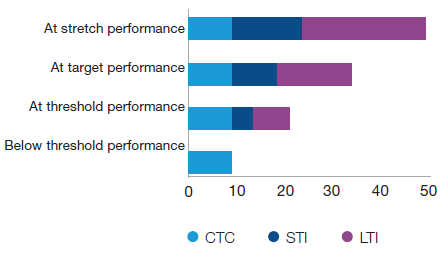
Other executive directors (R’000s)

The different components of remuneration, their objectives, the policy which governs it and their link to the business strategy are summarised below. Where changes to the policy are envisaged for the following financial year, these are highlighted.
The Group views the executive directors who are members of the Group executive committee as the current “prescribed officers” as defined in the Companies Act and therefore no separate remuneration policy disclosure for prescribed officers is necessary.
Proposed changes for FY2022
The impact of the pandemic is by no means behind us but the Group is confident in its ability to navigate this uncertainty and reaffirms its duty and commitment to building inclusive societies, particularly in South Africa, and to conduct business in a responsible manner across all its businesses. As a consequence, the Remuneration committee proposes a set of measurements for both STI and LTI that balances profit and purpose as set out in Table 4.
The overarching principle when formulating these proposals was to balance the needs of all stakeholders while staying true to the performance culture of Bidvest. The changes can be summarised as follows:
- In relation to financial metrics, explicit objective measures have been upweighted from 40% to 70% and 60%, respectively, for STI and LTI, as bolstered financial strength to withstand a prolonged period of disruption is no longer needed as a reinforced risk mitigant tool. The stretch hurdles for both are higher to fairly reflect the leveraged outcome. ROFE hurdles have been increased to reflect the changed asset composition of Bidvest post the recent acquisitions;
- The sustainability metric has been broken down into environmental, social and governance objective measurement elements, deduced from the Group ESG Framework, with performance hurdles as set out in Table 3 below, and applicable to both STI and LTI, with 15% and 20% weightings, respectively. The performance will be assessed by the Social, ethics and transformation committee; and
Table 3: Measurement elements incorporated into the sustainability metric
| Threshold 30% |
Target 30% |
Stretch 30% |
|||
| Sustainability | |||||
| Environmental | |||||
| Reduction in Scope 1 and 2 emissions and water intensity (of FY19 base; focus businesses) | 0–5% | 5%+ | |||
| Code of Ethical Purchasing (or equivalent) declarations (based on # of offshore suppliers) | 50% | 70% | 80% | ||
| Social | |||||
| African appointments (top and senior management) | 40% | 45% | 50% | ||
| Local procurement with B-BBEE L1 – 4 suppliers | 55% | 60% | 65% | ||
| Governance | |||||
| B-BBEE rating for 80% of all operating businesses | min L5 | min L4 | min L3 | ||
| ALICE score (quarterly average) | 50% | 40% | 30% | ||
- The strategic metric has been explicitly defined as 1) execution of strategy; 2) innovation and technology deployed; and 3) return uplift on major acquisitions compared to their investment case. The latter will be evaluated for three years post the effective date with sequential improvement achieved. The performance against these elements will be assessed by the Acquisition committee against a portfolio of evidence, using a scoring table. This measure will have a 15% weighting for STI and 20% for LTI.
Given the lingering uncertainty with regards to key macro drivers, GDP and inflation, both geographically weighted, remain the base for HEPS growth considerations.
Effective 1 July 2021, Group Exco as well as divisional CFOs will participate in LTI through a combination of CSP and SAR to better align with Group executive directors.
Table 4: Summary of remuneration components for executive directors
| Component, objective and link to strategy |
Policy | Future changes | Resultant FY2022 policy | |
| Guaranteed pay (CTC) |
Base package To help attract and retain the best talent. It aligns with business strategy as it takes into account internal and external equity, thereby ensuring competitiveness and rewarding individuals fairly based on similar jobs in the market. Reviewed annually and set on 1 July. |
Level of skill and experience, scope of responsibilities and competitiveness of the total remuneration package is taken into account when determining CTC. |
No changes are proposed for FY2022. |
Unchanged Level of skill and experience, scope of responsibilities and competitiveness of the total remuneration package is taken into account when determining CTC. |
|
Benefits Provides employees with contractually agreed basic benefits such as retirement fund benefits (defined contribution), medical aid, risk benefits and life and disability insurance. Benefits recognise the need for a holistic approach to guaranteed package. |
The Company contributes towards retirement benefits as per the rules of its retirement funds. Medical aid contributions depend upon each individual’s needs and package selection. Risk and insurance benefits are Company contributions, all of which form part of total cost of employment. |
No changes to standard employment benefits. |
Unchanged The Company contributes towards retirement benefits as per the rules of its retirement funds. Medical aid contributions depend upon each individual’s needs and package selection. Risk and insurance benefits are Company contributions, all of which form part of total cost of employment. |
|
| Short-term incentives (STIs) |
To motivate and incentivise delivery of performance, financial and non-financial, consistent with the Group’s strategy over the one-year operating cycle. Encourages sustainable growth in headline earnings per share and return on funds employed for shareholders whilst maintaining a strong financial position, combined with strategic and sustainability metrics, to ensure well-balanced KPIs. It rewards executive directors for their measurable contribution. Bonus levels and the appropriateness of measures and weightings are reviewed annually to ensure that these continue to support Bidvest’s strategy. The annual bonus is paid in cash in August/September each year. |
Threshold, target and stretch performance targets are set for the following metrics: Financial performance
Non-financial performance
The weighted outcome derives a STI which is capped at a maximum of 165% of the CEO’s CTC and 150% of CTC for the other executive directors. Linear vesting will occur between the performance hurdles set. |
Upweight HEPS growth from 20% to 40% and set the threshold, target and stretch hurdles at GDP + CPI, GDP + CPI +1% and GDP + CPI + 4%, respectively. Upweight ROFE from 20% to 30% and increase the threshold, target and stretch hurdles at 24%, 25% and 30%, respectively. Remove the balance sheet and liquidity measurement. Introduce specific sustainability measurement elements and targets, as set out on above, against which the Social, ethics and transformation committee will assess performance for a changed weighting of 15%. Explicitly define the measurement elements of the strategic metric as execution of strategy, innovation and deployment of technology and return uplift on major acquisitions. Performance to be assessed by the Acquisition committee for a changed weighing of 15%. |
Post proposed changes to metrics: Financial performance
Non-financial performance
The weighted outcome derives a STI which is capped at a maximum of 165% of the CEO’s CTC and 150% of CTC for the other executive directors. Linear vesting will occur between the performance hurdles set. |
| Long-term incentives (“LTIs”) |
Conditional Share Plan To motivate and incentivise delivery of long-term, sustainable performance. This aligns executives’ interests with shareholders through conditional rights to future delivery of equity. Vesting of conditional rights to shares is subject to performance targets, thereby supporting the performance culture of the Group. |
Award levels are set according to best practice benchmarks, to ensure support of Group business strategy. Awards consist of conditional rights to shares, subject to performance conditions over a three-year performance period and continued employment period for the duration of the vesting periods of three years (75% of the award) and four years (25% of the award), respectively. The Group performance metrics comprise the following:
|
Upweight HEPS growth from 20% to 30% and set the threshold, target and stretch hurdles at compound GDP + CPI, GDP + CPI + 1.5% and GDP + CPI + 5%, respectively. Upweight ROFE from 20% to 30% and increase the hurdles to be 24%, 25% and 28%, respectively, for threshold, target and stretch. Remove the TSR metric. Introduce specific measurement elements into the sustainability and strategic metrics as discussed under STI. |
Post proposed changes: Objective performance targets set for the following metrics:
Subjective performance scoring of the strategic metric (20% weighting) which include specific measurement elements of execution of strategy, innovation and deployment of technology and return uplift on major acquisitions. Awards consist of conditional rights to shares, subject to performance conditions over a three-year performance period and continued employment period for the duration of the vesting periods of three years (75% of the award) and four years (25% of the award), respectively. |
Further details on long-term incentive plans:
Conditional Share Plan
At the 2008 AGM, shareholders approved a CSP for executive directors and senior employees with significant managerial or other responsibilities. Under the CSP, participants are awarded a right to future delivery of equity (ie a conditional right to receive shares). Vesting of shares is subject to the achievement of performance conditions. Group performance conditions, each with different weightings, have been imposed. The performance period is three years, coinciding with the Group’s financial year. 75% of awards vest after a three year period and the remaining 25% after a four-year period.
Further details on the award levels, performance period and measure can be found in Part 2 of this report.
Share Appreciation Right Plan
Upon the unbundling of Bid Corporation Limited (“Bidcorp”) from Bidvest during May 2016, shareholders approved a new Share Appreciation Right Plan (“SAR Plan”). It is the intention that senior management (excluding executive directors) will participate in the SAR Plan. SARs vest after three, four and five years and lapse after seven years.
Share dilution
An aggregate limit applies to the CSP and SAR Plan and no more than 5% of the issued share capital of Bidvest can be issued in settlement of both the CSP and the SAR Plan. If shares are purchased in the open market for settlement of allocations in terms of the CSP and the SAR Plan, the limits will not be impacted.
Non-executive directors
Terms of service
Non-executive directors are appointed by the shareholders at the AGM. Interim board appointments are permitted between AGMs. Appointments are made in accordance with Group policy. Interim appointees retire at the next AGM, when they may make themselves available for re-election.
As appropriate, the board, through the Nominations committee, proposes their re-election to shareholders. Each year, one third of the non-executive directors retire by rotation. A three-term limit is in place for non-executive directors.
Fees
Group policy is to pay competitive fees for the role while recognising the required time commitment. Fees are benchmarked against a comparator group of JSE-listed companies. The fees comprise an annual retainer component and attendance fee for scheduled meetings, as tabulated in Part 2 of this report. The chairman of the board receives an annual fee in lieu of retainer and attendance fees. In addition, non-executive directors are compensated for travel and subsistence on official business where necessary and to attend meetings. No contractual arrangements are entered into to compensate non-executive directors for the loss of office.
Non-executive directors do not receive STI nor do they participate in any LTI schemes, except where non-executive directors previously held executive office, and they remain entitled to unvested benefits arising from their period of employment. The Group does not provide retirement contributions to non-executive directors.
Management proposes non-executive directors’ fees (based on independent advice) to shareholders annually for shareholder vote.
Shareholder engagement
The Group’s remuneration policy and the implementation thereof are placed before shareholders for consideration and approval under the terms of an advisory non-binding vote at the 2020 AGM as provided for in the Listings Requirements and recommended by King IVTM.
In the event that 25% or more of the votes cast are recorded against either the remuneration policy resolution or the implementation resolution, then:
- Executive management will engage shareholders to ascertain the reasons for dissenting vote. Where considered appropriate, members of the Remuneration committee may participate in these engagements with selected shareholders; and
- Executive management will make specific recommendations to the remuneration committee as to how the legitimate and reasonable objections of shareholders might be addressed, either in the Group’s remuneration policy or through changes on how the remuneration policy is implemented.
Directors’ interests in contracts
During the financial year, none of the current directors had a material interest in any contract of significance to which the Company or any of its subsidiaries were parties.
Non-binding advisory vote
Shareholders are requested to evaluate whether or not the tabled remuneration policy to be implemented in FY2022 strikes the appropriate balance between rewarding outcomes, financial and non-financial, considering the impact on all stakeholders by casting an advisory vote on the remuneration policy as contained in Part 1 of this report.
Part 2 – Implementation of remuneration policy
In this part of the report, the implementation of Bidvest’s remuneration policy voted on last year, is discussed. Achieved performance in FY2021 is measured against the agreed metrics in deriving incentive outcomes and personal performance considered in awarding salary increases.
Executive director remuneration
Guaranteed pay – base pay and benefits (FY2021)
It has been the Remuneration committee’s intention to close the gap between the basic remuneration of the executive directors and that of the upper quartile of the peer group over the medium-term, performance permitting. This step-approach was interrupted by the pandemic and the Group-wide freeze of salary increases in FY2021.
Based on an updated benchmarking conducted by the independent advisor, the Remuneration committee approved an adjustment greater than inflation to the basic remuneration of the executive directors to the upper quartile of the peer group, to reflect exceptional performance, tenure, race and gender. The respective increases, effective 1 July 2021, are 12%, 31% and 33%, for the CEO Mpumi Madisa, Mark Steyn, the CFO, and Gillian McMahon.
Short-term incentives (FY2021)
The performance measures and targets generating the awards were:
- HEPS growth (20% weighting) measured on a linear basis between the threshold (nominal growth), target (real growth) and stretch (2% real growth) hurdles. GDP and inflation are weighted based on the geographic mix of trading profit;
- ROFE (20% weighting) measured on a linear basis between the threshold 20%, target 21% and stretch 24% hurdles;
- Protecting balance sheet strength and liquidity (20% weighting) measured on threshold (net debt/EBITDA >2.5x and a weakened Group debt maturity profile from 30 June 2020 position), target (net debt/EBITDA 2.0 – 2.5x and an unchanged Group debt maturity profile from 30 June 2020 position) and stretch (net debt/EBITDA <2.0x and an improved Group debt maturity profile from 30 June 2020 position) hurdles;
- Sustainability and transformation (20% weighting) metrics, which include social, environmental and governance elements, as evaluated by the Group Social, ethics and transformation committee; and
- Strategic (20% weighting) metrics which include executive decision-making and business resilience to drive timeous, proactive and strategic decision-making, innovation and corporate action to be evaluated by the Group Acquisitions committee.
In the prior year, the Remuneration committee exercised its discretion in allowing the exclusion of the COVID-19 charges in calculating the FY2020 headline earnings growth and ROFE. This adjusted FY2020 headline earnings formed the base from which growth was determined (i.e. a higher base was used than the actual reported) against FY2021 headline earnings. The FY2021 headline earnings also excludes a R182 million COVID-19 charge.
In relation to the financial strength metric, the Audit committee concluded that the Group leverage of 1.8x was well below the stretch target. The maturity profile was successfully pushed out through the part repayment of the PHS bridge facility applying proceeds from asset disposals and other free cash together with the refinancing of a EUR facility, that was due in September 2022, with a foreign currency syndicated loan of GBP400 million, with a term of three years + one year + one year. The balance of the PHS bridge was settled shortly after year end.
In its discretion, the Social, ethics and transformation committee awarded a 90% score (“greatly exceeds expectations”) for the sustainability metric after considering that:
- There has been targeted approach in recruiting and diversity of skill throughout the whole organisation, and the tone has been firmly set from the top at both executive director and executive committee level (board: 70% female and 80% black; Exco 42% female and 50% black). A good signal of true accomplishment is that 74% of Bidvest’s managerial vacancies were filled by Black employees, with 14% being through internal succession. All divisions have demonstrated recruitment beyond target, and at top management, across divisions, Black representation is 42%, at senior management 45% and middle management at 59%;
- Targeted procurement spend for SMMEs was another KPI and the Group has engaged CGC Black Umbrellas to implement and execute an integrated enterprise and supplier development programme, to focus on 100% black owned and women owned businesses. This programme will help grow these businesses that are already part of the Group’s supply chain. Part of this programme will also focus on businesses that are distressed because of the COVID-19 pandemic;
- There is clear visibility on ethical conduct demonstrated by the Ethics facility, the issues being transparently presented to the committee each quarter and the level of interrogation and proactiveness by the executives to address each issue. Guidelines were set, and those calls involving discrimination, sexual harassment, and governance, must be reported to the committee in detail, with executives overseeing the closing out of such reports. There has been a definitive decline in these matters, and interventions are bearing fruit. The proof that the ethics line work, is the number of calls that are coming through, signaling trust in anonymity is being maintained. Management must be commended in the way this has been handled. At year end, only 15 calls remain open; and
- A draft sustainability framework was presented to the committee, and the submissions to the committee give a strong indication that, though we have not had visibility in terms of reporting, work was undertaken by the divisions. Target areas were outlined in terms of ESG targets and goals. For the financial year, the emission and water intensity of the Group, as measured per rand of revenue generated, declined by 8% and 6%, respectively. Most of the divisions have implemented recycling initiatives and some businesses have certified environmental management systems. Management is aware of the need to set targets to ensure a healthier planet for future generations.
In its discretion, the Acquisition committee awarded a 100% score for the strategic metric after considering the conclusion of the portfolio clean-up, the successful execution of operational restructuring plans without material labour disputes and with the benefits already materialising across the Group as well as the disposal of the asset intensive businesses, Bidvest Car Rental and BidAir Services, linked to the travel and tourism industry. Acquisitive growth ambitions were advanced through the acquisitions of Cordant, Axis and other bolt-on acquisitions and the R1 billion LPG terminal in Richards Bay was successfully commissioned, in October 2020, within budget. Innovation and technology were introduced to drive internal efficiencies (for example processing bots), better engage with customers, increase the online presence of businesses and add value to customers (for example environmentally friendly disinfectant; cable theft device, robotic floor scrubber, etc).
The bonus outcomes were calculated as follows:
Measures |
Weighting | Threshold 30% of max |
Target 65% of max |
Stretch 100% of max |
Actual performance |
Outcome | Weighted outcome |
| Financial measures: | |||||||
| HEPS | 20% | GDP | GDP+CPI | GDP+CPI+2% | 34.1% | 100.0% | 20.0% |
| ROFE | 20% | 20.0% | 21.0% | 24.0% | 31.6% | 100.0% | 20.0% |
| Non-financial measures: | |||||||
| Financial strength | 20% | 100.0% | 20.0% | ||||
| Sustainability and Transformation | 20% | 90.0% | 18.0% | ||||
| Strategic actions | 20% | 100.0% | 20.0% | ||||
| Overall score as a % of max [A] | 98.0% | ||||||
| Maximum STI as a % of CTC [B] |
165.0% (CEO) and 150.0% (EDs) |
||||||
| Overall score as a % of CTC [A x B] |
162% (CEO) and 147% (EDs) |
Long-term incentives
In line with the disclosure format recommended by King IVTM, information relating to LTIs awarded, vested and settled during FY2021 as well as outstanding LTIs are disclosed.
Further details pertaining to the above are contained in the table titled “Unvested long-term incentive awards and cash value of settled awards” in the Annexure.
Long-term incentives awarded during FY2021
All executive directors are awarded CSP awards. The following performance targets, weighting and performance periods are applicable to the CSPs awarded during 2021 and are to be tested over a three-year period that commenced on 1 July 2020. 75% of the awards will vest after a three-year period while the remaining 25% will vest after a four-year period:
| Performance conditions and weighting | Detail of performance conditions | Vesting profile |
|
Three-year compound HEPS growth:
Three-year average ROFE:
Three-year TSR:
The peer group: AVI, Barloworld, Imperial Logistics, Life Healthcare, Motus, Mr Price, Netcare, Pick n Pay Stores, PSG, Remgro, Spar Group, Super Group and Tiger Brands. Sustainability and transformation and Strategic metrics:
|
HEPS, TSR and ROFE:
The vesting of the sustainability and transformation and strategic metrics awards will be determined by the Group Social, ethics and transformation and Acquisition committees. |
The CSPs awarded during FY2021 at a target using the 20-day VWAP price as at 30 June 2020, can be expressed as 176% and 144% of CEO and average executive director CTC, respectively. This award was based on a benchmark exercise performed by the committees’ standing advisors.
Ilze Roux, as Group company secretary during FY2021, was awarded 75 000 SAR in December 2020 at an award price of R148.75 per share.
Long-term incentives vesting during FY2021
The first CSP awards (2016) vested during 2019. The remaining 25% of the 2017 accrued awards vested in September 2021.
The 2018 CSP awards were tested against performance targets over a three-year period which commenced 1 July 2018. Based on the actual performance and assigned weightings, 58% of awards accrued to beneficiaries with 75% having vested in September 2021 and the remaining 25% vesting in September 2022.
| 2018 award | |||||||
| Targets | |||||||
| KPI | Weighting | Threshold 30% of max |
Target 60% of max |
Stretch 100% of max |
Actual performance |
Outcome | Weighted outcome |
| HEPS | 40% | 11.6% | 14.6% | 17.6% | 3.3% | 0.0% | 0.0% |
| ROFE | 20% | 21.5% | 23.0% | 26.0% | 25.9% | 99.7% | 19.9% |
| Relative TSR | 20% | (15.3%) | (12.7%) | (10.2%) | 3.9% | 100.0% | 20.0% |
| Business enhancement | 10% | 83.3% | 8.3% | ||||
| Sustainability | 10% | 93.3% | 9.3% | ||||
| Overall score | 57.6% |
Long-term incentives settled during FY2021
Details relating to the settlement of long-term incentives are contained in the tables below.
Outstanding long-term incentives
As at 30 June 2021, the vesting of the CSP rights granted in 2019 and 2020, are estimated to be achieved as follows:
| Performance conditions | Weighting | Vesting | 2019 awards Weighting outcome |
| HEPS | 40.0% | 0.0% | 0.0% |
| ROFE | 20.0% | 100.0% | 20.0% |
| TSR | 20.0% | 100.0% | 20.0% |
| Strategic action | 10.0% | 90.0% | 9.0% |
| Sustainability | 10.0% | 90.0% | 9.0% |
| Expected vesting | 58.0% |
| Performance conditions | Weighting | Vesting | 2019 awards Weighting outcome |
| HEPS | 20.0% | 100.0% | 20.0% |
| ROFE | 20.0% | 100.0% | 20.0% |
| TSR | 20.0% | 74.5% | 14.9% |
| Strategic action | 20.0% | 100.0% | 20.0% |
| Sustainability | 20.0% | 90.0% | 18.0% |
| Expected vesting | 92.2% |
Total remuneration outcomes
Single figure of remuneration
The total remuneration outcomes are reflected below, comprising salary and benefits, cash incentive for FY2021 and long-term incentives where the performance period ended in FY2021. With reference to actual total pay during FY2021, Mpumi Madisa (R2.2 million), Gillian McMahon (R1.2 million) and Lindsay Ralphs (R11.2 million) realised benefit from the exercise of CSPs which previously vested.
| 2021 (R’000) | Basic remuneration |
Retirement/ medical benefits |
Other benefits and costs |
Cash incentives |
LTIP Reflected2 |
Single figure |
| Director | ||||||
| NT Madisa | 8 099 | 589 | 183 | 13 935 | 3 996 | 26 802 |
| GC McMahon | 3 176 | 315 | 192 | 5 292 | 2 821 | 11 796 |
| LP Ralphs1 | 6 207 | 522 | 459 | – | 12 505 | 19 693 |
| MJ Steyn | 4 174 | 266 | 222 | 6 626 | 4 046 | 15 334 |
| 1 | Retired 30 September 2020. |
| 2 | LTIP reflected includes: LTIP reflects early vesting on a proportional time-based basis and taking into account cumulative performance conditions for his outstanding CSPs in terms of Bidvest Scheme Rules. |
| Type of Award | Note | Award date | Tranche/% | Bidvest 20-day VWAP |
Vesting date |
| Conditional share | 3 | 27/11/2017 | 25% | 193,54 | 18/09/2021 |
| Conditional shares | 3 | 03/12/2018 | 75% | 193,54 | 03/12/2021 |
| SAR | 3 | 07/11/2016 | 3 | 193,54 | 07/11/2021 |
| SAR | 3 | 09/11/2017 | 2 | 193,54 | 09/11/2021 |
| 3 | The LTIP reflected is at the intrinsic value based on the 20-day VWAP as at 30 June 2021 for Bidvest and the actual number of shares that are going to vest. |
With reference to actual total pay during 2020, Anthony Dawe (R16.2 million), Mpumi Madisa (R5.6 million), Gillian McMahon (R1.6 million) and Lindsay Ralphs (R23.6 million) realised benefit from the exercise of replacement rights and CSPs which previously vested.
| 2020 (R’000) | Basic remuneration1 | Retirement/ medical benefits |
Other benefits and costs | Cash incentives2 | LTIP Reflected4 |
Single figure |
| Director | ||||||
| AW Dawe3 | 2 340 | 110 | 241 | 7 352 | 10 043 | |
| NT Madisa | 4 271 | 340 | 254 | 3 912 | 3 554 | 12 331 |
| GC McMahon | 2 899 | 321 | 211 | 2 808 | 2 150 | 8 389 |
| LP Ralphs | 11 153 | 946 | 904 | 11 668 | 11 996 | 36 667 |
| MJ Steyn | 3 817 | 258 | 228 | 3 560 | 492 | 8 355 |
| 1 | 30% salary and fee sacrifice was agreed to for the fourth quarter amounting to R2.0 million in total. |
| 2 | The cash incentive was restated to take into account the bonus that was provided for 2020 performance but was deferred until November 2020 once the impact of COVID-19 is further evaluated and subject to liquidity and capital structure being at acceptable levels as determined by the board. The board concluded that these requirements had been met and the bonus was paid. |
| 3 | Retired 28 November 2019. LTIP reflects early vesting on a proportional time-based basis and taking into account cumulative performance conditions for his outstanding CSPs in terms of the Bidvest Scheme Rules. |
| 4 | LTIP reflected includes: |
| Type of award | Note | Award date | Tranche/% | Bidvest 20-day VWAP | Bidcorp 20-day VWAP | Vesting date |
| Conditional share | 5 | 11/12/2015 | 25% | 149,87 | n/a | 18/09/2020 |
| Conditional share | 5 | 24/10/2016 | 25% | 149,87 | n/a | 18/09/2020 |
| Conditional share | 5 | 27/11/2017 | 75% | 149,87 | n/a | 18/09/2020 |
| Replacement share | 6 | 11/12/2015 | 3 | 149,87 | 274,31 | 11/12/2020 |
| SAR | 7 | 07/11/2016 | 2 | 149,87 | n/a | 07/11/2020 |
| SAR | 7 | 09/11/2017 | 1 | 149,87 | n/a | 09/11/2020 |
| 5 | The LTIP reflected is at the intrinsic value based on the 20-day VWAP as at 30 June 2020 for Bidvest. |
| 6 | The LTIP reflected is at the intrinsic value based on the 20-day VWAP as at 30 June 2020 for Bidvest plus Bidcorp. |
| 7 | The LTIP reflected is at the intrinsic value based on the 20-day VWAP as at 30 June 2020 for Bidvest. |
Non-executive remuneration
The remuneration paid to non-executive directors while in office of the Company during the year ended 30 June 2021 is analysed as follows:
| Directors | Directors’ fees R’000 |
2021 As directors of subsidiary companies and other services R’000 |
Total emoluments R’000 |
2020 Total R’000 |
| L Boyce5 | 232 | 232 | ||
| EK Diack6 | 1 114 | 1 114 | 1 802 | |
| AK Maditse6 | 654 | 654 | 931 | |
| SN Mabaso-Konyana5 | 272 | 272 | ||
| S Masinga | 745 | 745 | 863 | |
| BF Mohale | 1 664 | 1 664 | 1 135 | |
| RK Mokate | 801 | 155 | 956 | 1 527 |
| NG Payne7 | 1 766 | 1 766 | 2 052 | |
| MD Ruck8 | 496 | 496 | 368 | |
| N Siyotula | 692 | 692 | 534 | |
| T Slabbert9 | 405 | |||
| NW Thomson | 846 | 846 | 905 | |
| 7 516 | 1 921 | 9 437 | 10 522 |
| 5 | Appointed 12 March 2021. |
| 6 | Retired 1 April 2021. |
| 7 | Retired from The Bidvest Group board with effect from 28 November 2019, however, remains a director of Bidvest Bank Holdings Limited. Disclosed remuneration is for the 12 months ended 30 June 2021. |
| 8 | Resigned 30 June 2021. |
| 9 | Retired 28 November 2019. |
It is proposed that a 6.2% increase in non-executive directors’ fees for FY2022 be approved in line with the wage and salary increases approved across the Group.
| Basic per annum |
Per meeting attended | |
| Chairman1 | 1 744 866 | |
| Lead independent | 225 144 | |
| Board members | 116 462 | 46 776 |
| Audit committee chairman | 331 966 | 52 503 |
| Audit committee member | 87 705 | 38 184 |
| Remuneration committee chairman | 149 158 | 36 037 |
| Remuneration committee member | 41 167 | |
| Nominations committee member | 37 945 | |
| Acquisitions committee chairman | 99 876 | 42 480 |
| Acquisitions committee member | 44 628 | |
| Risk committee chairman | 177 080 | 31 263 |
| Risk committee member | 33 173 | |
| Social and ethics committee chairman | 106 200 | 31 263 |
| Social and ethics committee member | 31 263 | |
| Ad hoc meetings | 22 672 |
| 1 | Chairman’s fees cover chairmanship and membership of all board committees. No further fees are payable. |
The above fees are proposed net of VAT which may become payable thereon to directors, depending on the status of the individual director’s tax position.
Refer to special resolution 1 in Stakeholder governance foundation and our strategy of the notice of AGM for approval of the fees by shareholders in terms of section 66 of the Companies Act.
Non-binding advisory vote
Shareholders are requested to evaluate whether or not the remuneration policy adopted last year was effectively implemented in the year that ended 30 June 2021 by casting an advisory vote on the remuneration implementation report as contained in Part 2 of this report.
Approval
This remuneration report was approved by the board of directors of Bidvest. Signed on behalf of the board of directors.
Norman Thomson
Remuneration committee chairman
Annexure
| Names | Opening number on 1 July 2019 |
Granted during 2020 |
Forfeited/ lapsed during 2020 |
Settled/ exercised during 2020 |
Closing number on 30 June 2020 |
Cash value on settlement during 2020 |
Closing fair value at 30 June 2020 |
Strike price R |
| LP Ralphs | ||||||||
| Conditional Share Plan | ||||||||
| 11/12/2015 | 94 280 | – | 8 073 | 62 637 | 20 879 | 12 777 948 | 3 129 137 | |
| 24/10/2016 | 80 000 | – | 6 850 | 53 150 | 17 717 | 10 842 600 | 2 655 187 | |
| 27/11/2017 | 112 000 | – | – | – | 112 000 | – | 8 202 828 | |
| 03/12/2018 | 120 000 | – | – | – | 120 000 | – | 8 456 715 | |
| 28/11/2019 | – | 150 000 | – | – | 150 000 | – | 10 425 684 | |
| Total | 406 280 | 150 000 | 14 923 | 115 787 | 420 596 | 23 620 548 | 32 869 551 | |
| NT Madisa | ||||||||
| Conditional Share Plan | ||||||||
| 24/10/2016 | 20 000 | – | 1 713 | 13 287 | 4 429 | 2 710 548 | 663 797 | |
| 27/11/2017 | 30 000 | – | – | – | 30 000 | – | 2 197 186 | |
| 03/12/2018 | 40 000 | – | – | – | 40 000 | – | 2 818 905 | |
| 28/11/2019 | – | 75 000 | – | – | 75 000 | – | 5 212 842 | |
| 27/11/2020 | ||||||||
| Replacement rights (Options) | ||||||||
| 13/03/2014 | 6 250 | – | – | – | 6 250 | – | 1 166 485 | 238 |
| 03/11/2014 | 10 767 | – | – | 10 767 | – | 2 886 057 | – | 270 |
| 11/12/2015 | 20 000 | – | – | – | 20 000 | – | 2 452 753 | 302 |
| Total | 127 017 | 75 000 | 1 713 | 24 054 | 175 679 | 5 596 605 | 14 511 968 | |
| GC McMahon | ||||||||
| Conditional Share Plan | ||||||||
| 24/10/2016 | 12 000 | – | 1 028 | 7 972 | 2 658 | 1 626 288 | 398 278 | |
| 27/11/2017 | 15 000 | – | – | – | 15 000 | – | 1 098 593 | |
| 03/12/2018 | 30 000 | – | – | – | 30 000 | – | 2 114 179 | |
| 28/11/2019 | – | 50 000 | – | – | 50 000 | – | 3 475 228 | |
| 27/11/2019 | ||||||||
| Replacement rights (Options) | ||||||||
| 09/10/2014 | 5 000 | – | – | – | 5 000 | – | – | 251 |
| 11/12/2015 | 15 000 | – | – | – | 15 000 | – | – | 302 |
| Total | 77 000 | 50 000 | 1 028 | 7 972 | 117 658 | 1 626 288 | 9 793 081 | |
| MJ Steyn | ||||||||
| Conditional Share Plan | ||||||||
| 03/12/2018 | 40 000 | – | – | – | 40 000 | – | 2 818 905 | |
| 28/11/2019 | – | 60 000 | – | – | 60 000 | – | 4 170 274 | |
| 27/11/2020 | ||||||||
| SARS | ||||||||
| 07/11/2016 | 40 000 | – | – | – | 40 000 | – | 339 770 | 147 |
| 09/11/2017 | 40 000 | – | – | – | 40 000 | – | 467 542 | 159 |
| Replacement rights (Options) | ||||||||
| 09/10/2014 | 3 750 | – | – | – | 3 750 | – | 650 429 | 251 |
| 11/12/2015 | 7 500 | – | – | – | 7 500 | – | 919 782 | 302 |
| Total | 131 250 | 60 000 | – | – | 191 250 | – | 9 366 702 | |
| Names | Granted during 2021 |
Forfeited/ lapsed during 2021 |
Settled/ exercised during 2021 |
Closing number on 30 June 2021 |
Cash value on settlement during 2021 |
Closing fair value at 30 June 2021 |
Strike price R |
| LP Ralphs | |||||||
| Conditional Share Plan | |||||||
| 11/12/2015 | – | – | 20 879 | – | 2 932 038 | – | |
| 24/10/2016 | – | – | 17 717 | – | 2 487 998 | – | |
| 27/11/2017 | – | 56 736 | 41 448 | 13 816 | 5 820 543 | 2 631 399 | |
| 03/12/2018 | – | 68 157 | – | 51 843 | – | 13 061 766 | |
| 28/11/2019 | – | 150 000 | – | – | – | – | |
| Total | – | 274 893 | 80 044 | 65 659 | 11 240 579 | 15 693 164 | |
| NT Madisa | |||||||
| Conditional Share Plan | |||||||
| 24/10/2016 | – | – | 4 429 | – | 622 105 | – | |
| 27/11/2017 | – | 15 197 | 11 102 | 3 701 | 1 559 054 | 704 839 | |
| 03/12/2018 | – | – | – | 40 000 | – | 4 353 922 | |
| 28/11/2019 | – | – | – | 75 000 | 7 960 769 | ||
| 27/11/2020 | 134 000 | – | – | 134 000 | 22 059 099 | ||
| Replacement rights (Options) | |||||||
| 13/03/2014 | – | – | – | 6 250 | – | 1 648 872 | 238 |
| 03/11/2014 | – | – | – | – | – | – | 270 |
| 11/12/2015 | – | – | – | 20 000 | – | 3 996 390 | 302 |
| Total | 134 000 | 15 197 | 15 531 | 278 951 | 2 181 159 | 40 723 889 | |
| GC McMahon | |||||||
| Conditional Share Plan | |||||||
| 24/10/2016 | – | – | 2 658 | – | 373 263 | – | |
| 27/11/2017 | – | 7 600 | 5 550 | 1 850 | 779 387 | 352 419 | |
| 03/12/2018 | – | – | – | 30 000 | – | 3 265 441 | |
| 28/11/2019 | – | – | – | 50 000 | – | 5 307 179 | |
| 27/11/2019 | 46 000 | – | – | 46 000 | – | 7 572 526 | |
| Replacement rights (Options) | |||||||
| 09/10/2014 | – | – | – | 5 000 | 1 253 147 | 251 | |
| 11/12/2015 | – | – | – | 15 000 | 2 997 292 | 302 | |
| Total | 46 000 | 7 600 | 8 208 | 147 850 | 1 152 649 | 20 748 006 | |
| MJ Steyn | |||||||
| Conditional Share Plan | |||||||
| 03/12/2018 | – | – | – | 40 000 | – | 4 353 922 | |
| 28/11/2019 | – | – | – | 60 000 | – | 6 368 615 | |
| 27/11/2020 | 57 000 | – | – | 57 000 | – | 9 383 348 | |
| SARS | |||||||
| 07/11/2016 | – | – | – | 40 000 | – | 1 846 070 | 147 |
| 09/11/2017 | – | – | – | 40 000 | – | 1 520 277 | 159 |
| Replacement rights (Options) | |||||||
| 09/10/2014 | – | – | – | 3 750 | – | 939 861 | 251 |
| 11/12/2015 | – | – | – | 7 500 | – | 1 498 646 | 302 |
| Total | 57 000 | – | – | 248 250 | – | 25 910 739 |
Type of award
| Valuation methodology applied | ||||
| Award date | Tranche* | Market value estimation using a market valuation technique |
Intrinsic value** |
|
| Conditional share | 27/11/2017 | n/a | √ | |
| Conditional share | 03/12/2018 | n/a | √ | √ |
| Conditional share | 28/11/2019 | n/a | √ | |
| Conditional share | 28/11/2020 | n/a | √ | |
| Replacement share | 13/03/2014 | 3 | √ | |
| Replacement share | 09/10/2014 | 2 and 3 | √ | |
| Replacement share | 03/11/2014 | 3 | √ | |
| Replacement share | 11/12/2015 | 2 | √ | |
| Replacement share | 11/12/2015 | 3 | √ | |
| SARS | 07/11/2016 | 1 and 2 | √ | |
| SARS | 07/11/2016 | 3 | √ | |
| SARS | 09/11/2017 | 1 and 2 | √ | |
| SARS | 09/11/2017 | 3 | √ |
| Bidvest 20-day Vwap |
Bidcorp 20-day Vwap |
Bidvest 20-day Vwap |
Bidcorp 20-day Vwap |
Strike price |
Performance conditions vesting % |
Performance conditions |
Vesting date | ||
| Conditional share | 193.54 | n/a | 149.87 | n/a | n/a | 49% | √ | 25% – 30/09/2021 | |
| Conditional share | 193.54 | n/a | 149.87 | n/a | n/a | 58% | √ | 75% – 30/09/2021 |
|
| 25% – 30/09/2022 | |||||||||
| Conditional share | 193.54 | n/a | 149.87 | n/a | n/a | 58% | √ | 75% – 30/09/2022 |
|
| 25% – 30/09/2023 | |||||||||
| Conditional share | 193.54 | n/a | 149.87 | n/a | n/a | 93% | √ | 75% – 30/09/2023 |
|
| 25% – 30/09/2024 | |||||||||
| Replacement share | 193.54 | 307.82 | 149.87 | 274.31 | 237.54 | n/a | x | 25% – 13/03/2019 | |
| Replacement share | 193.54 | 307.82 | 149.87 | 274.31 | 250.73 | n/a | x | 25% – 09/10/2018 |
|
| 25% – 09/10/2019 | |||||||||
| Replacement share | 193.54 | 307.82 | 149.87 | 274.31 | 269.95 | n/a | x | 25% – 03/11/2019 | |
| Replacement share | 193.54 | 307.82 | 149.87 | 274.31 | 301.54 | n/a | x | 25% – 11/12/2019 | |
| Replacement share | 193.54 | 307.82 | 149.87 | 274.31 | 301.54 | n/a | x | 25% – 11/12/2020 | |
| SARS | 193.54 | n/a | 149.87 | n/a | 146.61 | n/a | x | 50% – 07/11/2019 |
|
| 25% – 07/11/2020 | |||||||||
| SARS | 193.54 | n/a | 149.87 | n/a | 146.61 | n/a | x | 25% – 07/11/2021 | |
| SARS | 193.54 | n/a | 149.87 | n/a | 158.75 | n/a | x | 50% – 09/11/2020 |
|
| 25% – 09/11/2021 | |||||||||
| SARS | 193.54 | n/a | 149.87 | n/a | 158.75 | n/a | x | 25% – 09/11/2022 |
| * | Where a tranche has not been included, the awards were already exercised. |
| ** | Intrinsic value less present value of September 2021 dividend which the instrument is not entitled to in respect of awards not yet vested. |